
Comparison
Raise Bilingual Kids with These Research-Backed Tips
Parents worry about speech delays and which method to pick. This guide summarizes the research on bilingual development milestones, the exposure needed (around 25 hours per week), and practical strategies like OPOL and Minority Language at Home, so you can raise a bilingual child without common pitfalls.
Verdict panel
- Compared
- not specified
- Target exam
- not specified
- Best for
- not specified
- Pricing last reviewed
- pricing currency unconfirmed
If you are trying to figure out how to raise bilingual kids, start with the fear that usually sits underneath the question: “Will two languages delay my child’s speech?” The best available answer is reassuring. A 2025 Journal of Child Language study reported that bilingual children reached babbling, first-word, 50-word, and multi-word milestones at the same ages as monolingual children.[1] Bilingualism itself is not the thing that makes a baby late to babble or a toddler late to combine words.
That does not mean every bilingual child develops in an identical-looking way. It means parents should not treat bilingual exposure as the first suspect every time language development feels slower than expected. If a child is missing milestones, the right response is still to ask a pediatrician or speech-language professional for help. But dropping the minority language “just in case” is not supported by the milestone evidence.
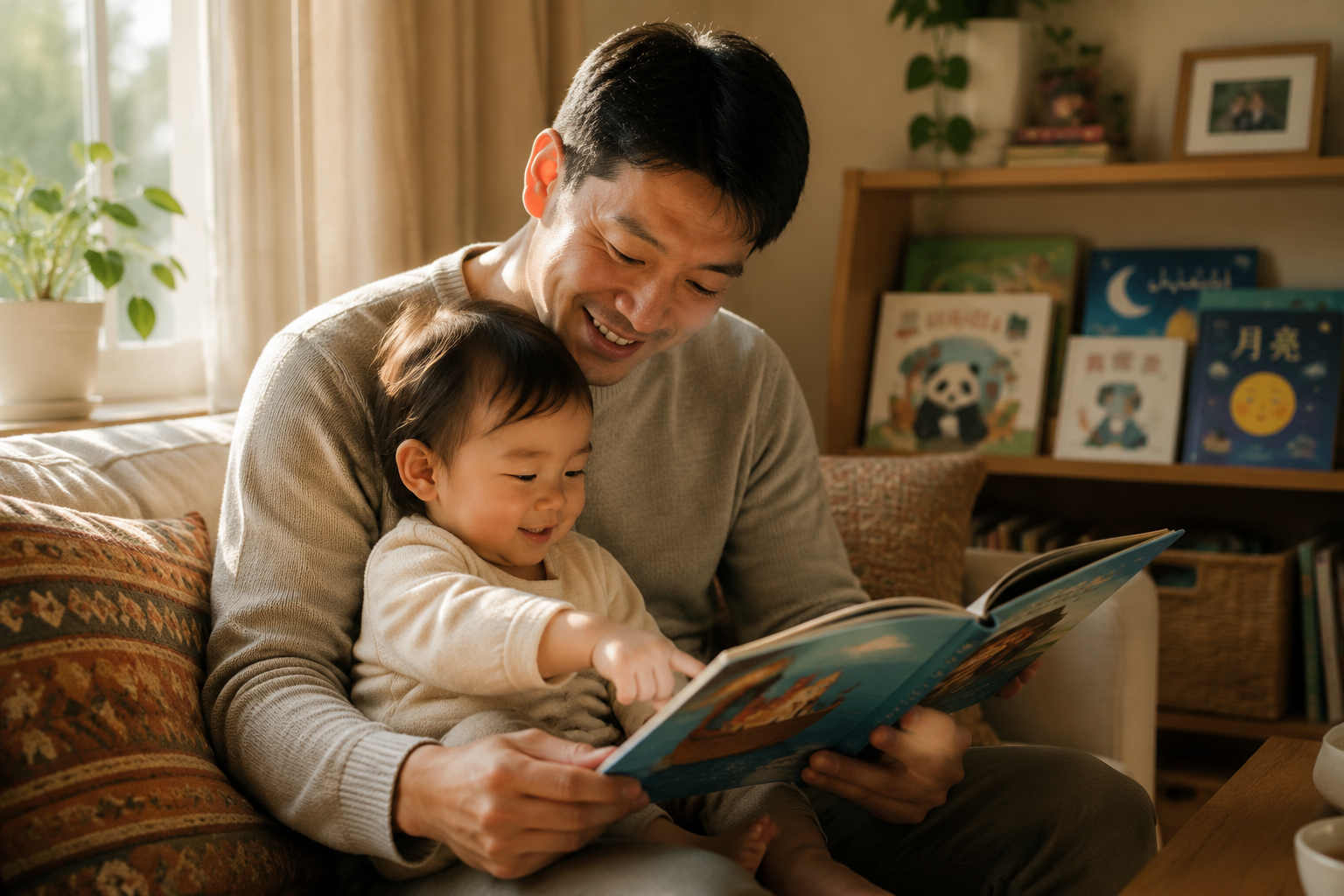
Normal bilingual development can look uneven
A bilingual toddler may know “dog” in English, “agua” in Spanish, and a grandparent’s word for “blanket,” then look unimpressive if you count only one language. That is why single-language word counts can mislead families. Byers-Heinlein and Lew-Williams describe “conceptual vocabulary” as a better lens: if a child knows a concept in either language, that knowledge counts, and translation equivalents are not double-counted.[2]
This matters in ordinary homes because bilingual children often distribute words according to where they hear and need them. The child may know kitchen words in the home language, playground words in the community language, and songs in whichever language the adult actually sings. That pattern is not a deficit by itself. It is a record of the child’s real life.
Code-mixing also worries parents more than it should. The same review argues that mixing languages is not evidence that children are confused; it can reflect flexible use of the words and grammar available to them.[2] A toddler who says, “More leche,” may not be failing to separate languages. The child may simply be using the fastest route to communicate with someone who understands both words.
There is still a useful distinction to make. Occasional mixing inside a child’s strongest relationships is different from a child having too little exposure to say much in the minority language at all. The first is normal bilingual behavior. The second is a planning problem: the child may be hearing the language, but not often enough, not interactively enough, or not in situations where using it matters.
The better question is not “Which method is correct?”
Families often get trapped comparing systems: One Parent, One Language, Minority Language at Home, Time and Place, mixed approaches. These can all work. They can also all fail if the child does not receive enough meaningful exposure or never has a reason to answer in the minority language.
The practical target many bilingual-family educators use is about 25 hours per week, or roughly 30% of a child’s waking hours, in the minority language.[3] Treat that as a helpful planning heuristic, not a lab-proven threshold. Children are not clocks. Still, the number is useful because it turns “speak more Spanish,” “use more Mandarin,” or “keep up Arabic” into something a tired household can actually inspect.
| If your current week looks like this | What to notice | What to adjust |
|---|---|---|
| The child hears the minority language mostly during short commands | Exposure exists, but conversation is thin | Add read-alouds, pretend play, mealtime talk, and repeated routines |
| A parent speaks the minority language, but switches when the child answers in the majority language | The child learns that the majority language is easier | Keep responding warmly in the minority language and model the sentence again |
| Relatives speak the language, but only on holidays | The language has emotional value but little weekly weight | Schedule brief recurring calls, songs, stories, or shared activities |
| The language appears mainly through videos | Input is present, but interaction is weak | Use media as a prompt for adult-child talk, not as the main exposure |
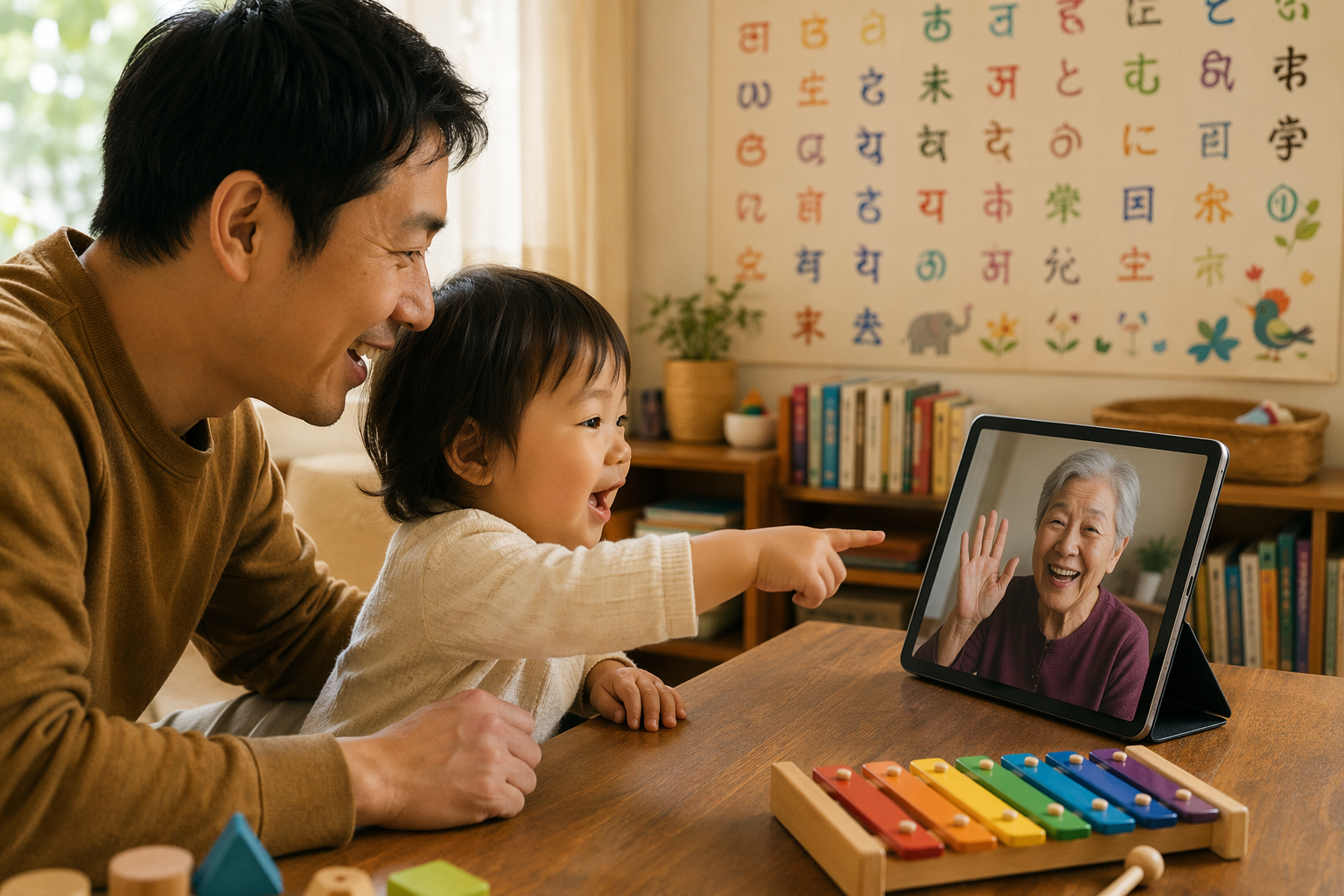
The other half of the equation is need. A child who knows every important adult will understand the majority language has little reason to struggle through the minority one. Need does not have to mean pressure or punishment. It can mean Grandma only uses Korean on the video call. It can mean bedtime stories are always in Portuguese. It can mean Saturday playgroup is where French is not a performance but the normal way to get the toy, join the game, and ask for more crackers.
Choose the structure your family can keep using
One Parent, One Language is familiar for a reason. If one adult is highly comfortable in the minority language and can use it consistently, OPOL gives the child a clear pattern: this person and this language belong together. But OPOL is neither necessary nor sufficient. Byers-Heinlein and Lew-Williams note that successful bilingual development does not depend on OPOL alone, and families using OPOL still need enough exposure in both languages.[2]
Minority Language at Home often gives the endangered language more protection. If the child will hear English all day at daycare, school, playgrounds, stores, and media, then home may be the only place where the other language can accumulate hours. This approach can work especially well when both caregivers understand the minority language, or when one caregiver is willing to support it even if they are not fully fluent.
Time and Place can be more realistic for families whose language pattern changes across the week. Maybe mornings are in the minority language, bath time is always in the minority language, or weekends with relatives are protected from majority-language drift. The risk is that the protected space becomes too small. A “Saturday morning only” plan may be emotionally meaningful, but it probably will not supply enough exposure by itself.
Mixed approaches are not automatically sloppy. Many bilingual households naturally move between languages because adults have different fluency levels, relatives visit, work schedules change, or the child’s childcare language dominates certain parts of the day. The test is not whether the plan looks elegant on paper. The test is whether the minority language keeps showing up in predictable, interactive, socially necessary ways.
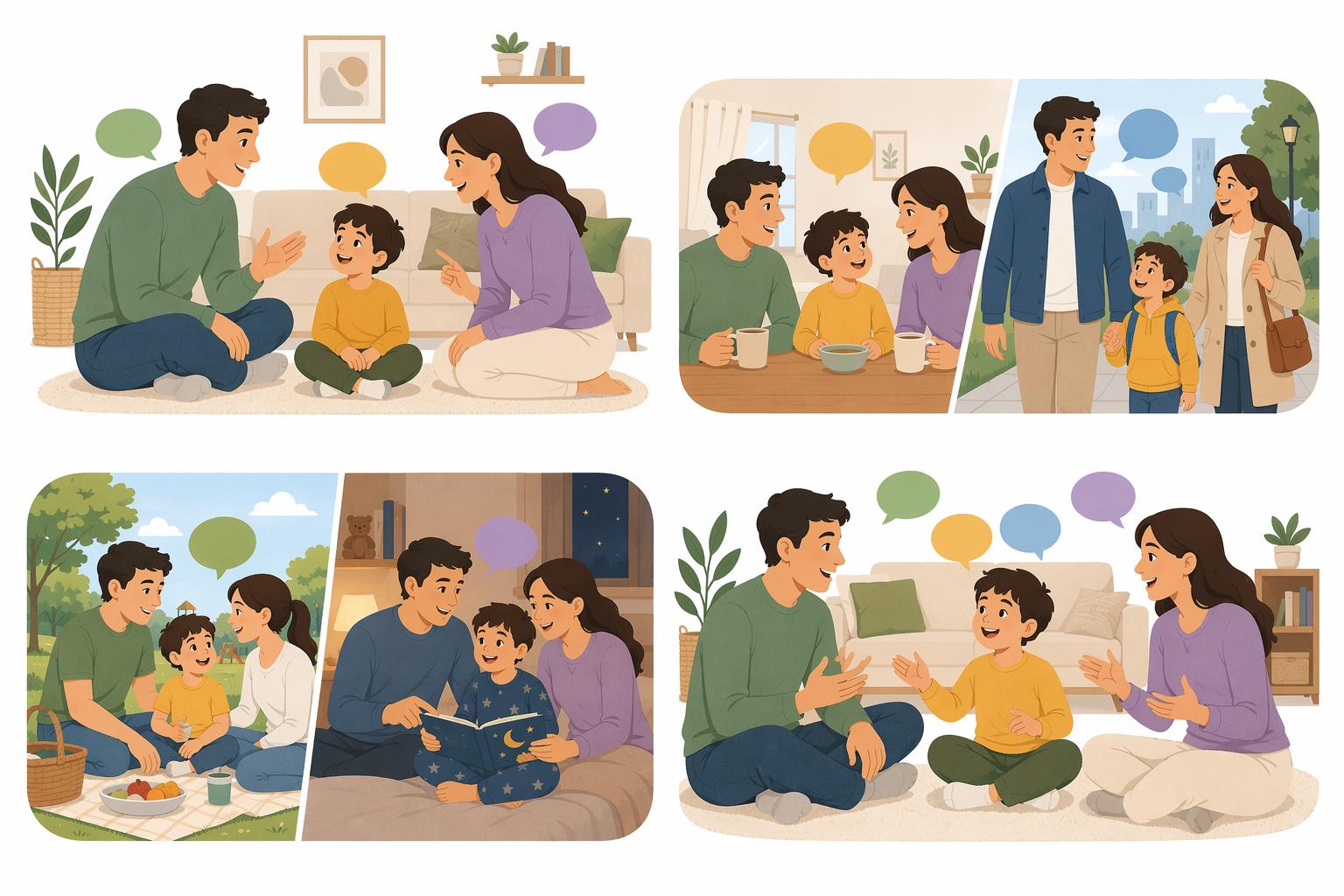
Build exposure out of routines, not heroic effort
The strongest bilingual plan for a young child is usually boring in the best possible way. The same book again. The same greeting from the same grandparent. The same bath song. The same request for socks, spoon, water, shoes, hug, more. Repetition is not a failure of creativity; it is how toddlers learn that words are useful.
- Read aloud daily in the minority language, even if the book is short and the child interrupts every page.
- Attach songs and rhymes to care routines: diaper changes, cleanup, handwashing, stroller walks, and bedtime.
- Use video calls for real interaction with relatives, not just polite greetings. Ask the grandparent to sing, show an object, tell a tiny story, or wait for the child to respond.
- Find or create small social reasons to use the language: a playgroup, religious setting, cultural event, neighbor, babysitter, or cousin.
- Keep caregiver language use steady enough that the child can predict which language belongs in which relationship or routine.
Bilingual Monkeys emphasizes everyday tactics like reading, music, relatives, cultural events, and deliberate exposure planning.[3] These are not glamorous, but they are the work. A toddler does not need a branded bilingual environment as much as a living one.
Tools can help when they serve the routine. Picture cards, labels, and spaced repetition systems can support vocabulary practice for older preschoolers or for parents trying to keep target words active. They should not replace conversation. If you use language-learning flashcards, use them as a bridge into talk: “Which animal did we see at the park?” “Can you give the red cup to Papa?” “Let’s call Auntie and show her the new word.”
Keep the minority language from becoming decorative
The minority language often starts with affection and loses ground through convenience. Everyone understands English. The child answers in English. The parent is tired. The grandparent switches to English to be kind. None of these moments is dramatic, but together they can teach the child that the minority language is ceremonial: good for songs, holidays, and counting to ten, but not needed for real life.
A better response is gentle persistence. If the child answers in the majority language, do not turn the moment into a test. Answer warmly in the minority language and recast the child’s meaning. If the child says, “I want juice,” the adult can say in the minority language, “You want juice. Here is your juice. Say ‘more juice’ if you want more.” The child hears the model without being shamed.
This is also where adults need to coordinate. A minority-language-speaking parent should not have to carry the whole language alone while everyone else treats it as optional. Even a less fluent partner can protect the routine by not interrupting, not translating everything immediately, learning household phrases, and making space for calls, books, music, and visits.
What benefits should parents expect?
There are real reasons to value bilingual development beyond communication with family. Zero to Three summarizes research linking dual language development with areas such as working memory, cognitive flexibility, and selective attention.[4] Those benefits are worth knowing, especially when relatives or professionals wrongly suggest that two languages are “too much.”
Still, cognitive benefits should not be turned into a sales pitch for producing superior children. The most immediate benefits are often simpler and more human: a child can understand a grandparent, participate in family stories, pray or sing in a community language, visit relatives without standing outside the conversation, and carry a part of family identity as ordinary speech rather than special-event vocabulary.
Pitfalls that quietly weaken a bilingual plan
The first pitfall is inconsistency that removes the child’s need to use the minority language. Some flexibility is normal. A household does not collapse because one bedtime went sideways. The problem is a pattern where the adult switches to the majority language every time the child hesitates, resists, or answers in the easier language.
The second is over-correcting. Toddlers do not need every mixed sentence repaired like a worksheet. They need more chances to hear and use the language in meaningful turns. Correction can be useful when it is brief and warm, but constant interruption makes the language feel like performance instead of communication.
The third is counting television as if it were a caregiver. Media can add songs, stories, accents, and cultural material, but young children learn language most powerfully through responsive interaction. If a video gives the adult ten minutes to cook dinner, fine. If the video becomes the main minority-language plan, the child is receiving sound without enough turn-taking.
The fourth is abandoning the minority language during the exact period when the child starts pushing back. Many toddlers and preschoolers prefer the community language because it is easier and socially dominant. That preference is not a verdict. It is information. The plan may need more peers, more relatives, more books the child actually likes, or more protected home time.
A practical way to start this week
Instead of redesigning your family life around a perfect bilingual method, look at the next seven days. Mark the times when the child will hear the minority language from a responsive person. Then mark the times when the child will have a reason to use it. The second set of marks is usually smaller. That is where the plan needs work.
- Pick the main structure: OPOL, Minority Language at Home, Time and Place, or a mixed plan with clear routines.
- Estimate whether the minority language is approaching a meaningful share of the week, using 25 hours or about 30% of waking time as a planning guide rather than a rule.
- Protect two daily routines in the minority language, such as breakfast and bedtime reading.
- Add one recurring social need: a relative call, playgroup, caregiver, neighbor, class, or community setting.
- Respond to majority-language answers without panic: model the minority-language version and keep the exchange moving.
Parents do not need to have started from birth, chosen the perfect system, or maintained flawless consistency to raise a bilingual child. They do need sustained exposure, responsive interaction, and situations where the language actually matters. That is less glamorous than a packaged method, and much more useful on a Tuesday night.
References
- Bilingual children reach early language milestones at the same age as monolingual peers, Journal of Child Language, Cambridge University Press, 2025.
- Bilingualism in the Early Years: What the Science Says, PMC, 2013.
- 50 Tips for Raising Bilingual Children, Bilingual Monkeys.
- Dual Language Development: Double the Benefit, Zero to Three.
Back to the exam this applies to
Target exam not specified — see all exam hubs.
Comments
Join the discussion with an anonymous comment.