
Comparison
How Psyche's Mars Gravity Assist Works (with Physics)
Understand how gravity assists actually work through momentum conservation and reference frames, using NASA's Psyche spacecraft Mars flyby in May 2026 as a real-world example with verifiable numbers.
Verdict panel
- Compared
- not specified
- Target exam
- not specified
- Best for
- not specified
- Pricing last reviewed
- pricing currency unconfirmed
The phrase “gravity assist” makes the maneuver sound as if a planet gives a spacecraft free energy by pulling on it. That is the part to fix first. Gravity bends the spacecraft’s path, but the speed gain that matters for an interplanetary mission is a reference-frame result: the spacecraft leaves with a different velocity relative to the Sun because it has exchanged a tiny amount of momentum with a moving planet.
NASA’s Psyche spacecraft gives this explanation a useful set of numbers. During its Mars flyby on May 15, 2026, Psyche passed 2,864 miles, or 4,609 kilometers, above Mars at closest approach, moving 12,333 mph, or 19,848 km/h. After the encounter, mission navigators reported that the flyby increased the spacecraft’s speed by about 1,000 mph and shifted its orbital plane by about 1 degree, putting it on a direct trajectory toward asteroid Psyche for an August 2029 arrival.[1]
Those numbers do not mean Psyche became faster relative to Mars just because it fell through Mars’s gravity. In the clean ideal version of the problem, with no engine burn during the flyby, the spacecraft approaches Mars and leaves Mars with the same speed in Mars’s frame. What changes is direction. Then, when that bent velocity is translated back into the Sun’s frame, the spacecraft can be faster, slower, or aimed differently in its solar orbit.
Start With the Train, Not the Planet
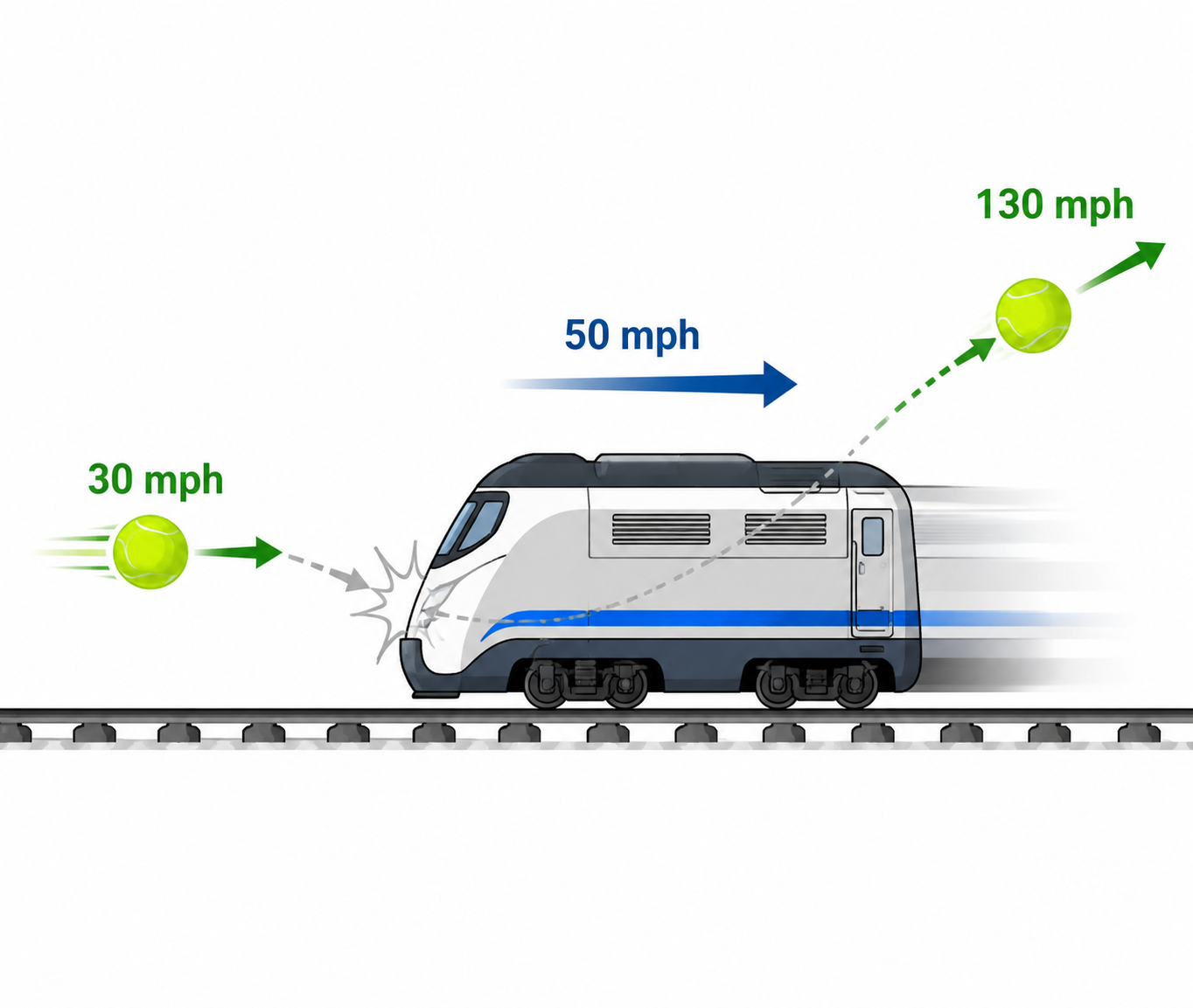
NASA’s gravity-assist primer uses a tennis ball and a moving train because the analogy forces the one question that matters: measured by whom? In the example, a train moves at 50 mph. A tennis ball is thrown toward the front of the train at 30 mph relative to the ground. From the train’s point of view, the ball is approaching at 80 mph, because the ball and train are moving toward each other. If the ball rebounds elastically, it leaves the train at 80 mph in the opposite direction in the train’s frame. To an observer standing on the ground, that rebound speed becomes 130 mph: 80 mph relative to the train plus the train’s 50 mph motion relative to the ground.[2]
Nothing mystical happened to the ball. The train lost an immeasurably small amount of momentum, and the ball gained a very noticeable amount because the train is massive. The same collision described from the train and from the ground has different velocity numbers, but one conservation law underneath it.
Now translate the roles. The tennis ball is the spacecraft. The moving train is the planet. The ground is the Sun’s frame, which is the useful frame for asking what kind of solar orbit the spacecraft is now in. The spacecraft does not literally bounce off the planet; gravity supplies the smooth turn instead of a collision. But the bookkeeping is similar: first describe the encounter in the planet’s frame, then transform back to the Sun’s frame.
| Analogy part | Gravity-assist part | What to track |
|---|---|---|
| Tennis ball | Spacecraft | Velocity before and after the encounter |
| Moving train | Planet | Large moving body that redirects the smaller object |
| Ground observer | Sun-centered frame | The spacecraft’s useful interplanetary speed |
| Elastic rebound | Gravitational bending | Direction changes while speed in the planet frame stays the same in the ideal case |
This is where many “space slingshot” explanations become too loose. If the only sentence a student remembers is “Mars pulled Psyche forward,” the student has a picture, but not a solvable physics problem. A solvable version names the frame: relative to Mars, Psyche’s path bent; relative to the Sun, that bent outgoing vector had a more useful speed and direction.
The Same Flyby Looks Different in Two Frames
Imagine freezing the Sun out of the picture for a moment and riding along with Mars. Psyche comes in from far away, falls into Mars’s gravitational field, speeds up as it approaches, swings around the planet, then climbs back out. Far before and far after the encounter, if no engine burn is added and we ignore small complications, Psyche’s speed relative to Mars is the same. Its direction is not.
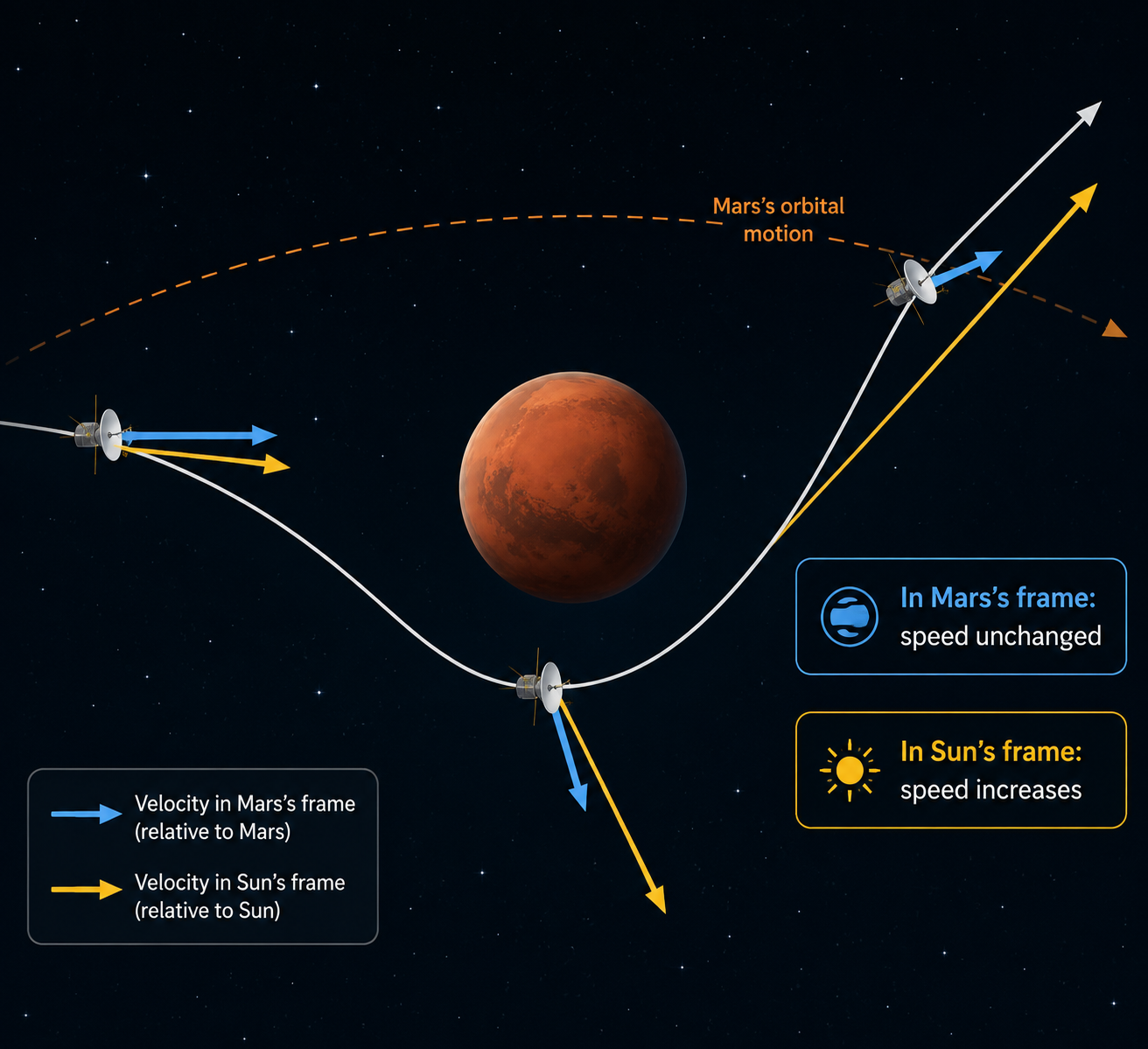
A velocity diagram is the cleanest way to see it. In Mars’s frame, draw the incoming velocity arrow and the outgoing velocity arrow with equal lengths. Put the bend between them. The bend angle depends on the flyby geometry: closer passes and slower approaches can bend the path more strongly, while mission safety, planetary protection, and navigation constraints limit what trajectory designers can actually choose.
Now add Mars’s orbital velocity around the Sun to both arrows. Vector addition can turn equal-length Mars-frame arrows into unequal Sun-frame results because their directions are different. If the outgoing arrow points more along Mars’s orbital motion than the incoming arrow did, the spacecraft gains heliocentric speed. If it leaves less aligned with the planet’s motion, it can lose heliocentric speed. If the geometry is tilted, the assist can also change the spacecraft’s orbital plane.
That last point matters for Psyche because its Mars encounter was not just a speed story. The reported result included about a 1-degree plane change as well as the roughly 1,000 mph speed increase.[1] In three-dimensional orbital mechanics, “help” can mean changing the tilt of the orbit, not merely making the speedometer number larger.
Where the Momentum Comes From
The spacecraft’s gain is paid for by the planet’s motion. During the encounter, the spacecraft and planet pull on each other with equal and opposite gravitational forces. The spacecraft’s momentum changes by a lot compared with its own mass. The planet’s momentum changes by the same amount in the opposite direction, but the planet is so massive that its velocity change is effectively undetectable.
A scale example makes the asymmetry less hand-wavy. Wikipedia’s gravity-assist article gives the estimate that a 1-ton spacecraft passing Jupiter changes Jupiter’s velocity by about 5 × 10^-25 km/s for each 1 km/s of speed gained by the spacecraft.[3] That is not zero; it is just too small to matter for Jupiter’s orbit in any practical sense.
This is also why “stealing gravity” is the wrong phrase. Gravity is the interaction that transfers momentum, not a fuel tank. The planet’s orbital motion is the reservoir that the spacecraft taps, and the enormous mass ratio hides the planet’s recoil from ordinary mission discussion.
Applying That to Psyche’s Mars Flyby
Psyche’s May 2026 Mars flyby is a good classroom example because the public numbers line up with the conceptual steps. First, the encounter itself: closest approach came on May 15, 2026, at 2,864 miles above Mars, with the spacecraft moving 12,333 mph at closest approach.[1] That closest-approach speed is not the same thing as the final speed boost. Near Mars, the spacecraft is deep in Mars’s gravitational field, so the local speed is high. The useful question is what trajectory the spacecraft has after it climbs away again.
Second, the outcome: after the flyby, NASA reported a speed increase of about 1,000 mph.[1] That is the heliocentric result, the number that helps describe Psyche’s new solar orbit. In the Mars-frame picture, the ideal unpowered flyby changes direction while preserving the far-before and far-after speed relative to Mars. In the Sun-frame picture, Mars’s own motion makes that redirected outgoing velocity more valuable for the route to the asteroid belt.
Third, the plane change: the flyby shifted Psyche’s orbital plane by about 1 degree.[1] One degree sounds small until you remember the length scale. Psyche is not making a local course correction across a room; it is shaping a multi-year path through the inner solar system toward a target in the asteroid belt. A slight tilt change near Mars can matter because it changes where the spacecraft’s future orbit intersects the asteroid’s orbit.
Before the flyby, JPL described the maneuver as a way to use Mars’s gravity to bend Psyche’s path and increase its speed so the spacecraft could continue toward its target without relying only on onboard propellant.[4] After the flyby, the confirmed speed increase and plane shift gave the tidy classroom version something better than a cartoon: a real spacecraft, a real planet, and a published before-and-after trajectory result.
A compact velocity check
For a student sketching this, the diagram does more work than a long paragraph. Use arrows, not just words:
- Draw Mars moving around the Sun.
- In Mars’s frame, draw Psyche’s incoming and outgoing far-field velocity arrows with the same length.
- Bend the outgoing arrow so it is aimed more usefully for Psyche’s solar orbit.
- Add Mars’s Sun-frame velocity vector to both arrows.
- Compare the resulting Sun-frame arrows; the difference is where the reported boost and direction change show up.
The important discipline is to stop switching frames silently. If a solution says “same speed” and “gained about 1,000 mph” in the same breath, both statements can be true only if they refer to different frames.
Why Psyche Needed the Assist
Psyche launched on a Falcon Heavy on October 13, 2023, for a journey of about 2.2 billion miles to asteroid Psyche.[5] It also carries xenon for Hall-effect electric thrusters; the spacecraft description lists 922 kg of xenon propellant.[5] Those thrusters are efficient, but efficient does not mean unlimited. A gravity assist can reshape a trajectory without spending the propellant that a comparable onboard maneuver would require.
There is no need to invent a specific “kilograms of xenon saved” number. The published result already tells the meaningful story: Mars supplied a trajectory change that mission planners wanted, and Psyche now has a direct route toward its August 2029 asteroid arrival.[1] The general rocket-equation lesson is enough here: large velocity changes are expensive when they must come from carried propellant, so trajectory designers look for legal ways to let planetary motion do part of the work.
The spacecraft is not passive after that. Electric propulsion still shapes long cruise arcs. The gravity assist changes the geometry of the problem so that the remaining cruise is feasible with the spacecraft and propellant it actually has.
The Mars Images Were Useful, but They Are Not the Mechanism
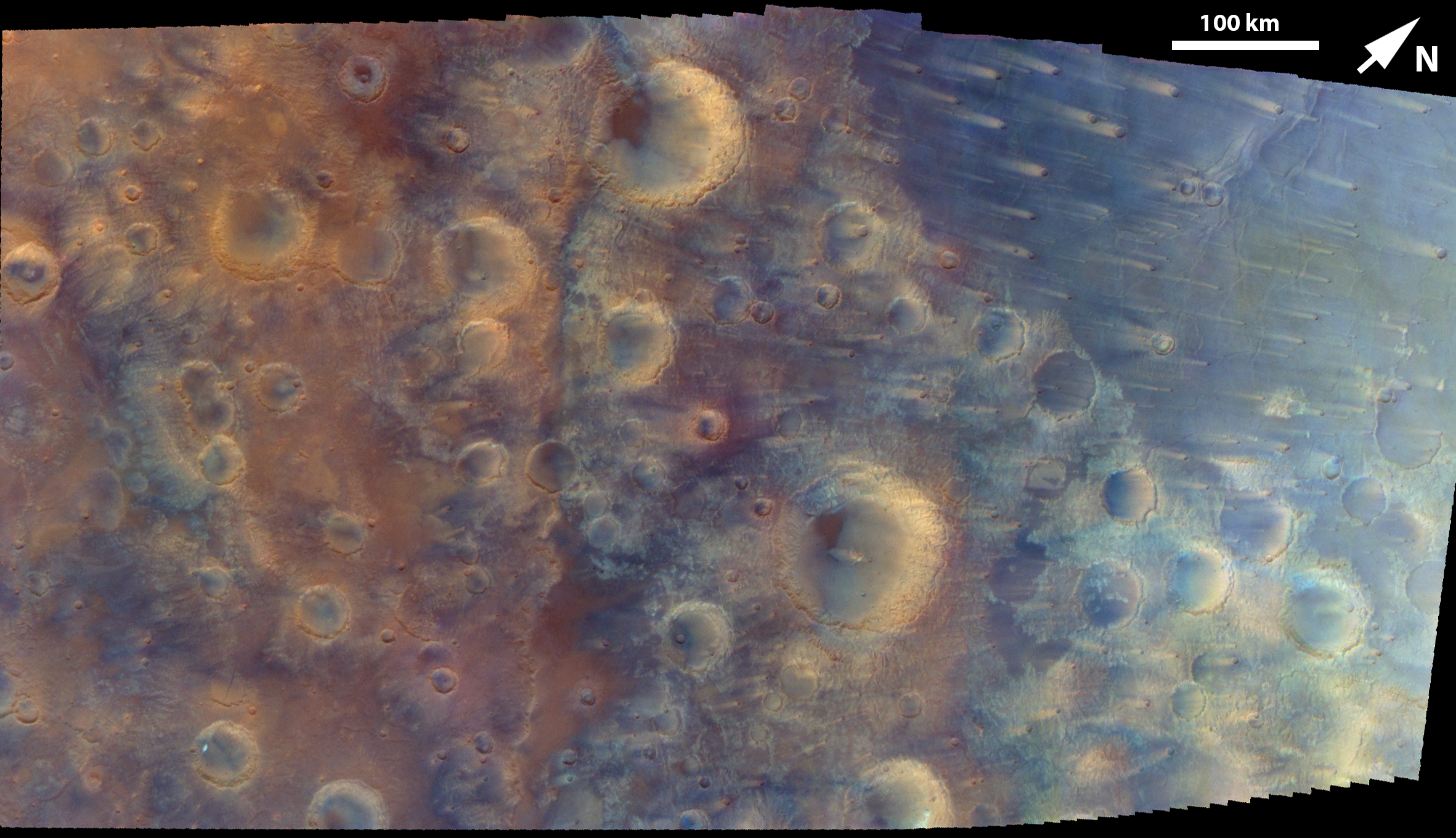
The flyby also gave the mission team a chance to test instruments on a known world. JPL reported that Psyche’s imagers captured thousands of Mars images during the encounter, while other instruments used the flyby as a calibration opportunity; Ars Technica described the event as a dress rehearsal in which the magnetometer may have detected Mars’s bow shock and the spectrometer could compare Mars observations with existing data.[1][6]
That is good mission practice, and the images are worth enjoying. They should not distract from the physics of the assist. The camera did not make the spacecraft faster. The encounter geometry did.
The Oberth Effect Is Related, Not the Same Explanation
One nearby concept often gets mixed into gravity-assist explanations: the Oberth effect. A rocket burn made near periapsis, when a spacecraft is moving fastest, can produce a larger change in orbital energy than the same burn made elsewhere. That is a powered maneuver effect, not the same thing as a pure gravitational flyby.[3]
So the safe wording for Psyche is narrow. The May 2026 result should be explained as a Mars gravity assist unless mission sources describe a powered periapsis burn as part of that specific boost. The available post-flyby reporting emphasizes the gravitational flyby result: about 1,000 mph of speed increase, about 1 degree of plane change, and a trajectory toward the August 2029 asteroid encounter.[1]
What a Student Should Be Able to Say
A strong explanation of how Psyche’s gravity assist works should sound something like this: in Mars’s frame, the spacecraft’s far-before and far-after speeds are the same for an ideal unpowered flyby, but Mars’s gravity turns the velocity vector. In the Sun’s frame, Mars is moving, so that turned vector can become a larger and differently aimed heliocentric velocity. Momentum is conserved; Mars’s velocity changes by an unimaginably tiny amount, while Psyche’s trajectory changes enough to matter.
Psyche’s flyby is valuable as a worked example precisely because the numbers are concrete: 2,864 miles above Mars, 12,333 mph at closest approach, about 1,000 mph gained afterward, about a 1-degree plane shift, and an August 2029 target arrival.[1] A gravity assist is a reference-frame and momentum-conservation maneuver, not free energy from gravity.
References
- NASA's Psyche Mission Aces Mars Flyby, Targets Metal-Rich Asteroid — JPL, May 19, 2026
- Basics of Spaceflight: A Gravity Assist Primer — NASA Science
- Gravity assist — Wikipedia
- NASA's Psyche Mission to Fly by Mars for Gravity Assist — JPL
- Psyche (spacecraft) — Wikipedia
- NASA's Psyche spacecraft returns unfamiliar views of a familiar world — Ars Technica
Back to the exam this applies to
Target exam not specified — see all exam hubs.
Comments
Join the discussion with an anonymous comment.