
Comparison
Is Pompeii Out of Time Good for Students?
A student-oriented review of NatGeo's Pompeii: Out of Time, weighing its academic credibility, interdisciplinary expert perspectives, and docudrama format to help AP and undergrad students decide if the series is a worthwhile study-break investment.
Verdict panel
- Compared
- Pompeii: Out of Time, BBC's Pompeii: The Last Day, PBS's Pompeii: The New Dig, Netflix's Immortal Pompeii
- Target exam
- not specified
- Best for
- AP and undergraduate students seeking enrichment for Pompeii coursework
- Pricing last reviewed
Early verdict: if you are looking for a Pompeii Out of Time review for students, the answer is yes, with a large asterisk. NatGeo’s three-part Pompeii: Out of Time is worth a three-hour study-break slot if you treat it as enrichment: a vivid supplement for thinking about evidence, survival, evacuation, and historical uncertainty. It is not a replacement for your course readings, your textbook chapter, your Latin notes, or your AP outline.
That matters because Pompeii is one of those ancient-history topics students often think they already know. Volcano. Ash. Bodies. Tragedy. The useful question is not whether this series can make the disaster feel dramatic; almost any competent Pompeii documentary can do that. The better question is whether it helps you see how knowledge about Pompeii is built from broken evidence rather than handed down from one clean archive.
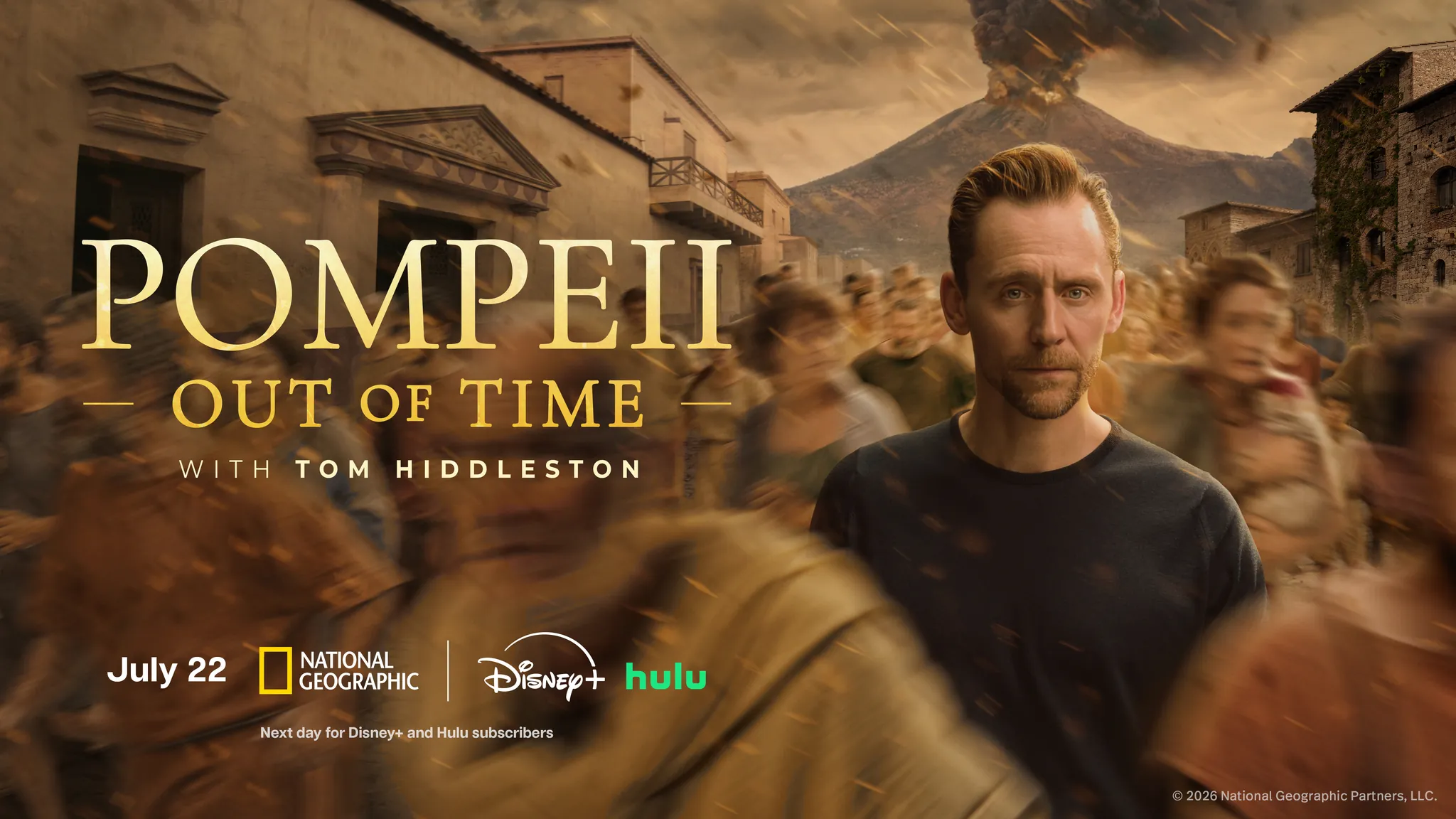
On that standard, Out of Time has enough academic substance to deserve attention. It premiered across NatGeo and Disney+ on July 22–23, 2026, so this is still an early verdict rather than a settled consensus, and the critical sample is thin. But the credibility signals are real: Tom Hiddleston is not just celebrity garnish, the series is grounded in Steven Tuck’s survivor-tracing work, and its strongest classroom value comes from watching experts move from inscriptions, names, objects, geology, and psychology toward cautious claims.[1]
Why the Hiddleston Factor Is Not the Main Problem
If you are allergic to celebrity-hosted documentaries, the Tom Hiddleston branding may look like the first red flag. It is not. Hiddleston studied Classics at Cambridge, where he earned a double first, and he has said he first visited Pompeii at age 17 in 1998.[2] That does not make him an archaeologist, but it does make the casting different from a purely promotional stunt.
For students, the better test is not whether the narrator has credentials. It is whether the series uses his presence to clarify evidence or to smooth over gaps. Out of Time does both. Hiddleston’s enthusiasm helps the material stay watchable, especially for tired students who might not voluntarily spend an evening with Roman epigraphy. But when the series leans into playful framing or scripted exchanges, the energy can make uncertain reconstructions feel more secure than they are.
That does not disqualify the series. Pleasure is not the enemy of studying. If a host keeps you attentive long enough to notice how a name on an inscription can become evidence for migration after disaster, that is a legitimate study benefit. The caution is simple: do not confuse charisma with proof.
The Best Reason to Watch: Survivors, Not Just Victims
The series is at its strongest when it follows the Pompeii Survivors Project, the decade-long work associated with classicist Steven Tuck. That project traced possible survivors by working through roughly 20,000 Latin inscriptions across 48 Roman cities and looking for names, family patterns, and post-eruption traces that might point to people who escaped or resettled after the disaster. Tuck’s work was published in the 2025 Oxford University Press book Escape From Pompeii.[1][3]
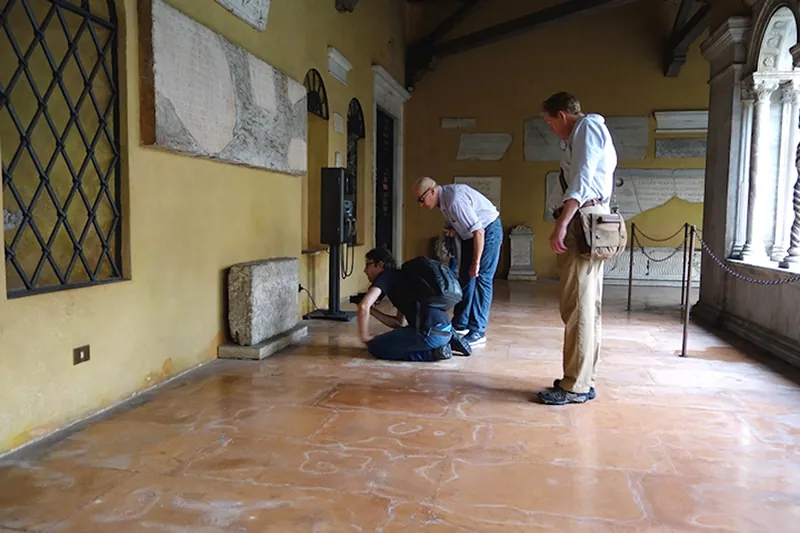
This is exactly where Out of Time becomes useful for coursework. Students often meet Pompeii through the dead: casts, skeletons, villas, frescoes, streets stopped in time. Survivors are harder to teach because they are less visually tidy. They do not sit in one excavation trench waiting to be photographed. They appear through names that recur, inscriptions that survive unevenly, and movements that have to be inferred rather than simply seen.
That makes the survivor material a good model for source-based writing. A student can watch the series and ask the same questions an instructor would ask of an essay draft: What is the evidence? What claim does it support? Is the claim about one person, a family group, or a broader pattern? Where does the argument shift from documented to plausible?
The answer is rarely as clean as television wants it to be. An inscription can preserve a name, but a name is not automatically a biography. A cluster of names after the eruption can suggest movement, but it does not by itself narrate fear, loss, or a route out of town. The educational value of Out of Time lies in making that process visible enough for students to discuss. It is less useful when it lets the finished story feel smoother than the evidence underneath.
| What the series shows | What a student should ask |
|---|---|
| Names and inscriptions linked to possible survivors | Does the evidence identify a person securely, or only support a reasonable possibility? |
| Objects found with bodies or at evacuation sites | Does the object prove a scene, or only constrain what could have happened? |
| Expert reconstruction of choices during eruption | Is this based on ancient evidence, modern disaster psychology, or both? |
| Dramatized dialogue between ancient people | Is any wording recoverable, or is the scene invented to express a plausible situation? |
The Method Lesson Is Stronger Than the Disaster Recap
Out of Time does cover the eruption itself, and some of that material is worth your attention. The eruption lasted about 24 hours rather than striking as a single instant; tremors occurred for four days before it; pyroclastic flows moved at about 100–200 kilometers per hour, or 60–120 miles per hour; and the eruption column reached about 20 miles, or 32 kilometers, high.[4]
Those details are useful because they change the moral shape of the story. If the disaster were instantaneous, there would be little to analyze beyond catastrophe. A longer timeline raises harder questions: who recognized danger early, who waited, who had the means to leave, who stayed with family, who trusted familiar routines, and who misread warning signs because the world had not yet become completely unlivable.
The series also benefits from a broader expert panel than many student-friendly ancient-history programs. Its contributors include classicists such as Tuck, archaeologists such as Sophie Hay, geoscientists such as Chris Jackson, and disaster psychologist Sarita Robinson, who discusses amygdala and fight-flight-freeze responses in the context of ancient disaster behavior.[1][3][4] That mix is not just decorative. Pompeii cannot be explained responsibly from one discipline alone.
For an AP World History, AP Art History, Latin, Classics, or earth-science student, this is the part to keep. The same event looks different depending on the evidence base. A geologist can explain what the mountain did. An archaeologist can interpret material remains. A classicist can track names and inscriptions. A psychologist can help frame human decision-making under stress, while still admitting that no modern model lets us read an ancient person’s mind.
That last limit matters. Disaster psychology can make ancient choices feel less foolish and more human, but it should not be treated as a time machine. If you use the series in class discussion, a strong comment would not be “people froze because of the amygdala.” A stronger comment would be: the series uses modern psychology to make plausible sense of delayed evacuation, but the ancient evidence still has to carry the historical claim.
Where the Docudrama Format Helps
The dramatized scenes are not automatically a flaw. Students remember stories more readily than abstract cautions about evidence, and Pompeii’s surviving material almost invites reconstruction. A house, a street, a skeleton, a purse, an inscription: none of these speaks in essay paragraphs. Television has to decide how to connect them.
When Out of Time is careful, the reconstruction helps students imagine the gap between source and claim. It gives shape to choices that can otherwise remain flat: leaving early or waiting, carrying money or food, following officials or family members, interpreting tremors as ordinary inconvenience or as warning. Those are not trivial questions. They are the difference between treating ancient people as museum specimens and treating them as historical actors under pressure.
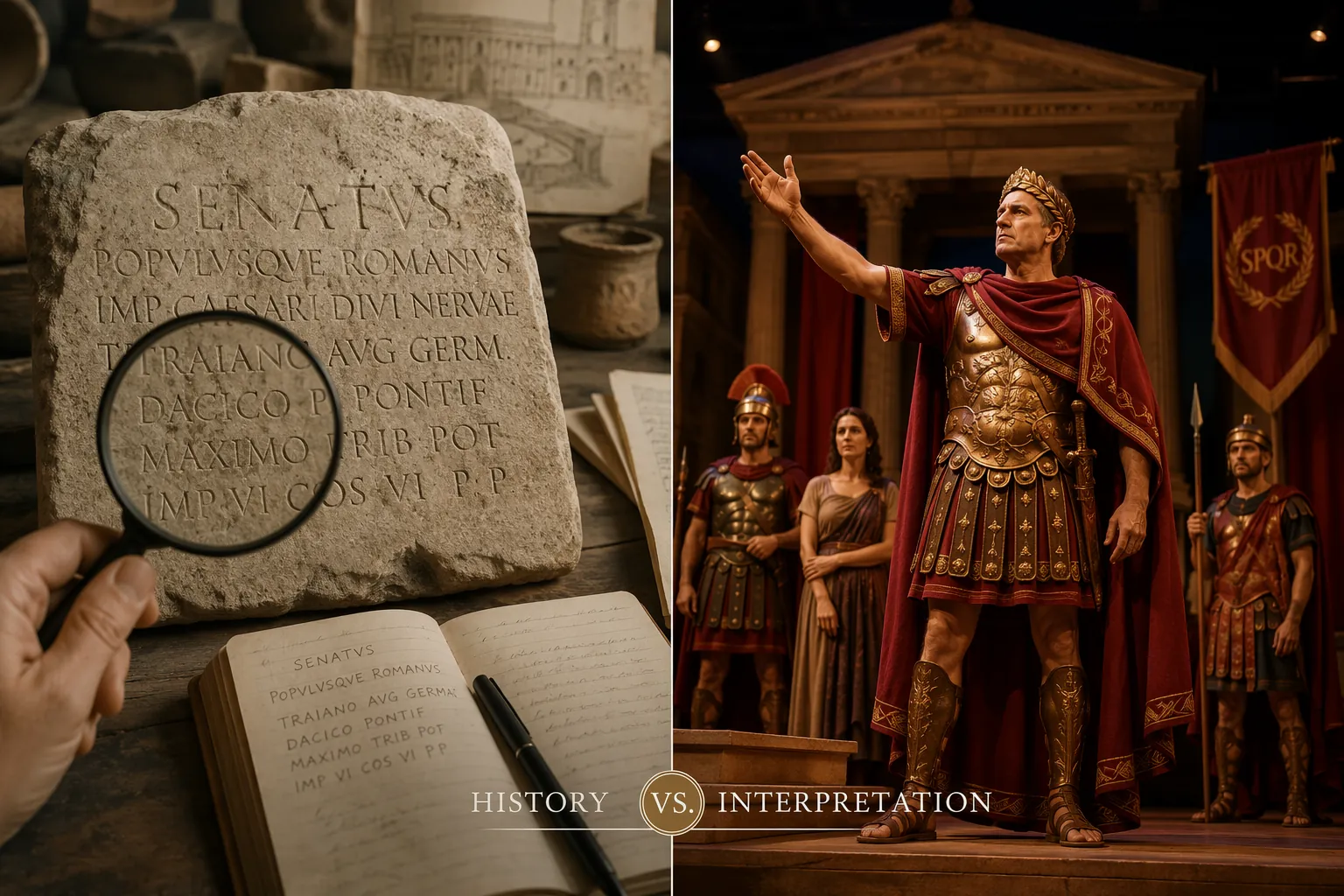
The format is also helpful for students who are practicing evidence evaluation beyond history class. Standardized-test reading sections often reward the same habit: separating what a passage states from what it implies. Out of Time gives you a more visual version of that skill. The inscription states one kind of thing. The object states another. The reenactment proposes a connection. Your job is to notice which layer you are looking at.
Where It Can Mislead Students
The same docudrama machinery can also blur the line between evidence and invention. The most important example is not a random costume choice or a melodramatic glance. It is the kind of scene where the series builds a convincing human moment from a very small physical base.
Ars Technica’s reporting on the production notes a scene involving a Praetorian at Herculaneum giving a beach evacuation speech. The problem is not that the scene is impossible. The problem is that it is unverifiable. The physical finds support a much narrower statement: a sword, belt, and money clip were found. They do not preserve the man’s speech, his exact role in organizing others, or the words he used.[3]
That distinction is the whole classroom issue in miniature. “A Praetorian may have been present with military equipment” is a different claim from “this man rallied people with these words.” One belongs closer to archaeological inference; the other belongs to dramatized possibility. A good student can still learn from the scene, but only by labeling it correctly.
The scripted banter has the same risk. It can lower the barrier to entry, especially if you are tired and need the material to feel less like homework. But when banter presents interpretation with the rhythm of fact, pause. Write down the claim, then ask what would have to survive for that claim to be known. A name? A body? A tool? A wall painting? A later inscription? If the answer is “none of that, exactly,” you are probably dealing with dramatization rather than recoverable history.
How to Watch It Without Letting It Replace Studying
If you are watching for class, do not take notes as if every scene has equal evidentiary weight. Use a simple three-column page instead: known, inferred, dramatized. That is enough structure to turn the series from passive viewing into source practice.
- Known: physical finds, inscriptions, eruption timing, named experts’ direct explanations.
- Inferred: survivor routes, family movements, likely choices under pressure, links between names across places.
- Dramatized: dialogue, private emotions, exact speeches, scene-by-scene behavior not directly preserved.
For AP or undergraduate discussion, the most useful takeaway is not “Pompeii was worse than I thought.” It is more specific: Pompeii’s evidence is abundant but uneven. Some material is almost brutally concrete; some of the most interesting human questions require cautious reconstruction. That tension is what makes the series worth assigning in excerpts or recommending as a supplement.
If you are watching for an exam, be stricter. Do not let three hours of documentary time replace active recall, essay outlining, vocabulary review, or practice questions. Use the series for examples: how evidence survives, how scholars argue from fragments, how interdisciplinary explanations work, and how easily a polished narrative can outrun its sources.
The Reviews Are Split, and That Actually Helps
The early reception is not uniform. The Los Angeles Times called the series “a little goofy,” New Scientist described it as “unabashedly cheesy — but it works,” and The Guardian called it “tearjerking television.”[5][6][7] That range is a useful warning for students: your tolerance for the format will shape how much you get from the content.
If theatrical reenactments help you stay engaged, you may come away with a stronger grasp of survival, evacuation, and historical reconstruction. If scripted banter makes you distrust the whole enterprise, you may need to watch with an instructor’s framing or skip to expert-heavy sections. Neither reaction is intellectually superior. The key is whether you can keep asking what evidence supports the scene in front of you.
How It Compares With Other Pompeii Documentaries
Do not choose Out of Time because it is the only worthwhile Pompeii documentary. It is not. The more precise reason to choose it is that it centers survivors rather than only victims. That focus gives it a different classroom use from documentaries built mainly around volcanology, excavation, or Roman disaster management.
A brief comparison is enough. BBC’s Pompeii: The Last Day is often treated as stronger for the eruption as a disaster sequence. PBS’s Pompeii: The New Dig is more directly tied to archaeological process. Netflix’s Immortal Pompeii is more useful for post-disaster Roman crisis management. Those comparisons should not be stretched into a full ranking without deeper verification, but they clarify the niche: Out of Time is most valuable when you want to think about who got out, how scholars try to find them, and where the evidence runs thin.
Final Verdict for Students
Pompeii: Out of Time earns high marks as a student supplement because it turns Pompeii from a frozen tragedy into a problem of evidence. Its best material shows historians, archaeologists, geoscientists, and psychologists working with fragments: inscriptions that may preserve survivor traces, objects that constrain possibilities, geological timelines that reshape human choices, and modern models that can suggest but not prove ancient behavior.
Watch it if you want a vivid model of how ancient-history claims are built. Annotate the dramatized portions carefully, especially dialogue and emotionally complete scenes based on limited finds. Then return to your actual course outline, exam plan, primary-source packet, or textbook chapter. The series can make your studying sharper, but it should not become the study plan itself.
References
- Tom Hiddleston tracks possible Pompeii survivors in new docuseries, CNN, July 20, 2026, https://www.cnn.com/2026/07/20/science/pompeii-survivors-docuseries
- Pompeii: Out of Time with Tom Hiddleston preview, HistoryExtra, https://www.historyextra.com/period/roman/pompeii-out-of-time-with-tom-hiddleston-preview/
- Tom Hiddleston tracks possible Pompeii survivors in new docuseries, Ars Technica, July 2026, https://arstechnica.com/science/2026/07/tom-hiddleston-tracks-possible-pompeii-survivors-in-new-docuseries/
- Pompeii documentary with Tom Hiddleston explores who survived the eruption, Science News, https://www.sciencenews.org/article/pompeii-documentary-tom-hiddleston
- Pompeii: Out of Time with Tom Hiddleston review, Los Angeles Times, July 22, 2026, https://www.latimes.com/entertainment-arts/tv/story/2026-07-22/pompeii-out-of-time-with-tom-hiddleston-review-nat-geo
- Tom Hiddleston’s new Pompeii show is unabashedly cheesy — but it works, New Scientist, https://www.newscientist.com/article/2580587-tom-hiddlestons-new-pompeii-show-is-unabashedly-cheesy-but-it-works/
- Pompeii: Out of Time with Tom Hiddleston review — tearjerking television, The Guardian, July 18, 2026, https://www.theguardian.com/tv-and-radio/2026/jul/18/pompeii-out-of-time-with-tom-hiddleston-tearjerking-television-disney
Back to the exam this applies to
Target exam not specified — see all exam hubs.
Comments
Join the discussion with an anonymous comment.