
Comparison
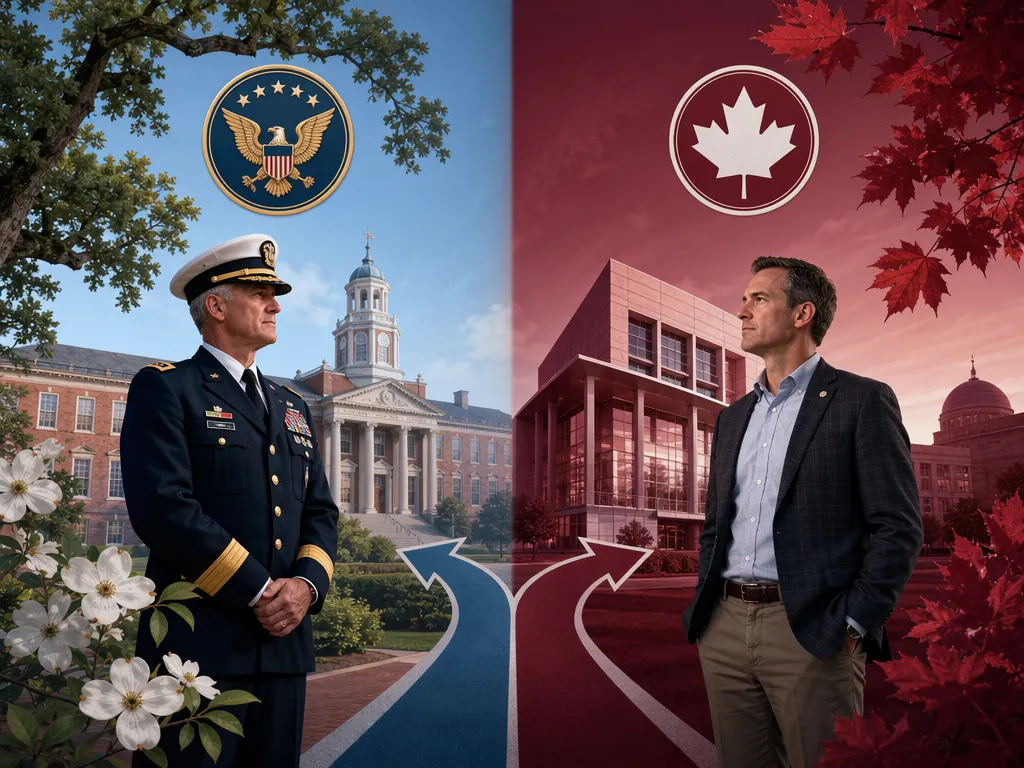
How the Pentagon Fellowship Split Changes UNC vs Harvard for Military Students
The Pentagon's 2026 policy changes ended DoD-funded fellowships at Harvard and established a new Senior Service College Fellowship partnership with UNC. This comparison explains the two separate pathways—DoD-funded access at UNC and privately-funded scholarships at Harvard—so military students can choose based on rank, career stage, and tuition benefits.
Verdict panel
- Compared
- UNC Senior Service College Fellowship, Harvard American Service Fellowship
- Target exam
- not specified
- Best for
- Senior officers and veterans with 7+ years of service
- Pricing last reviewed
For a military student comparing UNC and Harvard in Q3 2026, the first correction is simple: the two schools are not offering different versions of the same Pentagon-backed opportunity. UNC has just been approved as a Department of Defense-funded Senior Service College Fellowship partner for senior officers. Harvard, after losing its DoD-funded fellowship channel, is using a privately funded American Service Fellowship for veterans and active-duty students entering the Kennedy School’s Mid-Career Master in Public Administration program.
That split matters because the wrong assumption can send an applicant to the wrong funding office. UNC’s new Senior Service College Fellowship was approved on July 22, 2026, and is described as a 10-month, DoD-funded program for senior military officers preparing for strategic leadership; slot count, curriculum, and implementation details have not yet been published.[1] Harvard’s current military pathway is more fully mapped: the American Service Fellowship is a privately funded $100,000 scholarship for veterans and active-duty students with at least seven years of service, covering MC/MPA tuition, fees, and a partial living stipend, with a Dec. 1, 2026 application deadline for the 2027-28 cohort.[2]
The Practical Split
| Question | UNC | Harvard |
|---|---|---|
| Primary military pathway after the Pentagon shift | Senior Service College Fellowship approved as a DoD-funded partnership | American Service Fellowship at Harvard Kennedy School, privately funded |
| Main applicant profile | Senior military officers preparing for strategic leadership | Veterans and active-duty students with at least 7 years of service |
| Program length or program target | 10-month SSC Fellowship; details pending | MC/MPA pathway at Harvard Kennedy School |
| Funding structure | DoD-funded fellowship route; operational details not yet published | $100,000 scholarship covering full MC/MPA tuition, fees, and partial living stipend |
| Known deadline | Not yet published in available announcement materials | Dec. 1, 2026 for the 2027-28 cohort |
| Key caution | Do not assume every military student at UNC qualifies for the SSC Fellowship | Do not assume Harvard is closed to military students because DoD fellowships ended |
The table is deliberately blunt because applicants and benefits counselors need clean categories. A DoD-funded senior-officer fellowship is not the same thing as a privately funded scholarship for an MC/MPA student. A veteran with seven years of service may fit Harvard’s stated fellowship profile and still have no access to UNC’s SSC track. A senior officer nominated or selected through the appropriate service process may find UNC newly relevant and still need to wait for the published mechanics before making a family or career move.
One wording note also helps avoid confusion: some 2026 reporting and administration language uses “Department of War” or “DoW” in place of the Department of Defense. The student-facing issue is the same either way: whether the funding authority is a military-funded fellowship, a university scholarship, a state residency rule, or something else entirely.
What UNC Can Offer, and What Is Still Unpublished
UNC’s new role is important because it gives the university a formal Senior Service College Fellowship pathway at the exact moment Harvard’s DoD-backed route has ended. The published announcement says the fellowship is a 10-month, DoD-funded experience for senior military officers preparing for strategic leadership.[1] That phrase does a lot of work. It points toward officers already far enough along in their careers to be considered for senior service college-level development, not toward dependents, junior enlisted service members, early-career officers, or all veterans broadly.
The responsible reading is also the narrow one. UNC has been approved as a partner; the announcement does not yet supply the number of fellowship slots, the start date, the precise curriculum, or the service-by-service selection process.[1] A senior officer can treat UNC as newly available in the DoD-funded fellowship map. That same officer should not treat the announcement as a completed orders packet.
UNC does have a visible military ecosystem around that new pathway. The university reported roughly 1,200 military students, 1,300 military dependents, and 150 ROTC cadets across three programs, and cited rankings of No. 7 among Military Friendly Schools and No. 8 among Best Colleges for Veterans in the 2025-26 cycle.[1] Those numbers do not prove that a specific graduate program will be the right fit. They do suggest that a military student is less likely to be the first person on campus asking how service obligations, family moves, benefits paperwork, and academic calendars collide.
There is a separate UNC cost point that should not be mixed up with the SSC Fellowship. Active-duty members stationed in North Carolina on permanent assignment may qualify for in-state tuition under North Carolina’s residency rule cited by the UNC registrar.[3] That can matter for an active-duty student pursuing another UNC program outside the senior service college channel. It does not automatically turn a dependent, a veteran living elsewhere, or a service member stationed outside North Carolina into an in-state student.
What Harvard Still Offers Military Students
Harvard’s situation is easy to misread because the funding loss was real, but the broad conclusion that Harvard is closed to military students is wrong. The DoD-funded senior service college route is no longer the route. The Harvard Kennedy School American Service Fellowship is a different route: privately funded, attached to the MC/MPA, and aimed at veterans and active-duty applicants with at least seven years of service.[2]
The dollar figure is unusually concrete. Harvard describes the fellowship as a $100,000 scholarship covering full MC/MPA tuition, fees, and a partial living stipend.[2] For context, Harvard Kennedy School lists 2026-27 MC/MPA tuition at $64,340, plus a $9,797 summer program fee.[4] A student comparing out-of-pocket exposure should look first at whether the scholarship applies to the exact program they are considering, then at what “partial living stipend” does and does not cover in Cambridge.
The cohort size is also meaningful but should be read as a floor, not a guarantee for any one applicant. Harvard’s pilot is described as supporting at least 50 students per year.[2] That makes it more accessible on paper than a small unnamed fellowship, but admissions, service eligibility, program fit, and fellowship selection still remain separate gates. The Dec. 1, 2026 deadline for the 2027-28 cohort gives applicants a real planning date, which UNC’s newly announced SSC pathway does not yet provide in the available materials.[2]
The funding source deserves attention. Because the American Service Fellowship is privately funded, it is not simply a replacement DoD fellowship wearing another label. Its continuation depends on private philanthropic support beyond the pilot structure described in the available Harvard materials.[2] That may not change the decision for a 2027-28 applicant, but it matters for anyone advising a later cohort or assuming the program will exist in the same form indefinitely.
Why the Pentagon News Created So Much Noise
The confusion did not come from nowhere. Reporting in early 2026 said 93 Senior Service College fellowships were eliminated across 22 institutions, with Harvard losing 21, the largest single-institution total described in that coverage.[5][6] That is a major shift for military education pipelines, and it explains why applicants started asking whether Harvard had become a dead end for military students.
The sharper language came from leaked Army emails reported in February 2026, including a description of Harvard as “fully off limits” and warnings that more than 33 other schools had been flagged as moderate or high risk, with students told to prepare backup plans.[7] That kind of language travels fast. It also needs a boundary. The leaked list was not formally confirmed by DoD as a systemwide admissions ban, and an Army spokesperson said at the time that only Harvard ties were being halted.[7]
For an applicant, the takeaway is narrower than the headlines. Harvard lost the DoD-funded fellowship relationship discussed in the 2026 reporting. Harvard did not stop admitting military students, and Harvard Kennedy School now advertises a privately funded fellowship for eligible veterans and active-duty students. UNC gained a DoD-funded SSC partnership, but that does not make every UNC graduate program a Pentagon-paid option.
Which Applicant Are You?
Senior Officer Seeking Strategic-Level Development
If you are a senior officer being considered for senior service college-level education, UNC is now the pathway to watch first. The reason is not school prestige or campus branding; it is funding authority and mission fit. The announced UNC fellowship is DoD-funded, 10 months long, and expressly tied to strategic leadership preparation for senior military officers.[1]
The immediate action is not to assume acceptance. It is to ask your service education office what nomination, selection, or assignment process will govern UNC once implementation details are released. Until slot count and curriculum are public, UNC is a newly approved option, not a fully described billet.
Veteran or Active-Duty Applicant With Seven or More Years of Service
If you meet the seven-year service threshold and are considering Harvard Kennedy School’s MC/MPA, Harvard remains a real military-student option through the American Service Fellowship.[2] This is where the comparison shifts from Pentagon access to private scholarship access. The fellowship’s stated value and deadline let a student build an application calendar and a cost estimate with more certainty than UNC’s newly announced SSC route currently allows.
The hard questions are different here. Does the MC/MPA match your career plan? Does the partial living stipend leave a manageable gap? Are you comfortable applying to a privately funded pilot rather than a standing DoD-sponsored fellowship? Those questions are more useful than asking whether Harvard “won” or “lost” in the Pentagon fight.
Active-Duty Member Stationed in North Carolina
If you are active duty on permanent assignment in North Carolina, UNC may matter even outside the SSC Fellowship. The registrar’s rule on in-state tuition can lower the cost of attendance for qualifying active-duty members stationed in the state.[3] This is not the same as being selected for a DoD-funded fellowship, but it can change the math for a degree-seeking student whose orders already place them near the university.
Dependents and veterans should be careful here. The published point is about active-duty members stationed in North Carolina on permanent assignment.[3] A spouse, child, recently separated veteran, or out-of-state applicant may have a different residency analysis. This is exactly the kind of distinction that should be confirmed with the registrar before a family builds a budget around in-state rates.
Early-Career Service Member or Military Dependent
Neither headline pathway is primarily built for early-career military students. UNC’s SSC Fellowship is described for senior officers.[1] Harvard’s American Service Fellowship requires at least seven years of service.[2] A dependent may benefit from a campus military community or separate benefits rules, but should not assume eligibility for either headline fellowship.
For readers still early in the service pipeline, long-term education planning starts much earlier than graduate fellowship selection. StudyMethod’s ASVAB Exam Prep Guide may be more relevant for someone still preparing to enter the military than for an officer comparing senior graduate education pathways.
Cost Exposure Is Not Just Tuition
The cleanest funding label in this comparison is UNC’s “DoD-funded” SSC Fellowship, but the least complete cost picture is also UNC’s, because the program details are still pending.[1] A senior officer may ultimately have a clearer military-funded route through UNC than through Harvard, but as of July 23, 2026, the public materials do not answer every practical question a student or spouse would ask: whether relocation is required, how the academic calendar is structured, what expenses are covered, and how many officers will be selected.
Harvard’s public cost picture is more specific because the fellowship is tied to a published degree program. The MC/MPA tuition and summer fee total $74,137 before living expenses, and the American Service Fellowship is described as a $100,000 award covering full tuition, fees, and a partial living stipend.[2][4] The important word is “partial.” A student moving a household to the Boston area should not treat a partial stipend as full cost-of-living coverage without reviewing Harvard’s current budget guidance and personal housing realities.
UNC’s in-state tuition rule may be the most overlooked cost lever for active-duty students stationed in North Carolina. It is not as dramatic as a named fellowship, but for a qualifying student outside the SSC track, residency classification can affect the bill before scholarships enter the conversation.[3] That benefit is also easier to misuse in planning documents because it sounds broad when it is actually tied to stationing status.
Campus Fit Still Matters, but It Should Not Override Eligibility
UNC’s reported military population gives applicants a reason to expect existing support structures, peer familiarity, and administrative experience with military-connected students.[1] That can matter for a spouse trying to understand a move, a veteran deciding whether a campus will understand service history without reducing it to a résumé hook, or an officer trying to coordinate academic obligations with career expectations.
Harvard’s draw is different. The Kennedy School MC/MPA is not a senior service college fellowship; it is a mid-career public administration degree with a dedicated military-service scholarship pathway. For the right applicant, the private fellowship may solve the biggest barrier Harvard created by losing DoD funding. For the wrong applicant, the name on the gate will not fix an eligibility mismatch.
This is where many comparisons become too tidy. UNC’s military-friendly rankings and community size are helpful signals, not promises of individual fit. Harvard’s $100,000 fellowship is a serious access tool, not proof that every veteran or active-duty student will be funded. The admissions office, benefits office, commander, and family budget all get a vote in different ways.
A Decision Rule for 2026-27
- Look first at UNC if you are a senior officer pursuing a DoD-funded senior service college-style fellowship and can tolerate pending implementation details.
- Look first at Harvard if you are a veteran or active-duty applicant with at least 7 years of service targeting the MC/MPA and want a privately funded scholarship pathway with a published deadline.
- Look closely at UNC’s registrar rules if you are active duty on permanent assignment in North Carolina, even if you are not part of the SSC Fellowship.
- Do not treat leaked “off limits” language as a blanket admissions rule for all military students at Harvard.
- Do not treat UNC’s new Pentagon partnership as a general scholarship for all veterans, dependents, or military-connected graduate students.
UNC and Harvard are no longer competing through the same Pentagon-funded channel. The right choice depends on rank, service history, program goal, residency or stationing status, and how much uncertainty a student can carry while UNC’s new SSC Fellowship details are still being filled in.
References
- UNC-Chapel Hill selected as Senior Service College Fellowship partner, UNC News, July 22, 2026.
- American Service Fellowship, Harvard Kennedy School.
- Tuition & Residency, UNC Registrar.
- Tuition and Fees, Harvard Kennedy School.
- Pentagon cuts fellowships at Harvard and other institutions, Inside Higher Ed, March 2, 2026.
- Pentagon memo eliminates Senior Service College fellowships, Insight Into Academia, Feb. 27, 2026.
- Army emails told students Harvard was off limits, Business Insider, Feb. 18, 2026.
Back to the exam this applies to
Target exam not specified — see all exam hubs.
Comments
Join the discussion with an anonymous comment.