Comparison
75–150mg Is the Optimal Caffeine Dose for Student Focus
Most students consume far more caffeine than needed for study focus. This article explains the 75–150mg sweet spot, maps it to real drinks, and shows how to use caffeine before or after studying to improve memory without anxiety.
Verdict panel
- Compared
- not specified
- Target exam
- not specified
- Best for
- not specified
- Pricing last reviewed
- pricing currency unconfirmed
The optimal coffee intake for student focus is usually smaller than the drink a tired student is most likely to buy. For one study session, the practical target is about 75-150mg of caffeine: enough to make attention feel easier, not so much that the body starts doing the studying instead of the brain.
That number matters because the coffee-shop menu does not announce itself in study doses. A drink can look ordinary and still push past the useful range before the first page of reading is finished.
| Drink or product | Approximate caffeine | How it fits a study session |
|---|---|---|
| Green tea | 25-40mg | Below the main focus range; useful for caffeine-sensitive students or late-day work. [1] |
| Energy pouch | 40-50mg | A small dose; may be enough for students who react strongly to caffeine. [2] |
| Single espresso | 63mg | Close to the lower edge; often better paired with food and a clear work block than treated as too weak. [1] |
| Filter coffee, 250ml cup | 80-120mg | The cleanest match for the 75-150mg target. [1] |
| Monster Energy | About 160mg | Slightly above the target; still near the range, but not a casual second-drink choice. [1] |
| 5-hour Energy | About 200mg | At the upper boundary where focus benefits stop looking like the point of the dose. [1] |
| Starbucks tall filter coffee, 355ml | About 260mg | Already well past the focus target before adding refills or another caffeinated drink. [1] |
| Starbucks grande filter coffee, 473ml | About 310mg | A common study purchase that behaves more like a high-dose caffeine intervention. [1] |
| Bang Energy | 300mg | Double the upper end of the practical focus range. [2] |
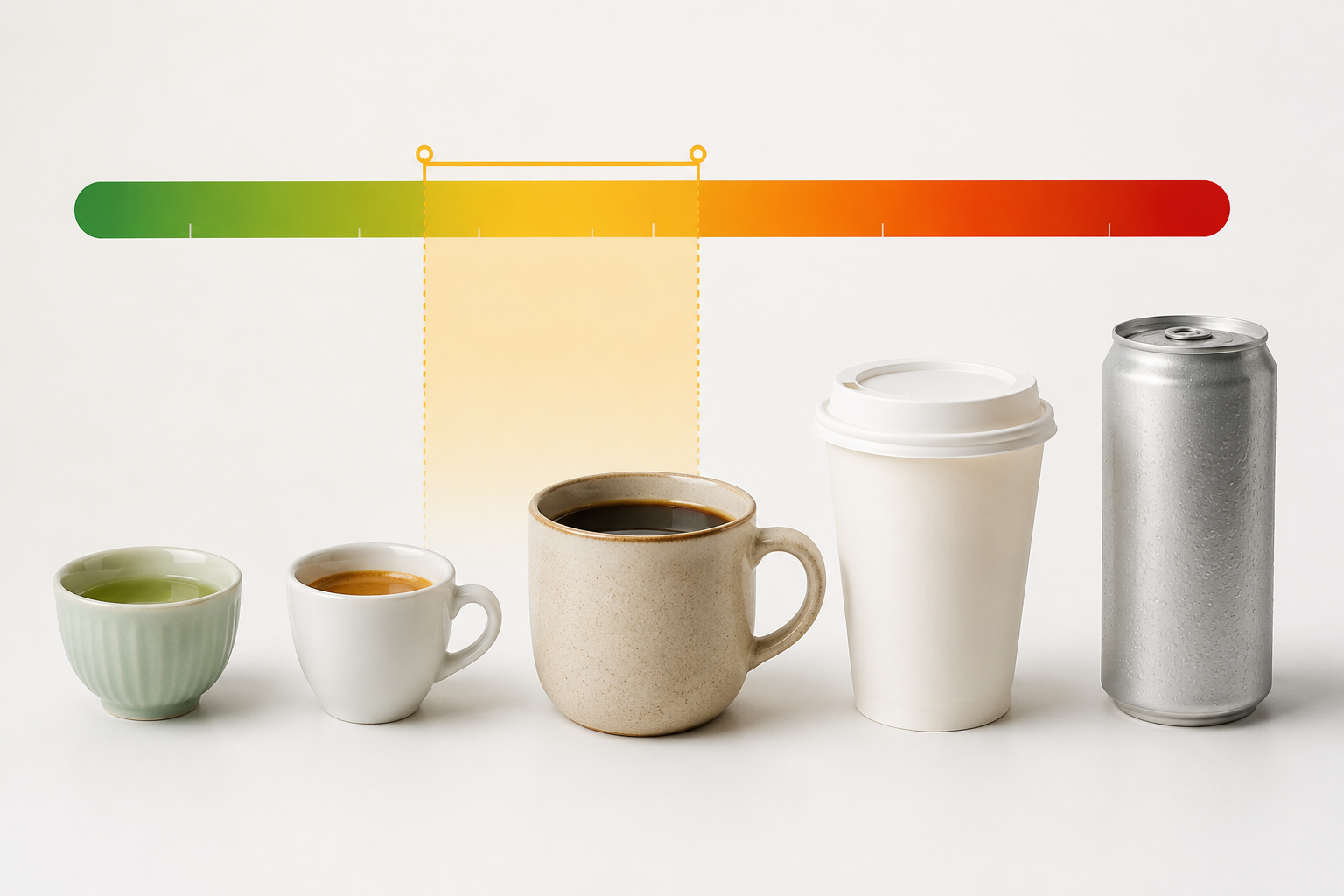
The table is the whole problem in miniature. A normal mug of brewed coffee can sit almost exactly where a student wants it. A large coffee-shop drip or 300mg energy drink can make the same student feel more committed while quietly moving them into a dose range where anxiety, restlessness, and scattered attention become more likely.
The Useful Range Is Narrower Than the Safety Limit
Caffeine does help studying. Across the cited evidence, 50-200mg is the broader range in which caffeine can improve sustained attention, reaction time, and working memory, with reported gains around 5-15% in controlled trials cited by Japanese Coffee Co. [3][4]
For most low-to-moderate tolerance students, though, the practical recommendation should be narrower: 75-150mg before a study session. Cream Energy frames a smaller 30-100mg per-session range, Coffee Hero gives 75-150mg for coffee-based studying, and Athenify discusses 100-200mg for broader cognitive performance. Those ranges are not a dramatic contradiction. They are measuring slightly different situations: a single study block, ordinary coffee use, and general cognitive performance. [1][2][3]
That is why the 400mg adult daily ceiling is a poor study target. Mayo Clinic notes that up to 400mg of caffeine a day appears safe for most healthy adults, but a safety ceiling is not the same thing as the dose that makes a paragraph easier to understand or a problem set easier to finish. [5]
Before Studying: Use Caffeine to Start the Work, Not Replace It
The best pre-study use is boring in a good way: take a modest dose, start the task, and let the caffeine make sustained effort feel less abrasive. A 250ml brewed coffee, a small coffee, or one espresso plus a lower-caffeine drink is usually closer to the goal than the largest cup available.
The mistake is treating caffeine as an emergency lever. At 75-150mg, many students get the parts they wanted: quicker reaction, easier vigilance, and a bit more working-memory stamina. Once the dose moves above about 200mg in a single sitting, the extra caffeine is less likely to add useful focus and more likely to add the symptoms students later describe as a personal failure: jitters, anxious urgency, stomach discomfort, and the strange experience of being alert but unable to settle.
This is especially important for reading-heavy work. A student can feel activated after a large drink and still reread the same page three times. The useful question is not whether the drink made the student feel awake. It is whether it helped them stay with one demanding task long enough for the work to improve.
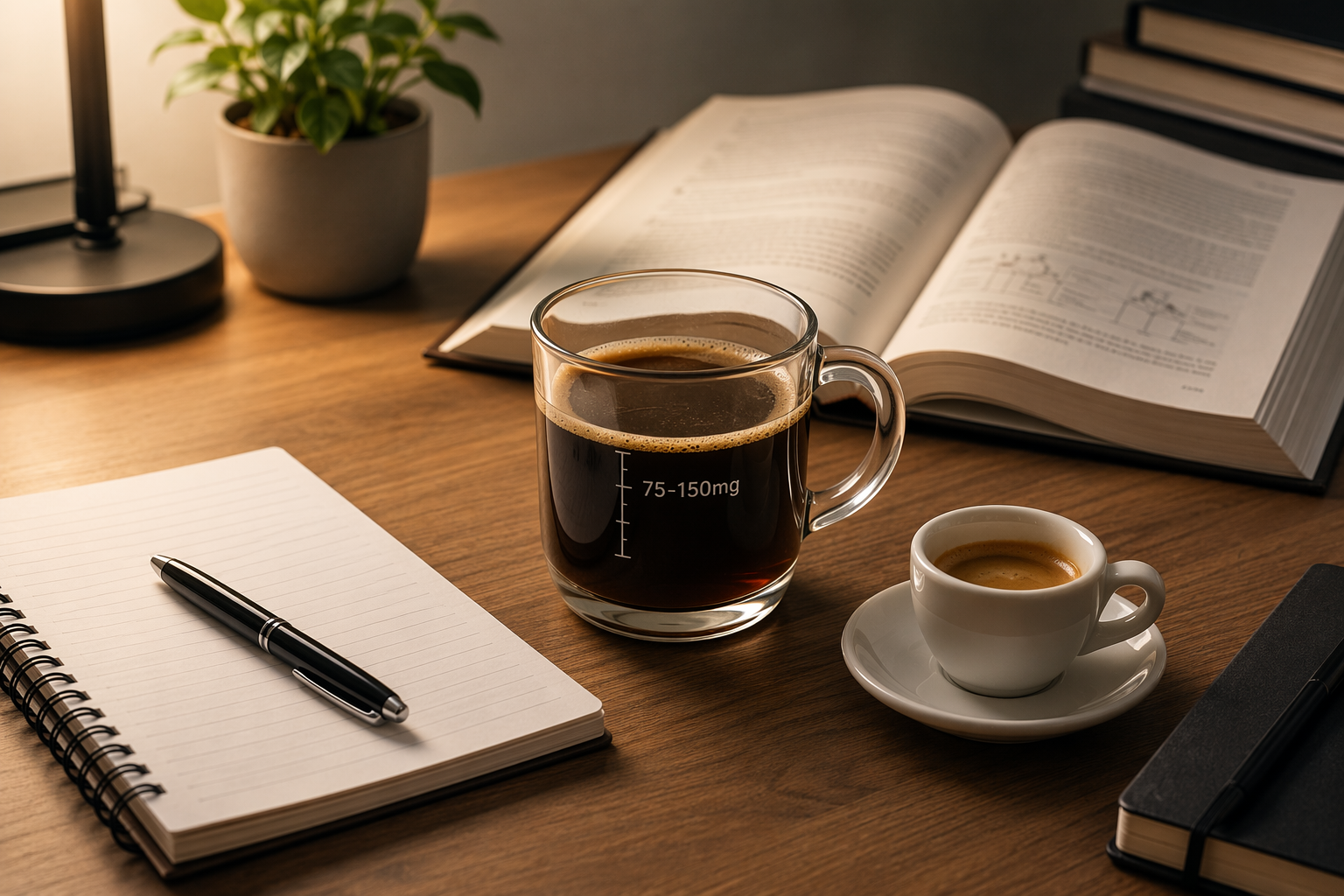
A Simple Pre-Study Translation
- If you are caffeine-sensitive: start around 30-75mg, such as green tea, a small caffeine pouch, or part of a coffee.
- If you have low-to-moderate tolerance: aim for 75-150mg, roughly a standard brewed coffee or a carefully sized coffee-shop order.
- If one drink is already 160-200mg: treat it as the full session dose, not the first round.
- If the drink is 260-310mg: recognize that it is above the focus target even if it is sold as an ordinary coffee.
- If 300mg feels necessary to begin studying: tolerance, sleep debt, or workload design may be the issue, not a shortage of caffeine.
After Learning: The 200mg Finding Is Different
There is one caffeine result that deserves to be kept separate from ordinary pre-study advice. In the Borota et al. 2014 study reported in Nature Neuroscience, participants who took 200mg of caffeine after learning showed improved memory consolidation and pattern separation 24 hours later. The study included more than 60 participants and tested caffeine after the learning phase, not as a drink used to feel alert while studying. [3]

That distinction changes the decision. Pre-study caffeine is about attention during the work. Post-study caffeine is about what happens to the memory after the work. A student who drinks coffee before a lecture, another coffee while rewriting notes, and an energy drink afterward is not applying the Borota finding; they are stacking doses across the day.
The post-learning result also used a 200mg caffeine tablet, not a flavored energy drink or a late-night coffee-shop order. Coffee may still contain the relevant compound, but the study does not prove that any 200mg caffeinated product, at any time of day, improves next-day recall. Timing and sleep matter too much to ignore. A 200mg dose after an afternoon learning block is a different choice from 200mg after a 9 p.m. cram session.
Used carefully, the post-study idea is most relevant after a meaningful learning session: finishing a practice exam review, closing a difficult chapter, or completing a spaced-repetition block where tomorrow's recall matters. It is not a reason to push every study session toward 200mg.
Personal Adjustment: Weight, Age, Tolerance, and Timing
A useful dose range still needs personal adjustment. Body-weight guidance cited by Athenify places adult cognitive effects around 3mg per kilogram; for a 70kg adult student, that estimate is 210mg, which sits near the upper edge rather than the center of the study-use range. [3]
High-school students need a stricter boundary. Adolescent guidance commonly caps caffeine around 100mg per day or about 2.5mg per kilogram for ages 12-18, and much of the adult cognitive-performance evidence does not directly transfer to younger students. [6]
Tolerance is the part students notice without naming it. Habitual caffeine use can make the same dose feel weaker, which encourages larger drinks and more frequent redosing. The practical warning is straightforward: the 75-150mg target fits low-to-moderate tolerance best, while students using 300mg or more every day may need a taper or a break of about two weeks to restore sensitivity.
Metabolism varies as well. CYP1A2 genotype can produce large differences in caffeine half-life, with estimates ranging from 1.5 hours to 9.5 hours. For studying, the consequence is simple: one student can drink coffee after lunch and sleep normally, while another can make the same choice and lose the night that was supposed to consolidate the work.
Use the Side Effects as Data
A student does not need a genetics test to make a better next choice. If 100mg produces calm alertness, stay there. If 150mg brings hand tremor, anxious urgency, or a racing heart, the dose is too high for that context. If caffeine taken after midafternoon damages sleep, the memory cost may cancel out the evening's apparent productivity.
The Grand Canyon University 2025 national survey reported that more than 95% of surveyed undergraduates consumed caffeine and that 75% had experienced negative effects. The survey covered more than 1,500 undergraduates across all 50 states, though it should be read with the caveat that it was conducted by a university beverage company. [7]
Even with that caveat, the pattern is familiar on any campus: caffeine is common, negative effects are common, and many students treat those effects as the cost of being serious. They are not always the cost. Sometimes they are just the receipt for buying too large a dose.
What to Order When the Goal Is Focus
For a normal study session, start with the drink size that lands near 75-150mg. That may be a standard mug of brewed coffee, a smaller coffee-shop order, espresso plus a low-caffeine drink, or tea for students who respond strongly. Avoid treating 200mg as the default just because it still fits within some cognitive-performance ranges.
The practical rule is plain: for studying, aim for 75-150mg; avoid going past 200mg when the goal is focus; consider the separate 200mg post-learning evidence only when the session, timing, and sleep window make sense; and if 300mg feels necessary, treat tolerance as the problem to solve.
References
- Best Coffee for Studying, Coffee Hero, 2026, link
- Caffeine and Studying: Complete Guide, Cream Energy, 2026, link
- Caffeine and Studying: What the Science Actually Says, Athenify, link
- Coffee Study: Effects of Caffeine on Attention and Focus, Japanese Coffee Co., link
- Caffeine: How much is too much?, Mayo Clinic, link
- PMC6296805, PMC, link
- How Caffeinated Are College Students in 2025?, Grand Canyon University, 2025, link
Back to the exam this applies to
Target exam not specified — see all exam hubs.
Comments
Join the discussion with an anonymous comment.