
Comparison
Nicaragua's 2021 Election Ban Explained for Students
This explainer unpacks how Ortega's government used a vague 2020 law to arrest all viable opposition candidates before Nicaragua's 2021 election, turning a fraudulent vote into a permanent one-party state by 2026. Students will understand the key tactics, the international response, and the broader pattern of democratic backsliding.
Verdict panel
- Compared
- not specified
- Target exam
- not specified
- Best for
- not specified
- Pricing last reviewed
- pricing currency unconfirmed
When people say Nicaragua had an “election ban,” they usually do not mean that the country canceled the 2021 vote. Nicaragua did hold a formal presidential election on November 7, 2021. The point is sharper: President Daniel Ortega’s government removed every viable opposition presidential contender before voters reached the ballot, using a 2020 law that barred people labeled “traitors” from running for office.[1]
That is why the 2021 election is useful for students studying democratic backsliding. The key event was not only what happened on election day. It was the sequence before election day: a vague law, arrests of would-be candidates, a ballot with the serious competition already gone, and then a government claim that the result gave it a mandate.
The law that made exclusion look procedural
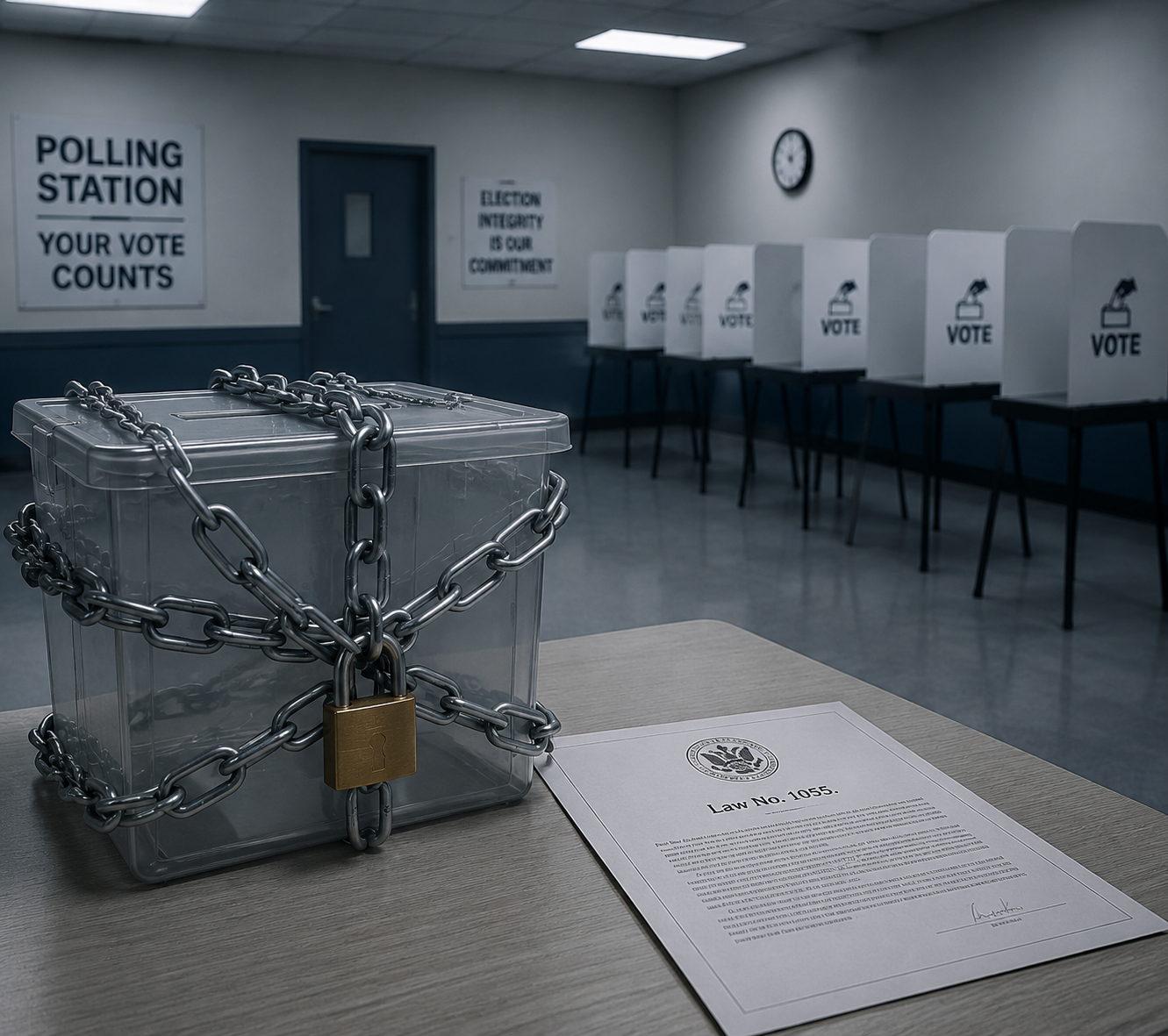
Law No. 1055, often called the Sovereignty Law, was passed in 2020. It allowed the authorities to block from public office anyone accused of undermining Nicaragua’s sovereignty or being a “traitor to the homeland.” Human Rights Watch warned in June 2021 that the law was being used against government critics and that its language gave officials wide room to punish opposition activity.[1]
For a student, the important detail is not the label alone. Every country has laws about treason, foreign interference, and national security. The danger comes when those terms are written or applied so broadly that ordinary political opposition can be treated as disloyalty. Once that happens, a government can say it is enforcing the law while it is actually deciding who may compete against it.
This is different from a simple cancellation of an election. A canceled election leaves an obvious blank space. Nicaragua’s 2021 process left forms, deadlines, courts, police files, party names, and a ballot. The paperwork mattered because it helped turn coercion into an official-looking sequence.

The election was decided before the ballot was printed
The clearest way to understand the 2021 election is to follow the calendar. Between late May and August 2021, opposition figures who could plausibly challenge Ortega were arrested, placed under investigation, or forced out before they could compete normally in the presidential race.[2][3]
| Date in 2021 | Opposition figure | What happened |
|---|---|---|
| May 27 | Cristiana Chamorro | Placed under investigation and later prevented from running; she had been viewed as a leading opposition possibility. |
| June 5 | Arturo Cruz Jr. | Arrested before candidate registration. |
| June 8 | Félix Maradiaga | Arrested after appearing before prosecutors. |
| July 22 | Juan Sebastián Chamorro | Arrested before candidate registration. |
| June–August | Other opposition hopefuls and political figures | Additional arrests and detentions narrowed the field before the vote. |
Cristiana Chamorro’s case showed how early the field was being reshaped. She was not defeated in a campaign. She was blocked before the formal contest could become meaningful. Soon after, Arturo Cruz Jr., Félix Maradiaga, Juan Sebastián Chamorro, and others were detained in a widening crackdown on opposition figures.[2][3]
In a functioning election, voters can remove a candidate by choosing someone else. In Nicaragua’s 2021 election, the state removed the candidates first. That distinction is the center of the case study. A ballot can still exist after competition has been taken away.
What “election by elimination” means
An unfair election can include biased media coverage, abuse of state resources, intimidation, or weak election administration. Those problems are serious, but they still leave an analytical question: did voters have a real chance to replace the government?
Nicaragua’s 2021 election crossed that line because the most important opposition options were removed before the public could vote. Seven opposition presidential candidates were arrested or pushed into exile before election day, leaving Ortega to run in a contest where the outcome had been structurally arranged in advance.[3]
A classroom way to test the difference is to ask what voters were still allowed to decide. If voters can punish the incumbent, organize around a credible challenger, hear competing campaigns, and see the loser leave office if defeated, then the election is doing democratic work. If the government decides beforehand which opponents count as legal, loyal, or eligible, the vote becomes more like confirmation than choice.
The official result and the competing reality of turnout
Ortega was declared the winner with roughly 75% of the formally counted vote in the November 2021 election.[3] That number is less informative than it may first appear, because the main opposition contenders had already been removed from the race.
Turnout became one of the clearest examples of competing political realities. The official turnout figure was 65.26%. The independent watchdog Urnas Abiertas estimated turnout at roughly 18.5%.[3] Those figures should be read with attribution: one is the government’s official account of participation, and the other is an independent monitoring estimate. The gap itself helps explain why legitimacy was so fiercely contested.
International institutions and governments largely rejected the election’s legitimacy. The Organization of American States approved a resolution saying the elections “were not free, fair or transparent and have no democratic legitimacy,” with 25 countries voting in favor and one against.[3] The European Union and the United States also rejected the vote as illegitimate, and the U.S. State Department described it as a sham election.[4]
Sanctions were a response, not the main story
After the election, the United States, European Union, and United Kingdom imposed targeted sanctions on Ortega, Vice President Rosario Murillo, and other senior officials. The United States also passed the RENACER Act, which expanded tools for sanctions and diplomatic pressure after the crackdown and election.[4][5]
Those responses matter, but they should not distract from the mechanism students need to identify. Sanctions came after the election had already been narrowed. The central lesson is not that outside governments disapproved. It is that the domestic contest had been hollowed out before the official vote took place.
How the 2021 mandate became a stronger authoritarian structure
The 2021 election did not end the process. It gave the government a result it could use while tightening control further. By 2023, Nicaragua had stripped more than 222 political prisoners and government critics of citizenship and expelled many of them to the United States.[6][7]
Citizenship stripping is not just a punishment of individuals. In civics terms, it attacks the legal relationship between a person and the state. A government that can exile critics and remove nationality is no longer only managing elections unfairly. It is deciding who belongs to the political community at all.
The institutional changes that followed made the system still less competitive. Constitutional reforms approved in 2024–2025 created a co-presidency for Ortega and Murillo, extended presidential terms to six years, and subordinated state institutions to the executive.[7][8] Nicaragua then withdrew from the Organization of American States in February 2025.[7]
This is the part of the case that turns a fraudulent election into a longer constitutional lesson. The ballot did not simply produce another term for an incumbent. It was followed by changes that made courts, institutions, citizenship, and future political competition more dependent on the ruling circle.
By 2026, even the promise of future elections was in doubt
On July 20, 2026, Ortega said Nicaragua would hold no more elections, according to Al Jazeera’s report published that day.[9] Because that announcement is very recent, its full legal and political implications are still developing. But it fits the direction of the preceding years: first the removal of competition, then the punishment of opponents, then institutional redesign, and finally an open rejection of future electoral choice.
For students, Nicaragua’s case shows why the phrase “election ban” can be misleading if it only makes us look for a canceled election day. In 2021, the ballot remained. What disappeared first was meaningful competition. After that came deeper losses: citizenship protections, institutional independence, and, by Ortega’s July 2026 statement, even the promise that future elections would continue.
References
- Critics Under Attack, Human Rights Watch, June 2021.
- Nicaragua: Five more opposition figures detained ahead of election, BBC.
- 2021 Nicaraguan general election, Wikipedia.
- Nicaragua’s Undemocratic Election, U.S. Department of State, 2021–2025 archive.
- Nicaragua is consolidating an authoritarian dynasty, Atlantic Council.
- Freedom in the World 2025: Nicaragua, Freedom House, 2025.
- BTI 2026 Nicaragua Country Report, Bertelsmann Stiftung, 2026.
- Explainer: Nicaragua’s descent into dictatorship, Chatham House, 2023.
- Ortega insists no more elections for Nicaragua, Al Jazeera, July 20, 2026.
Back to the exam this applies to
Target exam not specified — see all exam hubs.
Comments
Join the discussion with an anonymous comment.