
Comparison
Everything You Need to Know About NASA's Psyche Mission
This article explains NASA's Psyche mission, its goals, the asteroid 16 Psyche, and why it matters for understanding planet formation — perfect for students needing a clear overview for assignments or general science curiosity.
Verdict panel
- Compared
- not specified
- Target exam
- not specified
- Best for
- not specified
- Pricing last reviewed
- pricing currency unconfirmed
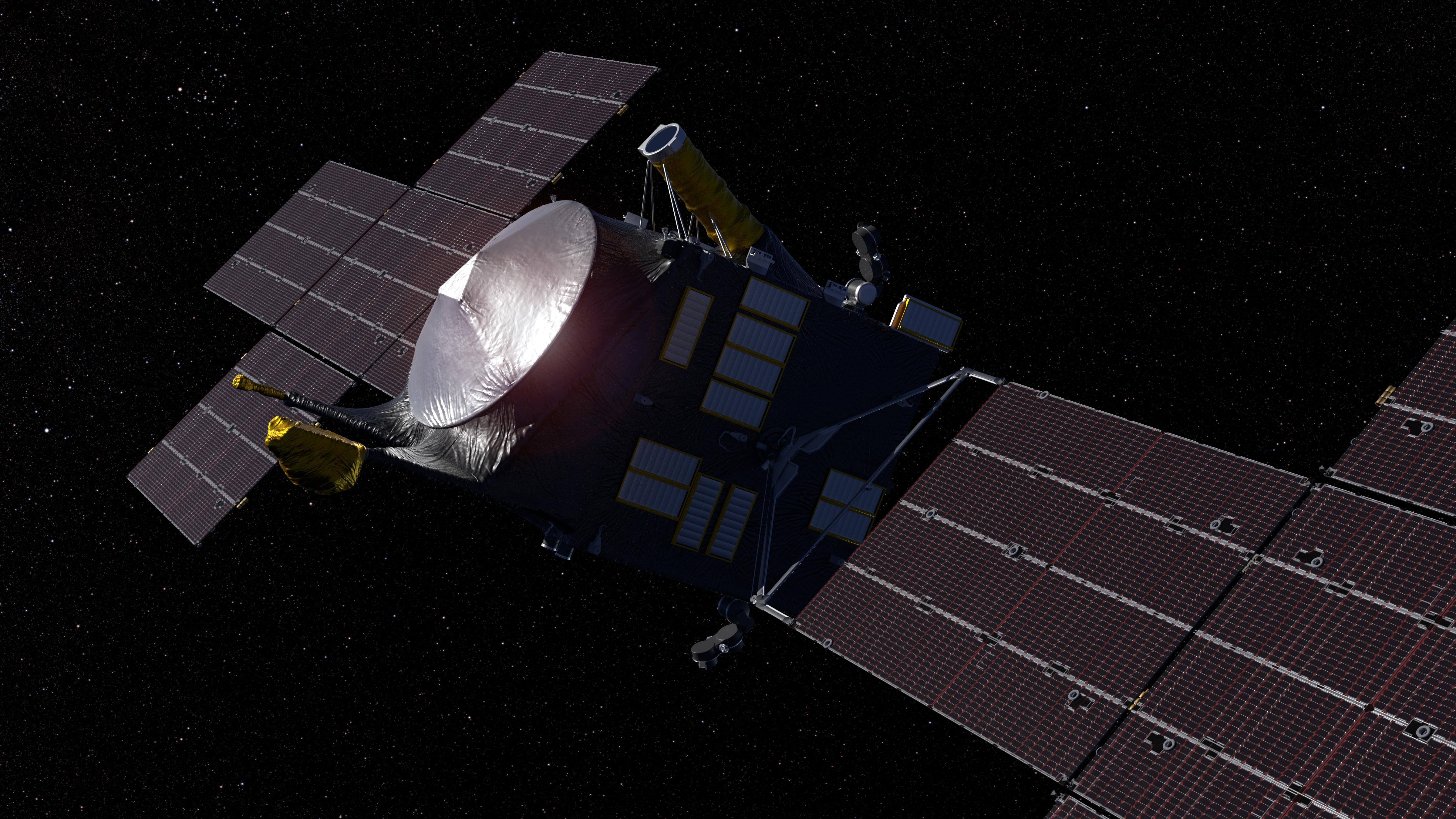
NASA’s Psyche mission is a spacecraft mission to 16 Psyche, a metal-rich asteroid in the main asteroid belt. It launched on Oct. 13, 2023, and is scheduled to arrive in August 2029, where it will orbit the asteroid rather than land on it.[1] The short version for an assignment is this: Psyche is going to test whether 16 Psyche is the exposed iron-nickel core of an ancient protoplanet, or whether the asteroid formed through a more complicated history of impacts, mixing, and cooling.
That wording matters. 16 Psyche is often described as a “metal asteroid,” but it is not known to be a solid iron ball. Current estimates describe it as a rock-metal mixture, with nickel-iron metal making up about 30–60% of its volume; its mean diameter is about 222 kilometers.[2] Those numbers are enough to make it unusual, but not enough to prove that it is a bare planetary core.
What Is 16 Psyche?
16 Psyche is an M-type asteroid located in the main asteroid belt between Mars and Jupiter.[2] The “M” class is associated with metallic composition, but asteroid classes are not the same thing as lab samples. From Earth, scientists infer composition using observations such as radar and thermal data; the spacecraft’s job is to replace those distant clues with close orbital measurements.
Its density is another useful guardrail against exaggeration. 16 Psyche’s estimated bulk density is about 3.98 grams per cubic centimeter, which is higher than many asteroids but lower than pure iron.[3] That fits the rock-metal-mixture idea better than the treasure-chest version that sometimes shows up in headlines.
The reason scientists care is not that metal is shiny or economically tempting. The reason is that metal-rich material may preserve information about differentiation, the process by which early planetary bodies separated into layers: dense metal sinking inward, lighter rocky material forming mantle and crust. Earth has an iron-rich core, but students cannot sample it directly. A metal-rich asteroid offers a possible indirect route into the same story.
Why Scientists Think It Could Matter for Planet Formation
In the early solar system, small bodies collided, melted, broke apart, and sometimes grew into larger worlds. Some became differentiated, meaning they developed internal layers. If 16 Psyche is the exposed core of one of those early bodies, it would be a rare chance to study material from a planetary interior without drilling thousands of kilometers into Earth.
NASA states the mission goals in that direction: to understand iron cores as building blocks of planet formation, to examine an exposed interior as a way of looking inside terrestrial planets, and to explore a type of world made largely of metal.[4] Those goals are broad, but they all point back to one classroom-friendly question: what happened to this small world before it became the asteroid we see today?
The answer is not settled. That is the point of sending the spacecraft. If a source says NASA is visiting “the core of a dead planet” as if that has already been proven, clean it up in your notes. A safer phrasing is: NASA is investigating whether 16 Psyche may be the exposed core of an ancient protoplanet.
The Three Main Origin Ideas
The most important part of the Psyche mission is not the launch vehicle, the travel time, or the spacecraft artwork. It is the origin problem. Scientists are trying to decide which history best explains an asteroid that appears unusually rich in metal while still not looking like a simple solid iron object.
Idea 1: An exposed protoplanet core
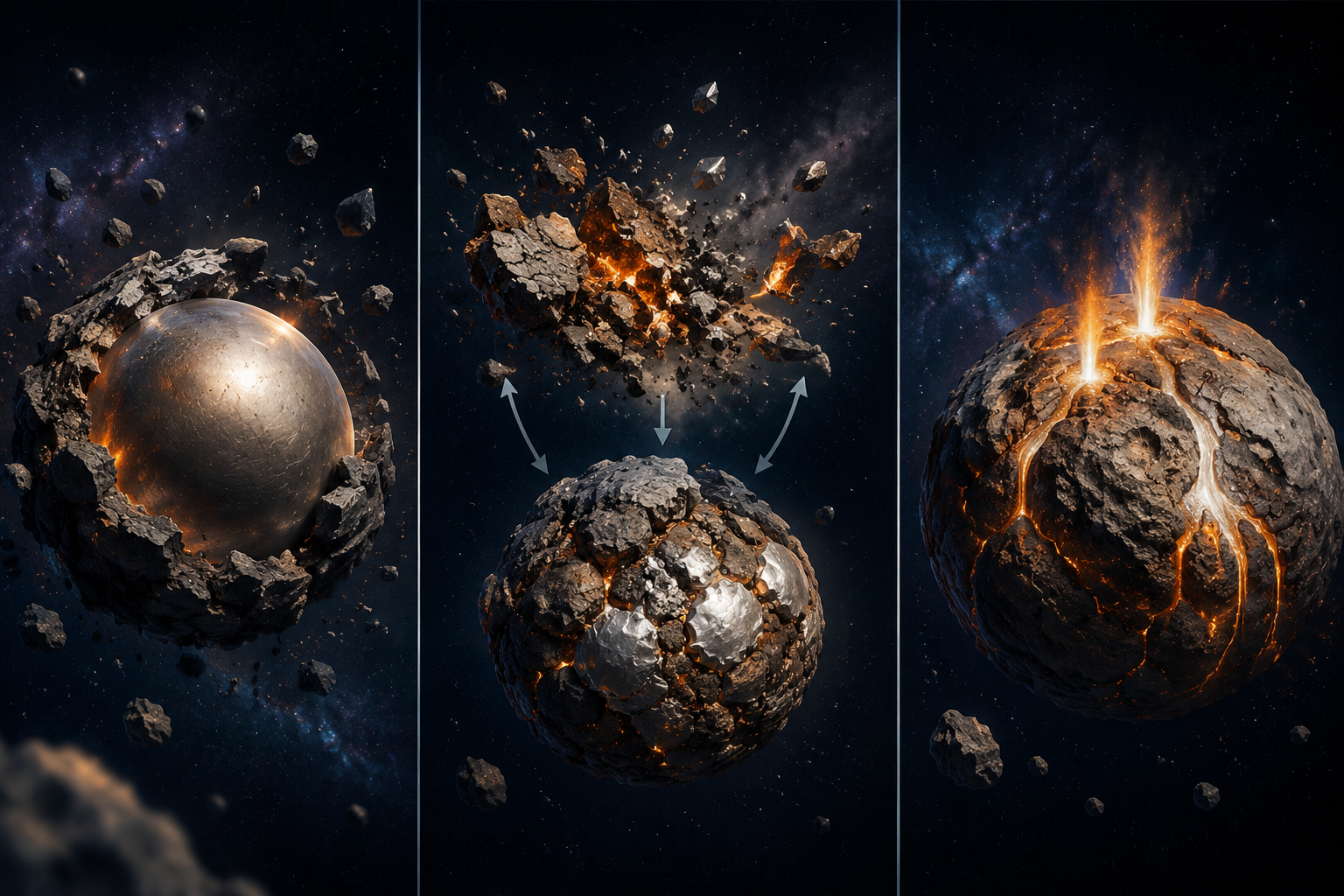
The classic explanation is that 16 Psyche began as part of a larger protoplanet. In this scenario, the body differentiated: metal sank into the center and rock formed outer layers. Later, large collisions stripped away much of the rocky mantle and crust, leaving the metallic core exposed.[3][5]
This is the version that makes the mission sound most dramatic, and it may be correct. But it is still a hypothesis. The spacecraft has to look for evidence that would fit a core-like body, such as high metal abundance, signs of a once-molten interior, and possible remnant magnetism from an ancient dynamo.
Idea 2: A disrupted body that re-accreted
A second possibility is less tidy: 16 Psyche may be a body that was broken apart and then reassembled from rock and metal fragments.[3] That would help explain why it appears to contain a large amount of metal without requiring it to be a clean, exposed core.
For students, this is the difference between a simple origin story and a messy solar-system history. A re-accreted asteroid could still teach scientists about differentiation and collisions, but it would not be the same as looking at one intact core.
Idea 3: Ferrovolcanism
A third idea is ferrovolcanism, sometimes described as iron volcanism. In this model, molten metal could have erupted through cracks as the body cooled, leaving metal-rich surface features even if the whole asteroid is not an exposed core.[3][5]
This hypothesis is a good reminder that surface composition can mislead if it is treated as the entire object. The mission needs to connect surface maps, elemental measurements, magnetic clues, and gravity data before scientists can judge which history is most likely.
How the Spacecraft Will Test the Asteroid’s Story
The Psyche spacecraft carries four main science investigations. The helpful way to remember them is not as a gadget list, but as four kinds of evidence: surface appearance, elemental composition, magnetic history, and internal structure.
| Instrument or investigation | What it measures | Why it matters |
|---|---|---|
| Multispectral imager | Surface geology and composition | Maps features and helps distinguish rock-rich and metal-rich areas |
| Gamma-ray and neutron spectrometer | Elemental composition | Measures elements, including evidence related to iron abundance |
| Magnetometer | Magnetic field or remnant magnetism | Looks for clues that the body once had a magnetic dynamo |
| X-band gravity science | Gravity field from radio tracking | Helps infer interior structure and mass distribution |
The multispectral imager is the mission’s mapping tool. It will photograph the surface in multiple wavelengths so scientists can compare regions, identify geologic features, and look for patterns in surface materials.[6] If 16 Psyche is a stripped core, scientists might expect a surface story different from a rubble-like body that reassembled after impacts.
The gamma-ray and neutron spectrometer matters because composition has to be measured, not guessed. It is designed to determine which elements are present at the surface, including information relevant to iron abundance.[6] That will help test whether Psyche’s metal richness is widespread, patchy, or tied to particular terrains.
The magnetometer is aimed at one of the most interesting possible clues: remnant magnetism.[6] A differentiated body with a molten metallic core might once have generated a dynamo, somewhat like the process that helps produce planetary magnetic fields. Finding ancient magnetization would not answer every question by itself, but it would be strong evidence that Psyche’s interior history was more planet-like than ordinary asteroid-like.
X-band gravity science uses radio tracking to map small changes in the spacecraft’s motion as it orbits.[6] Those changes reveal the asteroid’s gravity field, which helps scientists infer how mass is distributed inside. A body with a dense metallic interior, a mixed rubble structure, or uneven re-accreted material should not leave exactly the same gravitational fingerprint.
None of these instruments alone gets to announce, “case closed.” The mission becomes powerful because the measurements overlap. A metal-rich surface, remnant magnetism, and gravity data pointing to a dense internal structure would support one kind of interpretation; mixed composition and irregular structure could push scientists toward another.
The Trip to Psyche, Without Turning It Into a Mission Log
Psyche launched from Kennedy Space Center Launch Complex 39A on a SpaceX Falcon Heavy on Oct. 13, 2023.[1] After launch, the spacecraft began a long cruise using solar electric propulsion: Hall-effect thrusters accelerate xenon ions to produce a gentle but efficient push over time.[7]
The cruise has not been completely uneventful. In April 2025, the mission encountered a xenon pressure anomaly. Engineers resolved it by switching to a backup fuel line, and full operations resumed on June 16, 2025.[7] For a student overview, the key point is not the plumbing detail; it is that the propulsion issue was addressed before the spacecraft’s major 2026 navigation milestone.
That milestone was the Mars gravity assist on May 15, 2026. The spacecraft flew by Mars at about 4,500 kilometers altitude and roughly 12,333 miles per hour, using the planet’s gravity to reshape its path toward the asteroid belt.[7] As of Q3 2026, that keeps the mission’s main story pointed toward its planned August 2029 arrival.
Once at 16 Psyche, the spacecraft is planned to conduct science operations through November 2031. The orbital campaign is organized into four orbit regimes, descending from about 700 kilometers to about 75 kilometers above the asteroid.[7] That gradual approach is not just scenic. Different altitudes help different measurements: broad mapping first, then increasingly detailed gravity, composition, and surface observations.
A Side Note: The Cat Video Was Real, But It Is Not the Mission
Psyche also carries the Deep Space Optical Communications experiment, usually shortened to DSOC. It is a technology demonstration, not one of the asteroid science instruments. Its job is to test optical communication beyond the Moon, which could matter for future missions that need to send large amounts of data across deep space.[8]
The memorable detail is that in December 2023, DSOC transmitted an ultra-HD cat video from about 31 million kilometers away at 267 megabits per second.[8] That is a great fact for remembering the mission, and a terrible substitute for explaining it. If your assignment asks what Psyche is trying to learn, the answer is about asteroid origin and planetary cores, not space internet trivia.
What Students Should Be Careful Saying
A good Psyche explanation usually depends on careful verbs. Scientists “estimate” the asteroid’s composition before arrival. NASA “will test” origin hypotheses. The spacecraft “is scheduled” to arrive in 2029. Those words are not hedging for no reason; they separate what has been measured from Earth from what the spacecraft is being sent to find out.
- Too strong: “Psyche is the exposed core of a dead planet.” Better: “Psyche may be the exposed core of an ancient protoplanet, and the mission is designed to test that idea.”
- Too simple: “Psyche is made of metal.” Better: “16 Psyche appears to be a rock-metal mixture with an unusually high metal content.”
- Too vague: “NASA wants to study an asteroid.” Better: “NASA wants to learn whether 16 Psyche can reveal how early planetary bodies separated into crust, mantle, and core.”
- Too final: “The mission will prove how planets formed.” Better: “The mission will collect evidence that helps scientists compare competing models of early planetary formation.”
If you need one clean paragraph for notes, use this version: NASA’s Psyche mission is an orbiter launched in 2023 to study 16 Psyche, a metal-rich asteroid in the main asteroid belt. The spacecraft is scheduled to arrive in 2029 and will investigate whether the asteroid is the exposed core of an ancient protoplanet or a more complex rock-metal body shaped by impacts and cooling. Its instruments will map the surface, measure elemental composition, search for remnant magnetism, and use gravity science to study internal structure. The mission matters because Earth’s core is unreachable, so 16 Psyche may provide indirect evidence about how rocky planets formed and differentiated.
What the Mission Can and Cannot Tell Us Yet
Before arrival, Psyche is a mission built around a well-defined uncertainty. Scientists have enough evidence to think 16 Psyche is unusually metal-rich and worth visiting. They do not yet have the close-up data needed to decide whether it is a stripped core, a re-accreted mixture, a body with signs of ferrovolcanism, or something that combines parts of these stories.
That uncertainty is not a flaw in the mission. It is the reason the mission exists. As of Q3 2026, NASA’s Psyche mission is not just going to a strange asteroid; it is on its way to test whether one small world can help explain how rocky planets separate into crust, mantle, and core.
References
- Psyche Mission Overview, NASA Science
- 16 Psyche, NASA Science
- 16 Psyche, Wikipedia
- Psyche Science, NASA Science
- Psyche, The Planetary Society
- Psyche Mission FAQ, University of California, Berkeley Space Sciences Laboratory
- Psyche (spacecraft), Wikipedia
- Psyche (spacecraft), Wikipedia
Back to the exam this applies to
Target exam not specified — see all exam hubs.
Comments
Join the discussion with an anonymous comment.