
Comparison
Mount Olympus History and UNESCO Study Guide
A consolidated student resource covering Mount Olympus's 3,000-year arc from Greek mythology through Byzantine Christianity to its 2026 UNESCO World Heritage nomination, with key facts and sources for exam prep and research papers.
Verdict panel
- Compared
- not specified
- Target exam
- not specified
- Best for
- not specified
- Pricing last reviewed
- pricing currency unconfirmed
Mount Olympus is back in the news in July 2026 for a reason that is easy to misunderstand. Greece is seeking World Heritage inscription for the broader region of Mount Olympus, and the World Heritage Committee is considering the nomination during its July 19–29 meeting in Busan, South Korea. AP reported that the committee may refer the file back to Greece for further details rather than approve it outright, so the careful wording for students is: Olympus is under active World Heritage consideration, not already newly inscribed as of July 20, 2026.[1]
That current UNESCO moment is useful because it asks a sharper question than “Which gods lived on Olympus?” The nomination treats the mountain as a mixed cultural and natural site, proposed under criteria vi, viii, ix, and x: mythology and literature, geology, ecological processes, and biodiversity.[2] In study terms, those criteria force the evidence into one argument instead of four disconnected folders.
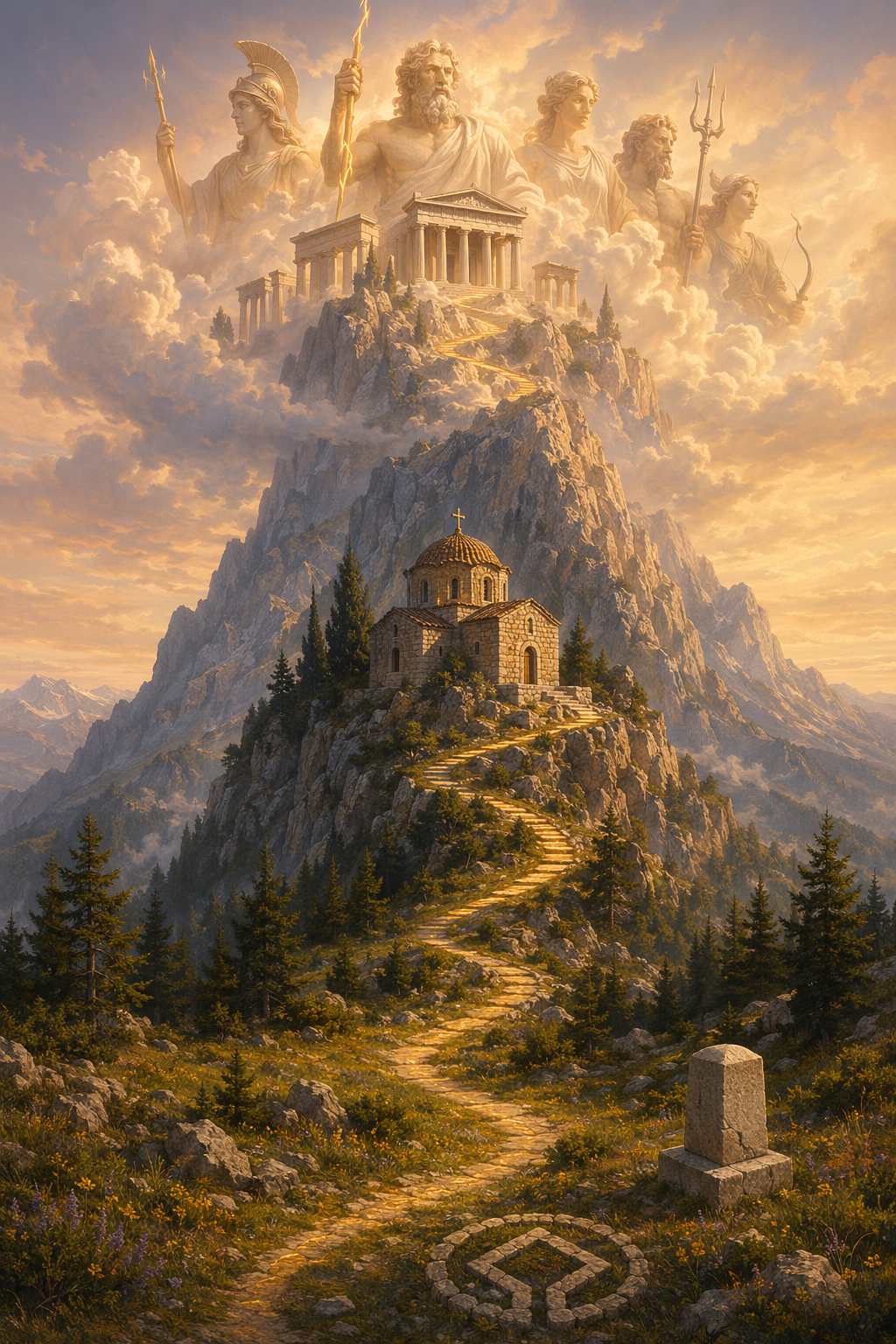
Quick Orientation Before the History
| Study point | What to remember |
|---|---|
| Location | Northern Greece, on the border of Thessaly and Macedonia, near the Aegean coast |
| Highest summit | Mytikas, commonly rounded near 2,918 m; a 2023 study refined the height to 2,917.727 m |
| Mountain form | 52 peaks, steep ravines, forested lower slopes, and alpine upper zones |
| First recorded ascent of Mytikas | 2 August 1913 by Daniel Baud-Bovy, Frédéric Boissonnas, and Christos Kakkalos |
| Modern protection | Greece’s first National Park in 1938; UNESCO Biosphere Reserve in 1981; World Heritage Tentative List submission in 2014 |
The elevation is a good example of why source hierarchy matters. The most precise modern figure is 2,917.727 m from a 2023 Journal of Mountain Science study; UNESCO and AP commonly round the height to 2,918 m, while Britannica gives 2,917 m.[3][2][1] Those are not rival mountains. They are different levels of rounding and measurement precision.

The Ancient Sacred Mountain Was Not Just a Mythic Address
For ancient Greek literature, Olympus was the divine seat of the Olympian gods. Homer’s Iliad and Odyssey place the gods in relation to Olympus, and Hesiod’s Theogony helps organize the divine genealogy and conflict traditions, including the Titanomachy.[4][5] For exam notes, the safest formulation is not that Homer “invented” Olympus, but that early Greek epic and didactic poetry helped make Olympus the literary center of divine authority.
The familiar list of the 12 Olympians matters, but it should not swallow the whole topic. Zeus, Hera, Athena, Apollo, Artemis, Poseidon, Demeter, Aphrodite, Ares, Hephaestus, Hermes, and Hestia or Dionysus are important because they make Olympus a symbolic capital: a place where divine family, political order, conflict, and patronage can be imagined together.[4][5] That literary Olympus then attaches itself to a real mountain with cult sites, cities, routes, and political neighbors.
The Pierian side of the mountain adds another layer. The Muses were associated with Pieria, and ancient traditions connected nearby Leivithra with Orpheus and Orphic memory.[4] These details are easy to reduce to decorative mythology, but they help explain why the wider Olympus region, not only the summit, appears in cultural heritage arguments.
Dion, Agios Antonios, and the Archaeological Anchor
Dion, at the foot of Olympus, is the place students should put beside the poems. It was a sacred city associated with Zeus and later with Macedonian royal display, making the mountain’s religious meaning visible in settlement, ritual, and politics rather than only in epic scenes.[4] If Olympus is only treated as “home of the gods,” Dion disappears; if Dion is included, the mountain becomes part of a lived sacred landscape.
The same is true higher up. Finds from the Agios Antonios peak have been associated with a Hellenistic sanctuary of Zeus.[4] A mountain summit with traces of worship gives a different kind of evidence from a poem: not more poetic, but more place-bound. Together, the literary and archaeological evidence helps explain why UNESCO criterion vi, which concerns direct or tangible association with traditions, beliefs, artistic works, or literary works, is central to the nomination.[2]
Olympus also sits near major political history. The rise of Macedon and the battles connected with Pydna belong to the region’s wider historical frame.[4] They do not replace the sacred story, but they keep it from floating above geography. Sacred landscapes survive in history because people fight, build, dedicate, govern, and remember around them.
Christian Olympus: Continuity Without Pretending Nothing Changed
The Christian layer of Olympus is not a simple continuation of ancient Greek religion. It is a reuse and reorientation of sacred height. The Prophet Elias chapel stands at 2,803 m and is described as the highest Orthodox chapel in the world; it was built in the 16th century on one of the mountain’s high peaks.[4] The point is not that Zeus quietly became Elijah. The point is that the mountain continued to attract religious meaning at altitude.

The Monastery of Hosios Dionysios, founded in 1542 at about 820 m, and the Holy Cave of St. Dionysios add a monastic geography to the mountain.[4] For a research paper, this is where the phrase “unbroken arc of sacred significance” becomes useful but needs discipline. The beliefs changed. The institutions changed. The mountain’s role as a place where religious communities locate holiness did not simply vanish.
How the UNESCO Criteria Organize the Whole Case
UNESCO criteria can look like committee language until they are used as sorting tools. The Olympus nomination is especially helpful for students because each proposed criterion gathers a different kind of evidence, and none of them alone explains the mountain’s importance.[2]
| Criterion | Student translation | Olympus evidence |
|---|---|---|
| vi | Association with beliefs, literature, and cultural memory | Homer, Hesiod, the Olympian gods, the Muses of Pieria, Dion, Agios Antonios, and later Christian sacred sites |
| viii | Earth history and geological features | The nominated area includes geological evidence such as the tectonic window highlighted in the UNESCO file |
| ix | Ecological processes still visible in the landscape | Forest and vegetation zones, including beech forest described in relation to ice-age refugium evidence |
| x | Biodiversity and habitats important for conservation | High plant diversity, local endemics, birds, mammals, and mountain habitats |
Criterion vi: Literature, Worship, and Memory
Criterion vi is the easiest to remember and the easiest to oversimplify. It is not just “Olympus is famous in mythology.” The stronger case is that Olympus is tied to a long chain of cultural expression: archaic epic, divine genealogy, local cult practice, sacred cities, summit worship, later Christian chapels, monastic foundations, and modern cultural identity.[2][4][5]
This is also where the nomination’s cultural logic depends on continuity rather than sameness. A student should not write as if ancient Greek polytheism and Byzantine Christianity were one religion. A better sentence would say that Olympus retained sacred status across religious transformations, first as the mythic and cultic mountain of the Greek gods and later as a Christian sacred landscape marked by chapels, monastery life, and pilgrimage sites.
Criterion viii: The Mountain Is Also Evidence of Earth History
Criterion viii shifts the frame from belief to geology. The UNESCO Tentative List file identifies geological value in the broader Olympus region, including a tectonic window.[2] That detail matters because World Heritage assessment is not a mythology prize. A mixed nomination must persuade evaluators that the natural fabric of the place has outstanding value as well.
The refined height measurement belongs here too, though it should not be overused. The 2023 study’s 2,917.727 m figure tells students that even a mountain known for ancient myth remains an object of modern scientific measurement.[3] The better lesson is not the decimal itself; it is the coexistence of epic fame and technical surveying in the same place.
Criterion ix: Forests as Processes, Not Scenery
Olympus rises through distinct vegetation and climate zones, from Mediterranean lower slopes through beech-fir and boreal coniferous zones to alpine tundra.[4] In UNESCO language, that is not background scenery. It helps support criterion ix, which concerns ecological and biological processes, including the beech forest evidence discussed in the nomination as an ice-age refugium.[2]
For study notes, “refugium” is worth defining plainly: it is an area where species or ecological communities persisted when surrounding conditions changed. In an Olympus essay, that concept lets the vegetation history do more than decorate the mountain. It shows why conservation law and deep time belong in the same file as literature and archaeology.
Criterion x: Biodiversity Gives the Nomination Its Conservation Weight
Criterion x concerns biodiversity and conservation value. The UNESCO Tentative List file reports about 1,700 plant taxa in the broader Olympus region, around 25% of Greek flora, along with 56 Greek endemic species; the same body of data records 108 bird species and 32 mammal species.[2] Wikipedia, drawing on Olympus National Park Management Agency data, also reports 23 local endemic species found nowhere else on Earth and notes the Balkan chamois among the mountain’s mammals.[4]
These figures should be used carefully. They support the claim that Olympus has exceptional biodiversity value. They do not, by themselves, prove that every visitor route, settlement decision, or conservation measure is successful. Adoption of a protected status and effectiveness of protection are related questions, not the same question.
Protection Status: Three Labels Students Should Not Confuse
Olympus already has major protection history before the 2026 World Heritage process. Greece declared it the country’s first National Park in 1938, with a core area originally listed as 4,000 ha and later expanded within a broader 24,000 ha protected area in the UNESCO Tentative List description.[2] UNESCO’s Man and the Biosphere program recognizes Mount Olympus as a Biosphere Reserve designated in 1981.[6]
| Label | What it means | Olympus status |
|---|---|---|
| National Park | A domestic legal protection category | Declared Greece’s first National Park in 1938 |
| UNESCO Biosphere Reserve | A Man and the Biosphere designation focused on conservation, research, and sustainable relationships between people and nature | Designated in 1981 |
| World Heritage Tentative List | A national list of sites a country may nominate for World Heritage consideration | Submitted on January 16, 2014 |
| World Heritage inscription | Formal inscription by the World Heritage Committee | Under consideration in July 2026; not to be described as completed without a final decision |
The Tentative List date is another common trap. Greece submitted “The broader region of Mount Olympus” to the UNESCO Tentative List on January 16, 2014.[2] A Tentative List entry is a necessary stage in the World Heritage process, but it is not World Heritage inscription. Likewise, Biosphere Reserve status is a UNESCO designation, but it is not the same program as the World Heritage List.
A Clean Study Timeline
| Period or date | Event | Why it matters |
|---|---|---|
| Archaic Greek tradition | Homeric and Hesiodic works establish Olympus as a divine literary center | Core evidence for mythological and literary significance |
| Ancient and Hellenistic periods | Dion, Leivithra traditions, Macedonian associations, and Agios Antonios worship connect the sacred mountain to real places | Turns mythology into a historical sacred landscape |
| 168 BC and regional Roman-era transition | Pydna belongs to the wider Macedonian historical setting | Shows Olympus within political history, not outside it |
| 16th century | Prophet Elias chapel and the Monastery of Hosios Dionysios mark Christian sacred use | Shows religious reuse and continuity of sacred geography |
| 2 August 1913 | First recorded ascent of Mytikas by Baud-Bovy, Boissonnas, and Kakkalos | Adds modern exploration history |
| 1938 | Olympus becomes Greece’s first National Park | Begins the modern legal conservation layer |
| 1981 | UNESCO Biosphere Reserve designation | Adds international conservation recognition outside the World Heritage system |
| January 16, 2014 | Tentative List submission | Begins the formal World Heritage nomination pathway |
| July 19–29, 2026 | World Heritage Committee meeting in Busan considers the nomination | Current status is pending unless later verified |
The timeline is useful only if it stays connected to the argument. The ancient sources explain why Olympus became a sacred and literary mountain. The archaeological and regional history show that the sacred meaning touched actual settlements and peaks. The Christian sites show reuse of sacred height after religious change. The conservation and UNESCO stages translate older cultural and natural significance into modern legal and institutional language.
How to Write About Olympus Without Losing the Thread
A strong student paragraph on Mount Olympus usually does three things: names the layer, anchors it in evidence, and explains how it changes the meaning of the mountain. For example, the mythological layer should cite Homer, Hesiod, and the Olympian gods; the archaeological layer should move to Dion, Leivithra, or Agios Antonios; the Christian layer should cite Prophet Elias, Hosios Dionysios, and the Holy Cave; the modern heritage layer should distinguish National Park, Biosphere Reserve, Tentative List, and World Heritage nomination.
- Use “World Heritage nomination” for the 2026 process unless a final inscription decision is verified after the Busan meeting.
- Use 2,917.727 m when precision matters, but explain that many sources round the height to about 2,918 m.
- Do not treat Biosphere Reserve status as the same thing as World Heritage inscription.
- Do not make the Christian sites a footnote if the essay’s argument is continuity of sacred landscape.
- Do not use biodiversity numbers as proof of management success; they measure natural value, not policy effectiveness.
If you need a one-sentence thesis for notes, this is a safe version: Mount Olympus matters because its ancient Greek mythological status, archaeological cult evidence, Christian sacred sites, ecological and geological value, and modern conservation designations all occupy the same mountain landscape. That sentence is less flashy than “home of the gods,” but it is much harder to knock apart in an exam.
Where the 2026 Nomination Leaves the Question
The disciplined current-status judgment is simple: Mount Olympus is already globally important, but its 2026 World Heritage outcome should not be described as settled while the Busan meeting is still in progress and AP has reported the possibility of referral for more information.[1] A referral would not erase the mountain’s significance; it would mean the committee wants a stronger or clearer nomination file before inscription.
Olympus is not important simply because ancient poets placed gods there. It matters because sacred imagination, cult practice, Macedonian and regional history, Christian worship, mountain ecology, geological evidence, biodiversity, national conservation law, and UNESCO procedure all meet on the same slopes. Few study topics let one mountain carry that much historical layering without becoming an abstraction.
References
- Greece's Mount Olympus aims for UNESCO World Heritage List, AP News, July 2026.
- The broader region of Mount Olympus, UNESCO World Heritage Centre.
- Revisiting the determination of Mount Olympus Height, Journal of Mountain Science, 2023.
- Mount Olympus, Wikipedia.
- Mount Olympus, Britannica.
- Mount Olympus, UNESCO Man and Biosphere Programme.
Back to the exam this applies to
Target exam not specified — see all exam hubs.
Comments
Join the discussion with an anonymous comment.