
Comparison
How to Memorize Every World Cup Winner by Year
Learn a simple framework to memorize all 23 World Cup tournaments and 8 champion nations using pattern recognition, narrative hooks, and the BIG FUSE mnemonic.
Verdict panel
- Compared
- not specified
- Target exam
- not specified
- Best for
- not specified
- Pricing last reviewed
- pricing currency unconfirmed
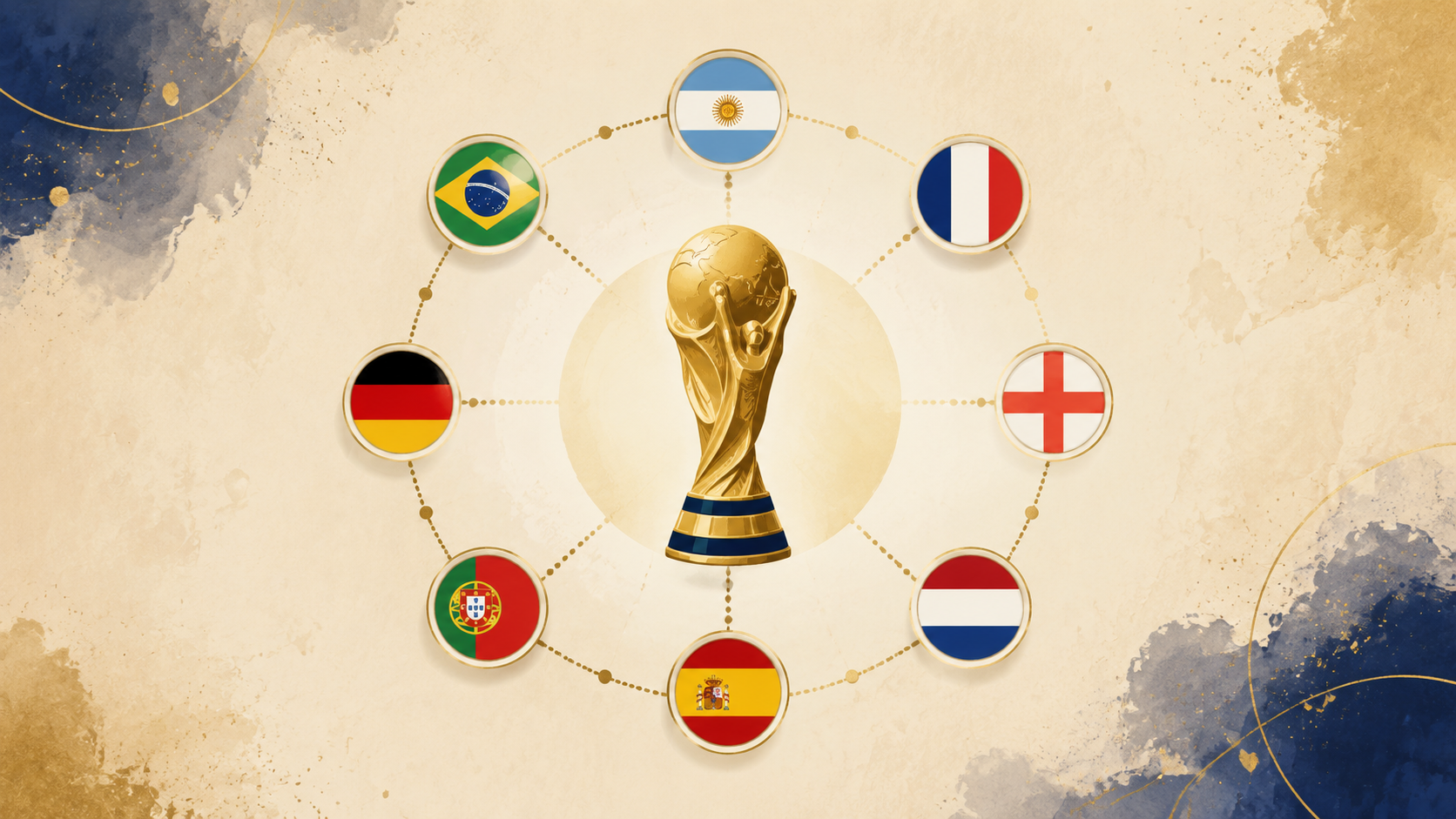
“World Cup winners list by year” sounds like a long, stubborn thing to memorize. It is smaller than it looks. From 1930 through 2026, there have been 23 tournaments and only 8 champion nations: Brazil, Italy, Germany, France, Uruguay, Spain, England, and Argentina.[1][2]
That is the first useful move: do not start by staring at 23 separate rows. Start by shrinking the list into a memory map. Eight countries do all the work. A few countries repeat. A few years are strange enough to become hooks. Once those pieces are in place, the year-by-year list becomes something you can reconstruct instead of something you have to recite by force.
Start With The Eight Winners
Use the acronym BIG FUSE for the champion nations:
- B — Brazil
- I — Italy
- G — Germany
- F — France
- U — Uruguay
- S — Spain
- E — England
- A — Argentina
BIG FUSE is not the whole answer. It will not tell you that Italy won in 1934 and 1938, or that Brazil’s first title came in 1958. What it does beautifully is set the boundary of the problem. If your answer is not one of those eight countries, it cannot be right.
| Champion nation | Titles | Years to remember |
|---|---|---|
| Brazil | 5 | 1958, 1962, 1970, 1994, 2002 |
| Germany | 4 | 1954, 1974, 1990, 2014 |
| Italy | 4 | 1934, 1938, 1982, 2006 |
| Argentina | 3 | 1978, 1986, 2022 |
| France | 2 | 1998, 2018 |
| Uruguay | 2 | 1930, 1950 |
| Spain | 2 | 2010, 2026 |
| England | 1 | 1966 |
Notice the shape before the details: Brazil is the only five-title country; Germany and Italy sit together at four; Argentina has three; France, Uruguay, and Spain each have two; England is the single-title outlier. That stack is easier to hold than a raw chronological list.
The Pattern That Makes The List Learnable
The World Cup winners list has just enough repetition to reward pattern-hunting. Italy and Brazil are the only back-to-back champions: Italy in 1934 and 1938, Brazil in 1958 and 1962. No nation has repeated as champion since Brazil’s 1962 title.[1]
There is also a hard historical break. The 1942 and 1946 tournaments were not held because of World War II, so the list jumps from Italy in 1938 to Uruguay in 1950.[1] That gap is not a nuisance; it is a memory handle. When a sequence has a missing bridge, mark it.
Then comes the oddest entry: 1950. Uruguay won that tournament, but there was no single final match. The champion was decided through a final round-robin group, which is why 1950 can look confusing if you are comparing it with later “final winner” tables.[1]
Host winners are useful, but only in a limited way. Six of the first 22 completed tournaments were won by the host nation: Uruguay in 1930, Italy in 1934, England in 1966, West Germany in 1974, Argentina in 1978, and France in 1998.[1] That helps anchor a few years, but it does not replace the main sequence.

Reconstruct The Winners By Era
Now attach the years to narrative clusters. This is where the list stops behaving like 23 loose facts.
1930 To 1950: Uruguay, Italy, Italy, Gap, Uruguay
The opening block is compact: Uruguay won the first World Cup in 1930, Italy took the next two in 1934 and 1938, then the tournament paused for 1942 and 1946. When it returned in 1950, Uruguay won again through the round-robin format.[1]
A simple way to rehearse this first section is: Uruguay opens, Italy doubles, war interrupts, Uruguay returns. That sentence carries five tournament years once you have practiced the dates a few times.
1954 To 1970: Germany Appears, Brazil Takes Over, England Gets One
The next cluster starts with West Germany in 1954, then Brazil wins in 1958 and 1962. Brazil’s 1958, 1962, and 1970 titles are especially strong anchors because Pelé was part of all three winning squads.[1]
England sits between Brazil’s second and third titles, winning in 1966. That makes the rhythm easy to test aloud: Germany 1954, Brazil-Brazil 1958 and 1962, England 1966, Brazil 1970.[1]
1974 To 1990: Hosts, Argentina, Maradona, Germany Again
West Germany won in 1974, Argentina won at home in 1978, Italy returned in 1982, Argentina won again in 1986, and West Germany won in 1990.[1] This is one of the easiest sections to lose if you try to memorize it as plain rows, because Germany, Argentina, Italy, Argentina, Germany has a mirror-like shape.
Use Diego Maradona as the 1986 hook. Once 1986 is fixed as Argentina, 1978 becomes Argentina’s earlier home-title anchor, with Italy’s 1982 title between them and Germany on both sides of the wider block.[1]
1994 To 2006: Brazil, France, Brazil, Italy
From 1994 through 2006, the list alternates in a tidy way: Brazil in 1994, France in 1998, Brazil in 2002, Italy in 2006.[1] This is also where penalty-shootout finals can help if you like match-format hooks: 1994 and 2006 were decided on penalties.[1]
For study purposes, the important move is not to romanticize every final. It is to tag the sequence: Brazil returns after 24 years in 1994, France gets its first in 1998, Brazil gets its fifth in 2002, and Italy gets its fourth in 2006.[1]
2010 To 2026: Spain Starts And Ends The Modern Run
The modern sequence is short enough to memorize as a line: Spain 2010, Germany 2014, France 2018, Argentina 2022, Spain 2026.[1][2]
Spain’s 2010 title was its first. Spain then defeated Argentina 1-0 on July 19, 2026, becoming a two-time World Cup champion.[2][3] Because that 2026 result is recent, older pre-final pages may still frame Argentina as the latest champion; for a current 2026 study deck, Spain is the correct final entry.
Lionel Messi is the clean hook for Argentina’s 2022 title, just as Maradona is the clean hook for 1986.[1] Put those two Argentine years together in your memory, then add 1978 as the earlier home-win anchor.
The Complete World Cup Winners List By Year
Use this table as the reference grid after you have rehearsed the memory route. The goal is to cover the winner column and rebuild it from the era anchors, not to read the table ten times and hope.
| Year | Winner | Memory hook |
|---|---|---|
| 1930 | Uruguay | First World Cup; host winner |
| 1934 | Italy | First half of Italy’s back-to-back |
| 1938 | Italy | Second half of Italy’s back-to-back |
| 1950 | Uruguay | Round-robin exception; no single final match |
| 1954 | West Germany | Germany enters the winners list |
| 1958 | Brazil | First Brazil title; Pelé-era anchor |
| 1962 | Brazil | Brazil repeats; last successful title defense |
| 1966 | England | England’s only title |
| 1970 | Brazil | Brazil’s third title; Pelé-era anchor |
| 1974 | West Germany | Host winner |
| 1978 | Argentina | Argentina’s first title; host winner |
| 1982 | Italy | Italy returns after its 1930s double |
| 1986 | Argentina | Maradona hook |
| 1990 | West Germany | Germany’s third title |
| 1994 | Brazil | Penalty-shootout final |
| 1998 | France | France’s first title; host winner |
| 2002 | Brazil | Brazil’s fifth title |
| 2006 | Italy | Penalty-shootout final |
| 2010 | Spain | Spain’s first title |
| 2014 | Germany | Unified Germany name; fourth German title |
| 2018 | France | France’s second title |
| 2022 | Argentina | Messi hook; penalty-shootout final |
| 2026 | Spain | Spain’s second title; defeated Argentina 1-0 |
How To Practice Until The List Sticks
A mnemonic gives you the entrance. Retrieval practice does the storing. Build the list into flashcards, then test it in both directions: year to winner and winner to years.
- Write BIG FUSE from memory, then expand each country into its title years.
- Recite the era route: Uruguay-Italy-Italy, World War II gap, Uruguay 1950, Germany 1954, Brazil-Brazil-England-Brazil, then the later clusters.
- Cover the winner column in the full table and fill it in from the year column.
- Reverse the task: choose a country and list every year it won.
- Mark the trouble spots separately: 1950, 1954, 1974–1990, and the 2010–2026 modern sequence.
- Review after a delay instead of immediately rereading. Spaced repetition is where the sequence becomes dependable.
If you use a flashcard app, make two card types. One should ask, “Who won the World Cup in 1986?” The other should ask, “Which years did Argentina win the World Cup?” The second card type is harder, but it is the one that proves you are learning the structure rather than recognizing a familiar row.
Different learners will prefer different hooks. Some will remember Pelé, Maradona, and Messi. Others will remember back-to-back champions, host winners, or the World War II gap. That is fine. The method is not magic; it is a way to give your memory more handles than a plain list provides.
The World Cup winners list is not easy because football history is simple. It is learnable because this particular dataset is compact: 23 tournaments, 8 champion nations, a few repeats, a few exceptions, and enough iconic anchors to let you rebuild the whole thing intelligently.
References
- List of FIFA World Cup finals, Wikipedia
- Spain beats Argentina 1-0 in 2026 World Cup final, World Soccer Talk, July 19, 2026
- FIFA World Cup winners list, Times of India, July 20, 2026
Back to the exam this applies to
Target exam not specified — see all exam hubs.
Comments
Join the discussion with an anonymous comment.