
Comparison
What Students Can Learn from Lionel Messi's Biography
This student-friendly biography of Lionel Messi covers his childhood battle with growth hormone deficiency, his record-breaking career from Barcelona to Inter Miami, and the key statistics and lessons students need for school projects. It provides verified facts, dates, and a narrative of perseverance that serves as a research-ready resource.
Verdict panel
- Compared
- not specified
- Target exam
- not specified
- Best for
- not specified
- Pricing last reviewed
- pricing currency unconfirmed
Lionel Messi is an Argentine footballer who has played for FC Barcelona, Paris Saint-Germain, Inter Miami, and Argentina. For a student writing a biography, the easy mistake is to begin with the giant numbers: 8 Ballon d'Or awards, 46 team trophies, more than 900 senior career goals, and a FIFA World Cup scoring record that reached 21 career goals in 2026.[1][2][3] Those facts matter, but they make more sense after one earlier fact: Messi's career almost turned on whether his family could afford medical treatment when he was still a child.

The Childhood Problem That Shaped the Story
Messi was born on June 24, 1987, in Rosario, Argentina.[4] He grew up in a working-class family and began playing football as a small boy. The part students should notice is not only that he was talented early. Many children are talented early. The more important problem came when he was diagnosed with a growth hormone deficiency around age 10.[4][5]
Growth hormone deficiency affected Messi's physical development and required regular treatment. Reports commonly describe the treatment cost as about $500 per month, a heavy expense for his family.[4][5] This is where the biography becomes more than a sports story. A child had ability, but ability alone did not pay for medicine, travel, or a path into professional training. His parents had to consider choices that involved money, distance, and risk before Messi was old enough to understand all of the consequences.
Local clubs in Argentina recognized Messi's promise, but Barcelona became the club willing to connect that promise to a practical solution. In December 2000, Barcelona officials made an informal commitment to sign him on a restaurant napkin, a moment that has become one of football's most famous origin stories.[6] The detail can sound charming now, but for a family at the time it meant something more serious: a possible way to keep medical treatment and football training going.
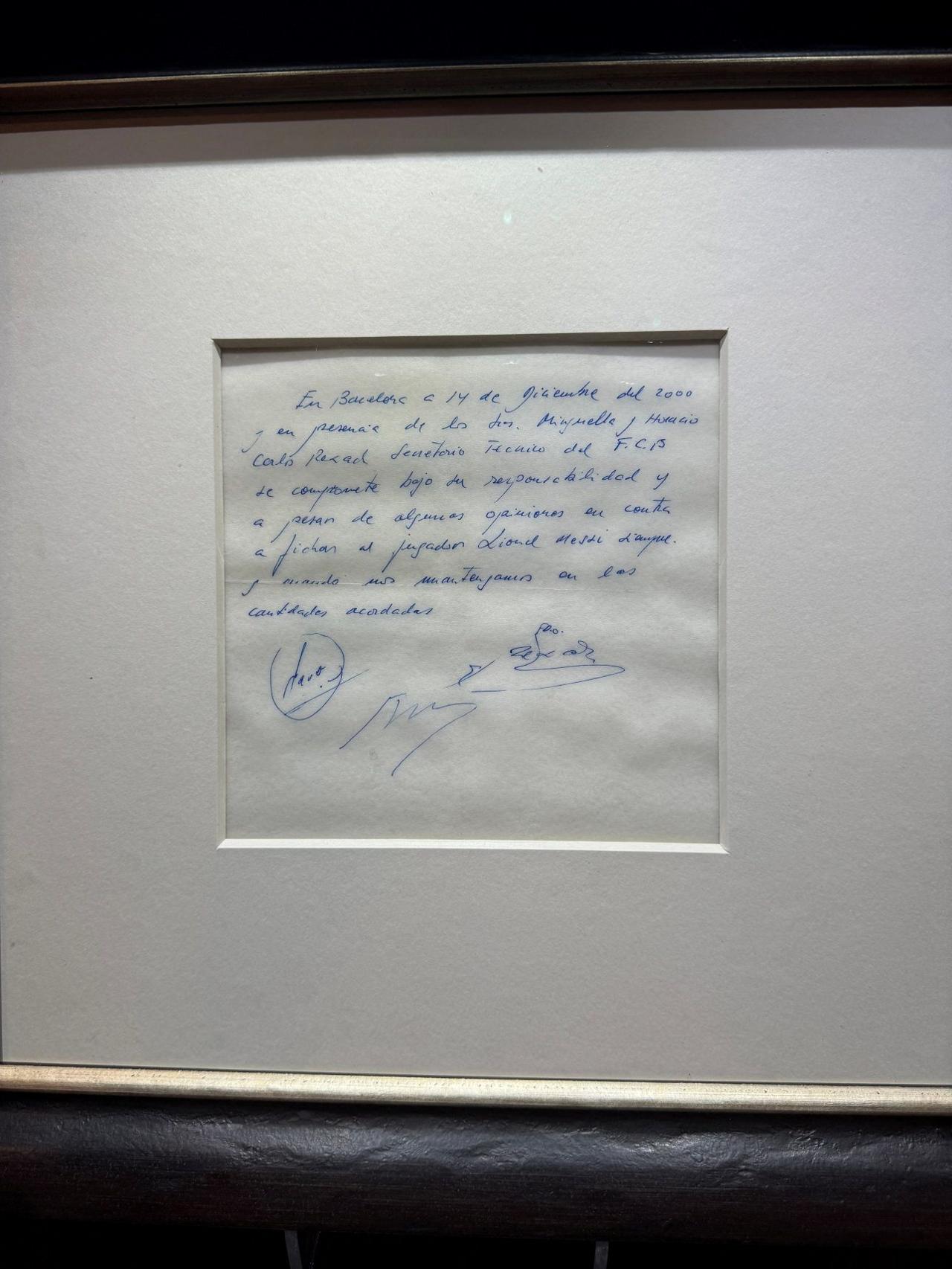
At age 13, Messi moved to Spain with his father while the rest of his close family remained in Argentina at first.[4][5] That move is one of the most useful facts for a school project because it shows the cost hidden behind later success. Messi did not simply get discovered and become famous. He left home, entered a new country, joined a demanding academy, and had to keep developing while carrying the pressure of a decision his family had made for his future.
Quick Facts for Students
| Topic | Student-ready fact |
|---|---|
| Full name | Lionel Andres Messi |
| Born | June 24, 1987, in Rosario, Argentina |
| Childhood challenge | Diagnosed with growth hormone deficiency around age 10 |
| Move to Spain | Moved to Barcelona at age 13 after the club agreed to sign him |
| Main clubs | Barcelona, Paris Saint-Germain, Inter Miami |
| National team | Argentina |
| Ballon d'Or awards | 8 |
| Team trophies | 46 |
| Major Argentina titles | Copa America 2021, FIFA World Cup 2022, Copa America 2024 |
| 2026 World Cup note | Reported all-time men's World Cup scoring record: 21 career goals; final tournament details should be verified before publication |
Barcelona: From Academy Player to First-Team Star
Barcelona's youth academy, La Masia, gave Messi a place to train, but it did not remove the difficulty of proving himself. He was smaller than many opponents, far from home, and entering one of the world's most competitive football systems. His first-team debut came in 2004, and by the late 2000s he had become central to Barcelona's attack.[1][4]
For students, this chapter is important because it shows a change in the kind of challenge Messi faced. As a child, the question was whether he would get the treatment and opportunity needed to continue. At Barcelona, the question became whether he could turn opportunity into consistent performance. The evidence says he did. Barcelona won league titles, domestic cups, and European titles with Messi as a key player, including 10 La Liga titles, 7 Copa del Rey titles, and 4 UEFA Champions League titles during his years with the club.[1][2]
This is also the point where a biography should avoid making Messi sound successful by magic. His rise depended on daily training, adaptation to a new environment, and the ability to perform repeatedly after opponents had studied him. A single brilliant match can make a player famous for a week. Messi's Barcelona career made him important for more than a decade.
The Record-Breaking Peak
The year 2012 is one of the clearest examples of Messi's scoring peak. He scored 91 goals in a single calendar year, passing Gerd Müller's 1972 record of 85.[4][7] That number is useful in a student report because it measures a full year, not one tournament or one good month. It shows both volume and durability: league matches, cup matches, international games, travel, pressure, and recovery all had to fit into the same year.
By March 2026, Messi had reached another major mark: his 900th senior career goal, becoming the second male player reported to reach that milestone.[3] BBC Sport's breakdown of the first 900 goals makes the number less abstract: 755 were left-footed, 111 right-footed, 30 headers, 112 penalties, 70 free kicks, and 724 from inside the box.[3] Those details do not prove character by themselves, but they help students describe scale accurately instead of writing only that he scored “many goals.”
| Milestone | Why it matters in a biography |
|---|---|
| 2000 napkin agreement with Barcelona | Shows how one opportunity changed Messi's medical and football path |
| 2004 Barcelona first-team debut | Marks the start of his senior club career |
| 2012 calendar-year 91 goals | Shows the height of his scoring peak |
| 2021 Copa America | Gave Messi a major senior title with Argentina |
| 2022 FIFA World Cup | Completed the main international trophy missing from his career |
| 2025 MLS Cup with Inter Miami | Shows his later-career impact outside Europe |
| 2026 World Cup scoring record | Reportedly made him the all-time men's World Cup goals leader with 21 career goals |
Argentina: The Long Wait for International Vindication
Messi's Argentina career is useful for students because it complicates the idea of success. At club level, he won early and often. With the national team, the reward took much longer. Argentina came close in major tournaments before Messi finally captained the team to the Copa America title in 2021.[1][2] That title mattered because it answered years of criticism that he had not delivered the same kind of victory for his country that he had produced for Barcelona.
The next chapter was the 2022 FIFA World Cup. Argentina won the tournament, and Messi received the Golden Ball as the competition's best player.[2] For a class presentation, this is a good place to connect biography and public memory: a player can be globally famous and still have one missing achievement that shapes how people judge him. The 2022 final was also one of the most watched sporting events in the world; students comparing sports impact and audience size can use a separate World Cup final viewership study for that angle.
Messi's international story did not stop there. Argentina also won the Copa America in 2024, adding another major senior international trophy to his record.[1] Then came the 2026 World Cup, where reports credited Messi with becoming the first male player to appear in six World Cups and with raising his career World Cup total to 21 goals, passing Miroslav Klose's previous men's record of 16.[2][8] Because the 2026 World Cup final was played on July 19, 2026, students and teachers should verify final tournament awards and outcome details before turning in a project or publishing a report.
A Trophy Inventory Without Losing the Story
Awards can become a wall of numbers if they are not organized. The point is not to memorize every trophy. The point is to see the length of the career and the different settings in which Messi kept winning: Spanish football, European competition, South American competition, the World Cup, and later Major League Soccer.
| Category | Selected Messi achievements |
|---|---|
| Barcelona club honors | 10 La Liga titles, 7 Copa del Rey titles, 4 UEFA Champions League titles |
| Argentina honors | Copa America 2021, FIFA World Cup 2022, Copa America 2024 |
| Individual honors | 8 Ballon d'Or awards |
| Career total | 46 team trophies, described by official and reference sources as making him the most decorated footballer |
| Inter Miami honors | MLS MVP awards in 2024 and 2025; MLS Cup 2025 |
For a student, the phrase “most decorated footballer” should be used carefully. It does not mean Messi won every match, every final, or every award available. It means that, by the trophy counts reported in official honors pages and major reference sources, his accumulated team honors reached a historic level.[1][2]
Paris, Miami, and the Later-Career Chapter
After leaving Barcelona in 2021, Messi joined Paris Saint-Germain. That period should be included because it is part of the career sequence, but it should not be treated as his current club. By 2023, Messi had moved to Inter Miami in Major League Soccer.[2] For students using older biography pages, this is a common place where information can be outdated.
The Inter Miami chapter is shorter than the Barcelona story, but it matters because it shows that Messi's public career continued after Europe. He won MLS MVP awards in 2024 and 2025, and Inter Miami won MLS Cup in 2025.[1] The lesson is not that every late-career move has the same importance as a player's peak years. It is that a biography should follow the evidence through the present instead of stopping at the most familiar chapter.
Off the Field
Messi's public life outside football is usually less central to a student biography than his childhood challenge and playing career, but a few concrete details belong. The Leo Messi Foundation has supported children's health and education projects, and Messi has served as a UNICEF goodwill ambassador.[9] These details are stronger than a vague sentence saying he “helps people,” because they name the kind of work and the institution connected to it.
Messi's family life is also part of his public biography. He is married to Antonela Roccuzzo, and they have three children.[2] In major honors outside the field, Messi has been named Laureus World Sportsman of the Year, and in January 2025 he was awarded the Presidential Medal of Freedom in the United States.[10][11] These facts should stay brief in most student reports unless the assignment specifically asks about humanitarian work, citizenship honors, or celebrity influence.
How Students Can Use Messi's Biography in a Project
A strong student project about Messi should not be a poster full of unrelated facts. It should choose a clear idea and then use dates, events, and statistics as evidence. The childhood medical challenge, the move to Spain, the long Barcelona career, the delayed Argentina success, and the later Inter Miami chapter can each support a different kind of assignment.
- For a perseverance theme, focus on the growth hormone deficiency diagnosis, treatment cost, move to Spain, and continued training.
- For a timeline project, use 1987, 2000, 2004, 2012, 2021, 2022, 2023, 2025, and 2026 as anchor years.
- For a statistics project, compare 91 goals in 2012, 900 senior career goals by March 2026, 46 team trophies, and 21 career World Cup goals.
- For a presentation, explain what each number measures instead of reading the numbers in a list.
- For a current-events report, double-check 2026 World Cup final details because the tournament had just ended.
The most defensible conclusion is not that Messi succeeded only because he was gifted, or only because he worked hard. His biography shows both. Talent opened attention around him, but repeated sacrifice, adaptation, disciplined practice, and persistence across setbacks shaped what that talent became. That pattern is what makes Lionel Messi's biography useful for students: it gives them a real life in which early difficulty did not disappear, but was answered over time by choices, support, and sustained work.
References
- Honours - Leo Messi, Messi.com
- Lionel Messi, Encyclopaedia Britannica
- Lionel Messi: Inter Miami and Argentina forward scores 900th career goal, BBC Sport, March 18, 2026
- Lionel Messi Facts for Kids, Kiddle
- Lionel Messi Biography, Biography.com
- Lionel Messi: Barcelona napkin contract sells for nearly £1m, BBC Sport, May 2024
- Lionel Messi, Olympics.com
- Messi breaks all-time World Cup scoring record, Al Jazeera, 2026
- Leo Messi appointed UNICEF Goodwill Ambassador, UNICEF
- Lionel Messi, Laureus
- President Biden Announces Recipients of the Presidential Medal of Freedom, The White House, January 2025
Back to the exam this applies to
Target exam not specified — see all exam hubs.
Comments
Join the discussion with an anonymous comment.