
Comparison
Dynamic, Surge, or Surveillance? The Kroger Pricing Case Study
This article uses the Kroger electronic-shelf-label controversy to distinguish three pricing models — dynamic, surge, and surveillance — that are consistently conflated by lawmakers, media, and Kroger itself. It provides a framework for GRE and MCAT test-takers to evaluate competing evidence and stakeholder narratives in business policy passages.
Verdict panel
- Compared
- dynamic pricing, surge pricing, surveillance pricing
- Target exam
- GRE, MCAT
- Best for
- GRE and MCAT test-takers
- Pricing last reviewed
In the Kroger dynamic pricing case study, the first trap is vocabulary. Lawmakers call the threat “surge pricing.” News coverage often uses “dynamic pricing.” Privacy advocates warn about “surveillance pricing.” Kroger can deny one term while leaving the others untouched, and a rushed reader may treat the denial as broader than it is.
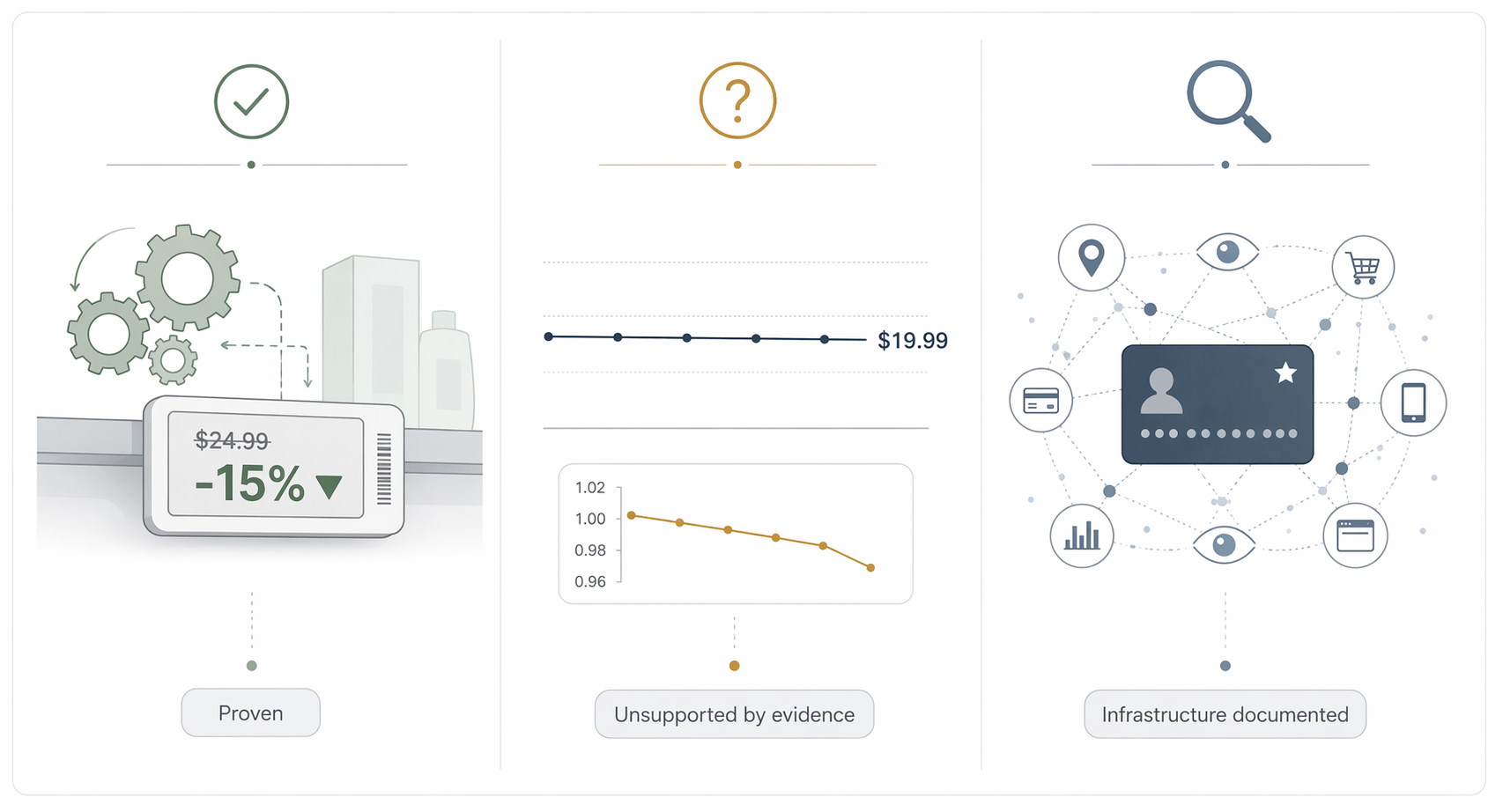
For test-prep purposes, the terms need to be separated before any claim is evaluated. Dynamic pricing means automated price changes tied to market conditions, inventory, timing, competition, or other non-personal variables. Surge pricing is a narrower claim: short-term price spikes driven by real-time demand. Surveillance pricing is different again: individualized prices or offers based on personal data, behavioral profiles, location, browsing history, loyalty-card records, or similar information.
That is a parsing framework, not a settled legal taxonomy. It is useful because the evidence does not support all three claims equally. Kroger has evidence of dynamic price adjustments, especially markdowns. The strongest available study does not show meaningful post-ESL surge pricing. At the same time, Kroger and the wider retail-data market have documented infrastructure that makes surveillance pricing a serious concern.
The clean version of the case is already too simple
A clean story would say that electronic shelf labels let Kroger raise prices whenever shoppers need an item most. Another clean story would say that the whole controversy is a misunderstanding, because electronic labels mostly reduce paper labor and help stores mark down products faster. Neither version survives careful reading.
The first concrete data point belongs to dynamic pricing, not surveillance pricing and not necessarily surge pricing. A Decodo analysis reported by Supermarket News found that Kroger made 55,601 price adjustments in 2025, with about half of the changes being decreases and an average drop of 9.1% among the reductions. The analysis drew on more than 1 million data points from 120 retailers, but it should be read with its source context in mind: Decodo is a data-access provider, so the figures are useful while the framing may not be neutral.[1]
Those numbers prove that Kroger changes prices frequently. They do not prove that Kroger raises prices on a thirsty shopper because it is hot outside, or on a particular shopper because their loyalty profile says they will tolerate it. A price adjustment count tells us that prices moved. It does not, by itself, identify the mechanism.
| Claim | What would have to be shown | What the available evidence supports |
|---|---|---|
| Kroger uses dynamic pricing | Prices are adjusted through automated or semi-automated systems in response to market, inventory, timing, or store conditions | Supported by reported large-scale price adjustments, including many markdowns |
| Kroger uses surge pricing | Short-term demand-driven price spikes become more common, especially after electronic shelf labels are installed | Not supported by the strongest cited ESL study |
| Kroger has surveillance-pricing capacity | Personal data, shopper profiles, loyalty-card records, biometric data, or data brokers could be used to personalize prices or offers | Supported as infrastructure and risk; not the same as proof that every shelf price is individualized |
Electronic shelf labels make price changes easier; they do not prove surge pricing
Electronic shelf labels matter because they reduce friction. A paper tag requires printing, sorting, staff time, aisle-by-aisle replacement, and a greater chance that the shelf and register disagree. A digital label can update faster. That does not tell us whether the new flexibility is used for markdowns, short-term spikes, personalized prices, or ordinary price maintenance.
The Kroger-Microsoft partnership is part of that mechanism background. Microsoft described Kroger’s EDGE shelf technology as using Azure IoT, with a pilot that began in 2018. Available deployment accounts trace the rollout from pilot to 500 stores by 2023 and roughly one in four stores by mid-2026.[2] That expansion helps explain why the controversy keeps returning: the technology makes more frequent price changes feasible at scale.
Separate academic work from Washington University’s Olin Business School found that electronic shelf labels can enable 54% to 853% more price changes, overwhelmingly discounts.[3] That finding should slow down a reader who sees “more price changes” and silently substitutes “more price increases.” More changes can mean more markdowns, faster clearance, smaller manual delays, or more experimentation. The direction and cause still have to be proved.
This is where many arguments start to leak. A passage may show that Kroger can change prices quickly, then infer that Kroger is changing prices upward during demand spikes. Capacity is not conduct. It is evidence that a practice is possible, not that the practice is occurring.
The best surge-pricing evidence cuts against the loudest accusation
The most important counterweight to the surge-pricing claim is a UC San Diego working paper released in July 2025. The study analyzed more than 180 million product observations across 114 stores and compared short-term price-spike behavior before and after electronic shelf label installation. It found that short-term spikes declined from 0.0050% of products before ESL installation to 0.0006% after installation.[4]
That is not a small detail. If the accusation is specifically that electronic shelf labels produced more short-term demand spikes, this study points in the opposite direction. It does not merely fail to find a large increase; it reports a lower observed rate after installation. For a GRE Argument essay or an MCAT CARS passage, this is the sentence one would underline twice, then write “scope” in the margin.
The study still deserves a quality label. It is a working paper, not yet peer-reviewed, so “disproves surge pricing forever” would be too strong. Its conclusion is narrower and more useful: based on a large observational dataset, there is moderate evidence that ESL installation did not meaningfully increase short-term surge-pricing behavior in the studied stores.[4]
This is the point at which a company denial can be both true and incomplete. If Kroger says it does not use surge pricing, the UCSD evidence makes that denial more credible for the specific claim of short-term demand spikes. But a denial of surge pricing is not a denial of dynamic pricing. It is not a denial of data monetization. It is not a denial of individualized targeting. It answers one mechanism.
The surveillance-pricing concern lives in a different evidence file
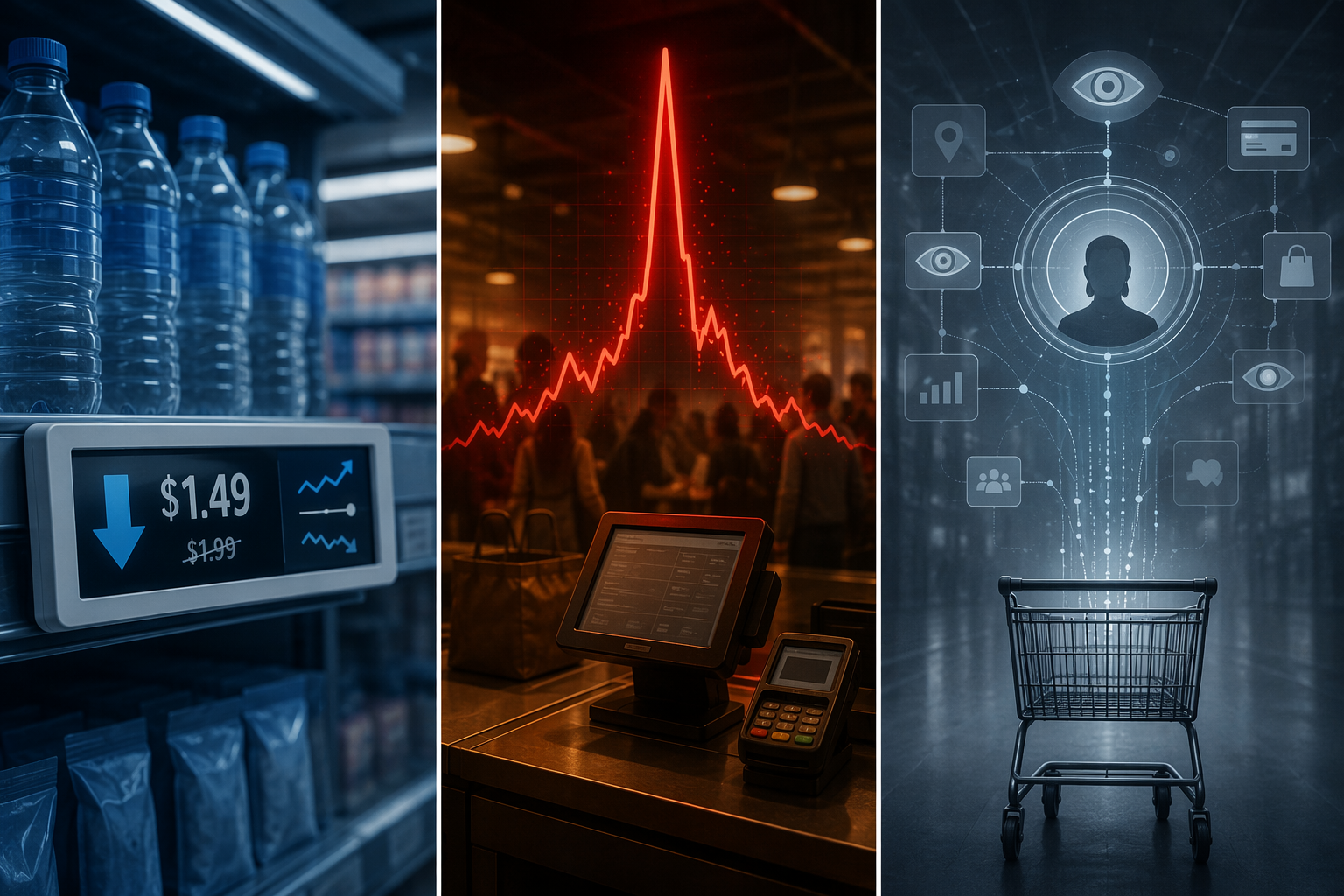
Surveillance pricing does not require a red graph over a shelf label. It requires data about the shopper and a system capable of using that data to sort, target, or discriminate among consumers. That is why “no surge pricing” does not settle the controversy. It may settle the wrong controversy.
Consumer Reports found that Kroger builds “secret shopper profiles” estimating household income and reported that Kroger’s data-advertising arm generated $1.5 billion in profit from loyalty-card data shared with more than 50 third-party partners.[5] Those facts do not prove that a shopper standing at a shelf receives a unique price on milk. They do show that Kroger’s grocery business is also a data business, and that shopper information has value beyond the immediate checkout lane.
The wider market makes the concern less speculative. The Federal Trade Commission’s January 2025 surveillance-pricing study reported that intermediaries use personal data such as mouse movements, location data, and browsing history to set individualized prices across more than 250 retail clients.[6] That is not a Kroger-specific finding. Its relevance is structural: retailers do not have to invent surveillance pricing from scratch if a market already exists for the data and tools.
EPIC’s analysis pushes the Kroger-specific question further by pointing to Kroger’s own privacy-policy language around biometric and facial-recognition data collection.[7] Again, the careful claim is not “facial recognition has been proved to set each grocery price.” The careful claim is that Kroger has disclosed data practices that fit the infrastructure side of surveillance pricing, and that infrastructure remains relevant even if the shelf-label surge claim weakens.
Once those files are separated, the public argument looks less contradictory. Dynamic markdown data and no-surge evidence can both be true. Surveillance-pricing infrastructure can still be documented. The error is treating them as mutually exclusive answers to one question.
Why shoppers may distrust the denial anyway
A trust problem is not the same as proof of surveillance pricing, but it affects how the argument is received. Consumer Reports investigated Kroger stores and found an average overcharge of $1.70, or 18.4%, per affected item across 26 stores in 14 states.[5] That sample is limited relative to Kroger’s broader store base, so it should not be inflated into a universal error rate. It does, however, explain why shoppers may not find reassurance in a narrow corporate denial.
If a shelf tag, register price, loyalty discount, digital coupon, and personalized offer do not line up cleanly, the ordinary shopper experiences one thing: opacity. In that environment, a technically precise denial can sound evasive even when the denied allegation is unsupported. That matters for analyzing persuasion. It does not change the burden of proof.
Profit claims need the same narrowing
Dynamic pricing is often defended or criticized with broad profit claims. MIT Sloan Management Review has reported that dynamic pricing can lift revenues by 8% and profits by up to 25%.[8] Those figures explain why firms are interested. They do not automatically transfer to grocery, where repeated household purchases, price memory, coupon systems, spoilage, competition, and trust all operate differently from travel or ride-share markets.
A passage that imports airline or ride-share economics into supermarket aisles without adjustment is asking the reader to accept an analogy. Sometimes analogies are useful. They are not evidence that the same pricing behavior is happening at Kroger.
Who benefits when the terms blur
The vocabulary drift is not random. “Surge pricing” gives lawmakers the sharpest public image: a family reaches for eggs, demand rises, the price jumps. It is an urgent phrase. It also points to the claim least supported by the strongest ESL evidence in the record.
Kroger benefits from the same blur in a different way. If critics say “surge pricing” when they mean a mixture of dynamic pricing, data monetization, and surveillance risk, Kroger can answer the narrowest charge. A denial of short-term demand spikes then travels farther than it should, because many readers hear it as a denial of the whole pricing controversy.
Media coverage also has an incentive to keep the terms fused. One controversy is easier to headline than three adjacent mechanisms with different evidentiary standards. But the simplification is costly. It lets weak claims borrow emotional force from stronger concerns, and it lets strong concerns be dismissed when a weaker accusation fails.
How to read the Kroger case under exam conditions
The useful method is mechanical in the best sense. First, define the mechanism being alleged. Is the passage talking about frequent price changes, short-term demand spikes, or individualized prices based on personal data? Second, match each piece of evidence to only the mechanism it actually supports. A price-adjustment count supports dynamic pricing. A before-and-after ESL study addresses surge behavior. Loyalty-card profiles, data sharing, and biometric-policy language belong to the surveillance-pricing file.
- If the claim is “Kroger changes prices dynamically,” the Decodo figures are relevant evidence, with vendor-commissioned context attached.
- If the claim is “ESLs caused surge pricing,” the UCSD working paper is the main counter-evidence and should be labeled moderate rather than final.
- If the claim is “Kroger has surveillance-pricing capacity,” loyalty-card data, third-party sharing, shopper profiles, FTC market findings, and privacy-policy disclosures are the relevant materials.
- If the claim is “Kroger has proved it will not overcharge or target consumers,” the evidence does not reach that broad reassurance.
The final judgment is not that Kroger is innocent of every concern, nor that every fear has been proved. The more precise conclusion is that Kroger can credibly deny demonstrated surge pricing while still benefiting from a public argument that keeps attention away from surveillance-pricing infrastructure. Lawmakers gain urgency from the word “surge.” Kroger gains cover from answering the narrowest charge. Readers lose when the terms collapse into one another.
On a GRE Argument task or an MCAT CARS passage, do not reward that collapse. Define the mechanism, assign each fact to the claim it can actually support, label the evidence quality, and ask which stakeholder benefits from the blurred term.
References
- “Walmart, Kroger and others use dynamic pricing: report,” Supermarket News
- “Kroger smart shelves ditch paper, drop lights, delight shoppers,” Microsoft
- “Detailed info about grocery inventories enable dynamic pricing,” Washington University Olin Business School, July 2024
- “New research debunks fears of supermarket surge pricing with electronic shelf labels,” UC San Diego Today, July 2025
- “Kroger Stores Overcharging Shoppers on Sale Items,” Consumer Reports
- “FTC Surveillance Pricing Study Indicates Wide Range of Personal Data Used to Set Individualized Consumer Prices,” Federal Trade Commission, January 2025
- “Kroger’s Surveillance Pricing Harms Consumers and Raises Prices With or Without Facial Recognition,” EPIC
- “How to Reap Higher Profits With Dynamic Pricing,” MIT Sloan Management Review
Comments
Join the discussion with an anonymous comment.