
Comparison
Globe Life Insurance Review for Financial Planning Students
A hands-on review of Globe Life that teaches financial planning students a four-dimension carrier evaluation scorecard, demonstrating that financial strength and consumer value are separate judgments.
Verdict panel
- Compared
- Globe Life, Level-premium term insurance
- Target exam
- not specified
- Best for
- CFP exam candidates
- Pricing last reviewed
A useful globe life insurance review for financial planning students should not start with a brand story. It should start with the exam-style mistake: a student sees AM Best A, S&P AA-, a large in-force block, and a national carrier ranking, then writes “strong company” as if that answers the client question. It answers one question. It does not answer whether the policy structure fits the client’s budget, whether complaint patterns create service risk, or whether the product solves the planning objective.
The compact verdict is this: Globe Life appears financially strong, but its most visible term product is a narrow-fit policy because premiums can rise every five years and coverage ends at a later age rather than staying level for the full planning period. Independent reviews also flag elevated complaint levels, including claims-delay concerns. That makes Globe Life a clean classroom case for separating carrier strength from client value, not a simple “good carrier” or “bad carrier” label.

The Four-Dimension Scorecard
For carrier review work, keep the dimensions separate. If the scorecard lets one strong column cover three weak ones, it is not a scorecard; it is a shortcut.
| Dimension | What it asks | Globe Life reading |
|---|---|---|
| Financial strength | Can the insurer meet claims obligations? | Strong: AM Best A and S&P AA- support claims-paying capacity. |
| Product structure | Do premiums, renewals, conversion terms, and termination rules match the planning need? | Weak for many standard term uses: the flagship term policy uses five-year step-rate renewals rather than a long level-premium period. |
| Consumer protection and complaint history | Do complaint patterns or regulatory events create due-diligence concerns? | Concerning: independent reviews flag a 2024 individual life complaint level more than four times the industry average, with claims delays identified as the main driver. |
| Client fit | Which client, if any, benefits from this product rather than a competitor’s? | Narrow: potentially useful for very small term policies or children’s whole life, but not a strong match for standard income replacement, final expense, or long-term predictable coverage needs. |

Financial Strength: Give Globe Life Credit, Then Stop There
Globe Life receives an A rating from AM Best and an AA- rating from S&P, and Forbes Advisor and NerdWallet both treat those ratings as meaningful evidence of financial strength.[1][2] Forbes Advisor also reports $231 billion of insurance in force and identifies Globe Life as the 19th-largest U.S. life insurer.[1]
Those facts matter. A life insurance recommendation that ignores claims-paying capacity is incomplete. But ratings are not product reviews. They do not tell a planner whether a premium schedule is easy to budget around, whether a renewal rule creates lapse pressure, whether a claims department draws unusual complaint volume, or whether the policy is the best available tool for a client’s objective.
That boundary is the point students need to catch. “Can probably pay covered claims” and “is the best fit for this client” are related, but they are not the same decision.
The Product Mechanics Carry Most of the Suitability Problem
Globe Life’s term product is easy to remember because the entry price looks simple. Forbes Advisor gives an example of a 40-year-old female in California buying $50,000 of coverage for $1 in the first month, then $21 per month afterward.[1] That example is useful in a classroom, but it should not be quoted as a national pricing claim. It is California-specific, and rates vary by state.[1]
The larger issue is not the first-month offer. It is the renewal design. Forbes Advisor reports that rates increase every five years at ages ending in 1 or 6, and coverage terminates between age 80 and age 90.[1] Choice Mutual warns that these increasing premiums can make the policy too expensive to keep and also notes the age-80 or age-90 termination feature.[3] NerdWallet similarly flags that rates can increase over time and prefers carriers offering level-premium term coverage.[2]
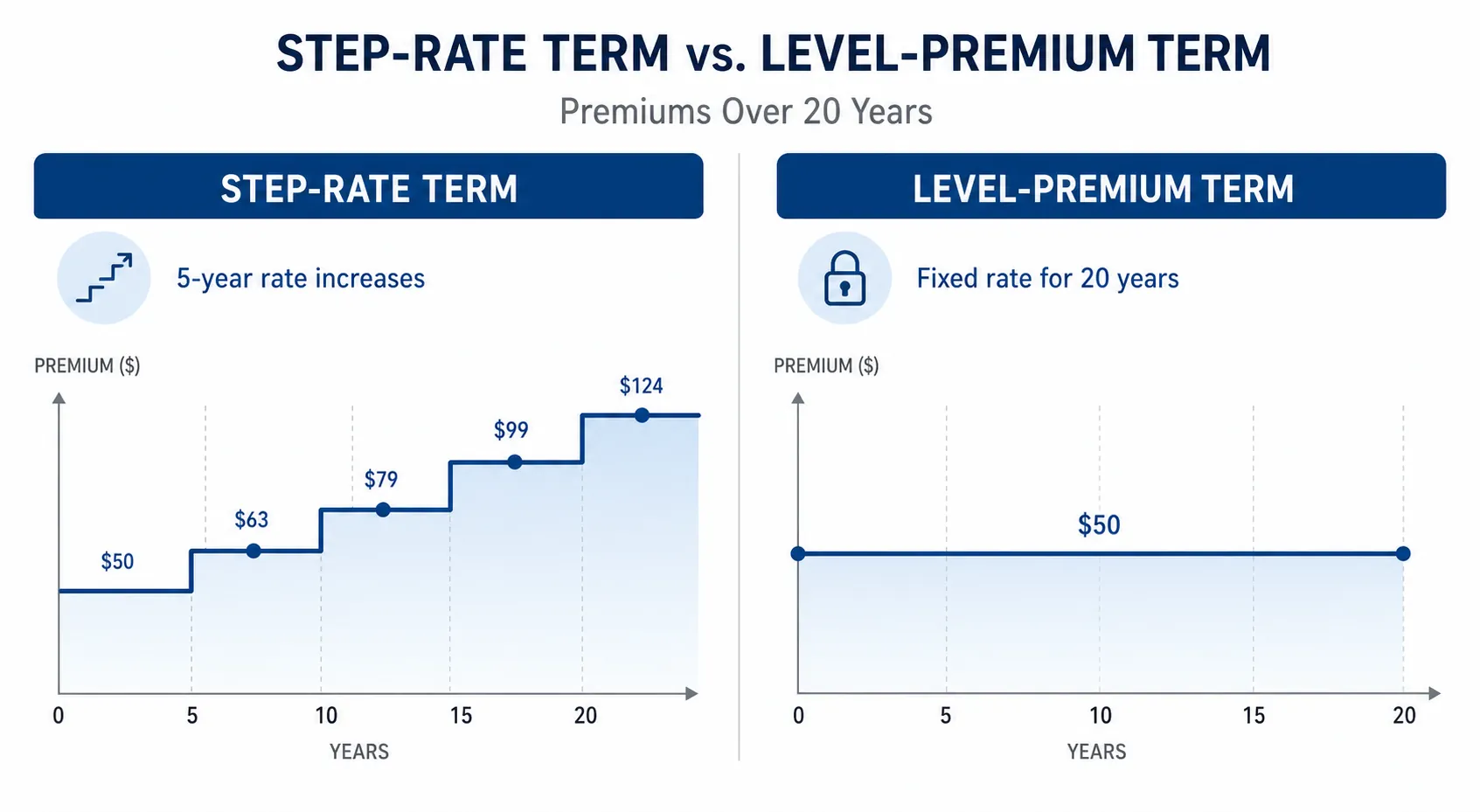
This is where a planning student should slow down. A five-year renewable step-rate term policy can look affordable at issue and still become difficult to keep later. The price does not merely change because the client voluntarily buys more coverage or adds a rider. The scheduled structure itself allows the cost to rise at five-year age bands.
Compare that with the planning logic of a level-premium 20-year term policy from a fully underwritten competitor. The purpose of that design is not glamour. It is budget control. If a parent needs income replacement while children are young, or a borrower wants coverage while a mortgage balance is high, the client usually needs the premium to stay boring. Boring is useful when the household budget is tight.
A step-rate policy changes the student’s analysis. The first question is no longer only “Can the client afford the premium today?” It becomes “Can the client afford the premium after several renewal jumps, at the exact time when age and health may make replacement coverage harder?” That is a different client conversation.
Why the Termination Age Matters
Coverage that terminates at age 80 or 90 may sound distant to a younger buyer, but termination rules are not trivia. They define the outer edge of the promise. For a pure income-replacement need, that may be acceptable if the coverage period is deliberately matched to working years. For a client who is informally using term insurance as burial coverage, legacy coverage, or late-life protection, termination can defeat the purpose.
That is why PinnacleQuote’s criticism matters in the final-expense category: it says Globe Life is the wrong choice for final expense because the step-rate structure undermines the fixed-budget premise of that planning need.[4] Final expense buyers are often trying to remove a future burden from family members. A product that becomes harder to keep as the insured ages works against that premise.
Conversion Is the Missing Question to Verify
The American College notes that more than 97% of term life policies never pay a death benefit because policyholders outlive the term.[5] That statistic does not make term insurance defective; term is designed to cover temporary risk. But it does make conversion features important. If the client later needs permanent coverage, the right to convert without starting over medically can be valuable.
Before treating Globe Life term as comparable to a fully underwritten level-term competitor, a student should verify Globe Life’s conversion options against competitors’ contracts. The available sources support concern about step-rate renewability and termination age; they do not support pretending every conversion detail has been resolved without reading the policy form.
Complaints Are Not a Cosmetic Footnote
Forbes Advisor reports that Globe Life’s 2024 individual life complaint level was more than four times the industry average, with claims delays identified as the primary driver.[1] NerdWallet, U.S. News, and ValuePenguin also flag elevated complaint ratios as a red flag.[2][6][7]
That complaint category deserves more attention than a vague “customer service could be better” line. A claim delay happens at the moment the policy is supposed to do its central job. The insured is gone. The beneficiary is waiting. The planner who recommended the coverage may be explaining a process to a family that has little patience for administrative friction.
There is one data caveat: the exact 2024 NAIC complaint index should be independently confirmed from the NAIC public database before relying on the precise figure. The research here supports the “more than four times industry average” statement as reported by Forbes Advisor, but it does not provide the precise index figure.[1]
A complaint ratio also should not be overread. It does not prove that every complaint is valid, and it does not predict with certainty that a future claimant will experience delay. It does, however, belong in the due-diligence file. If a student ignores it because the balance sheet looks strong, the student is mixing scorecard categories again.
The DOJ Investigation Belongs in Due Diligence, Not Drama
Globe Life disclosed that a Department of Justice investigation into sales practices by independent agents was announced in April 2024 after allegations from Fuzzy Panda, a short seller. Globe Life later announced that the DOJ closed the investigation on July 28, 2025 with no enforcement action.[8]
That sequence is a good test of professional discipline. The opening of an investigation is not proof of wrongdoing. The closing of an investigation without enforcement is not proof that every sales-practice concern was imaginary. For a planner, the correct use is narrower: document the event, document the resolution, and avoid turning either side into more certainty than the record supports.
Where Globe Life Might Fit
The independent-review consensus is not that Globe Life has no possible use. Forbes Advisor, NerdWallet, U.S. News, Choice Mutual, PinnacleQuote, Diversified Quotes, and Annuity Expert Advice converge on a narrow-use verdict: Globe Life may fit very small term policies or children’s whole life, but it is not competitive for standard income replacement, final expense, or any client needing long-term predictable coverage.[1][2][3][4][6][9][10]
That narrow fit matters because many insurance exam questions hide the answer in the client objective. A small, simple policy is a different assignment from a 20-year income-replacement plan. A children’s whole life purchase is different from a retiree’s final-expense need. A carrier can be acceptable for one narrow situation and still be a poor default recommendation.
| Client objective | Globe Life fit | Reason |
|---|---|---|
| Very small term policy | Possible limited fit | Independent reviews identify small policies as one of the few plausible use cases. |
| Children’s whole life | Possible limited fit | Independent reviews repeatedly place this in the narrow-fit category. |
| Standard income replacement | Weak fit | Step-rate renewals are harder to compare and budget around than level-premium term. |
| Final expense | Weak fit | Increasing premiums conflict with the fixed-budget logic of final-expense planning. |
| Long-term predictable coverage | Weak fit | Premium increases and termination rules create suitability concerns. |
How to Turn the Case Into an Exam-Ready Answer
For CFP-style insurance planning, the Globe Life case is useful because it forces a structured answer. The CFP exam assigns 11% of its content to insurance planning, so students need more than vocabulary; they need a repeatable way to evaluate a recommendation under time pressure.[11]
- Start with claims-paying capacity: AM Best A and S&P AA- support financial strength, but only for that dimension.
- Move to product structure: identify the five-year step-rate renewal pattern, the $1 first-month offer, later premium increases, and the age-80 to age-90 termination point.
- Add consumer-protection evidence: note the reported 2024 complaint level of more than four times the industry average and the claims-delay driver, while confirming the exact NAIC index before relying on the precise figure.
- Finish with client fit: separate small-policy convenience from income replacement, final expense, and long-term predictable coverage needs.
This is also the kind of decision-analysis habit that helps GRE-bound business and finance students. The same discipline used in GRE preparation—separating evidence from conclusion, narrowing claims, and refusing to let one strong fact answer the wrong question—shows up again in carrier evaluation.
Globe Life is not a simple “avoid at all costs” case. It is more useful than that. It shows why a financially strong insurer can still earn a weak suitability score when the product design, complaint record, and client objective do not line up.
References
- Globe Life Insurance Review, Forbes Advisor
- Globe Life Insurance Review, NerdWallet
- Globe Life Insurance Review, Choice Mutual
- Globe Life Insurance Review, PinnacleQuote
- Term Life Insurance, The American College
- Globe Life Insurance Review, U.S. News
- Globe Life Insurance Review, ValuePenguin
- Globe Life Inc. Announces Department of Justice Closes Investigation With No Enforcement Action, Globe Life Investor Relations, July 28, 2025
- Globe Life Insurance Review, Diversified Quotes
- Globe Life Insurance Review, Annuity Expert Advice
- CFP Exam Principal Knowledge Topics, CFP Board
Back to the exam this applies to
Target exam not specified — see all exam hubs.
Comments
Join the discussion with an anonymous comment.