
Comparison
Comparing Europe's Work Visas for International Students
This guide compares work visa rules across European countries for international students, covering permit requirements, weekly hour limits, and estimated earnings so you can choose the best destination.
Verdict panel
- Compared
- not specified
- Target exam
- not specified
- Best for
- not specified
- Pricing last reviewed
- pricing currency unconfirmed
If you are comparing a Europe work visa for students, the useful question is not simply whether international students can work. In many European countries, they can. The harder question is whether the rule is workable when rent is due, class hours are fixed, and an employer wants someone who can start without weeks of paperwork.
Across Europe, the answer changes quickly by country. A 2025 Euronews analysis using StudiesIn data for 30 European countries found that 14 countries required no separate work permit for international students, while most countries capped work at about 20 hours per week during term time. Estimated monthly earnings ranged from about €275 in Bulgaria to about €1,600 in Denmark, depending on wage levels and allowed hours.[1]

That spread is wide enough to change a study-abroad budget. A country with a high hourly wage can still be awkward if the employer must sponsor a permit. A country with no formal hour limit can still produce modest income if typical student wages are low. The comparison has to keep four things together: whether a separate permit is needed, how many hours are allowed, what those hours may pay, and how much uncertainty sits between the student and the first shift.
The Side-by-Side Reality
The cleanest first split is between countries where the student residence status usually carries work rights and countries where a separate work authorization or employer action is part of the process. For a student who needs income during the semester, that difference matters almost as much as the wage.
| Country or group | Work access during study | Typical term-time limit or structure | Budget meaning |
|---|---|---|---|
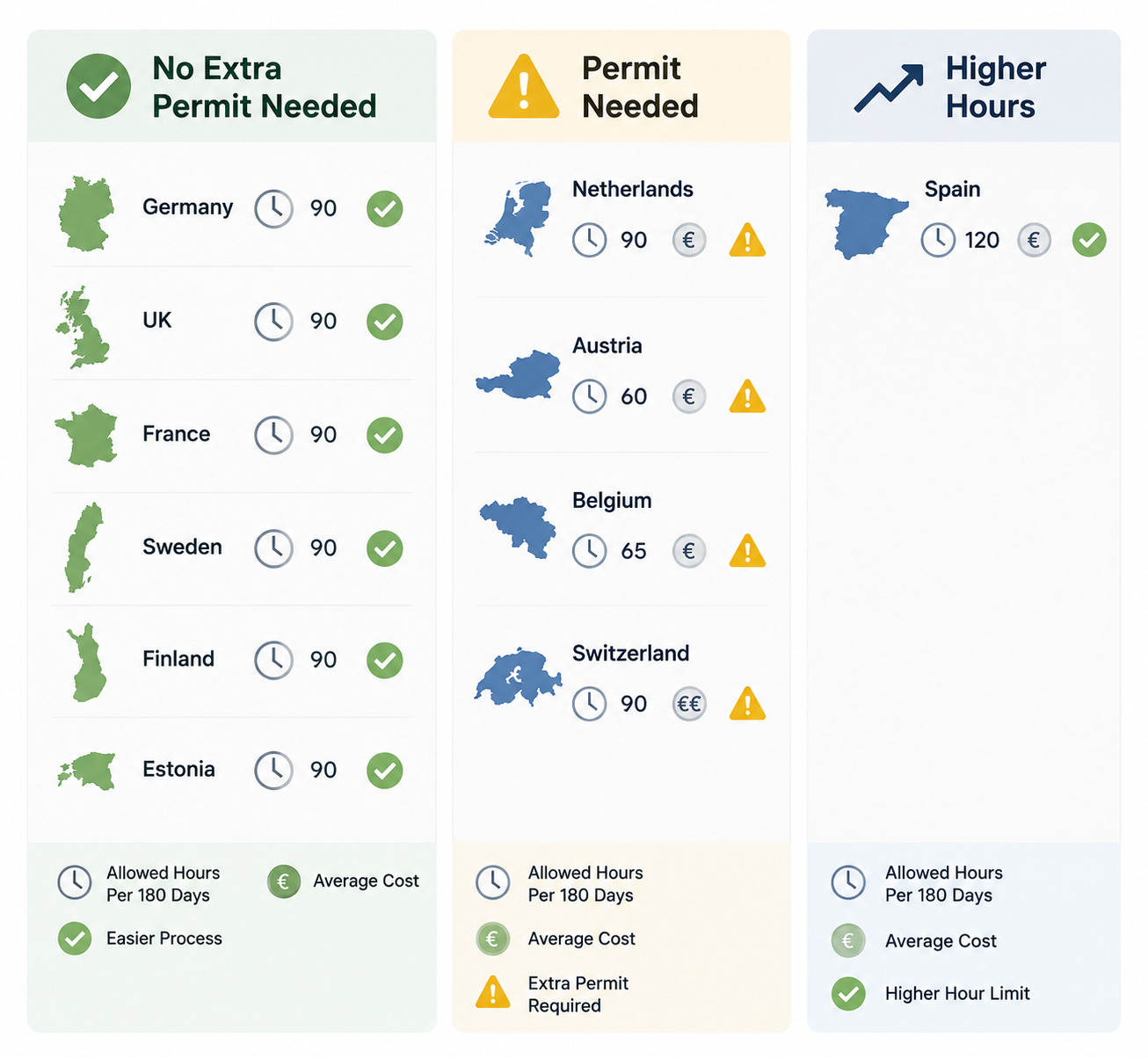
| Germany | No extra work permit highlighted in the 2025 comparison | 140 full days or 280 half days in the German system | Strong balance of access, earnings, and low public tuition |
| United Kingdom | No separate permit highlighted in the 2025 comparison | 20 hours per week during term time | High familiar option for English-language study, but tuition and living costs still need separate budgeting |
| France | No separate permit highlighted in the 2025 comparison | 964 hours per year, roughly 20 hours per week | Clear access with a familiar annual cap |
| Estonia | No formal hour limit highlighted in the 2025 comparison | No formal weekly cap in the cited dataset | Flexible on paper, but lower average wages change the income estimate |
| Spain | Student work allowed up to 30 hours per week | Up to 30 hours per week | Notable because the cap is higher than the common 20-hour model |
| Netherlands, Austria, Belgium, Switzerland | Employer permit or work authorization friction highlighted | Often 16 to 20 hours per week depending on country | The wage may look attractive, but the job search has an added administrative step |
This is also where broad advice becomes dangerous. Saying “students can work in Europe” hides the difference between a German student who can look for work without a separate permit and a student in the Netherlands whose employer must deal with a permit process for a limited-hour job.[2]
Hour Caps Are Not Just Legal Details
A 20-hour cap sounds manageable until it meets a real timetable. Lab sessions, language classes, commuting, and exam weeks do not arrange themselves around restaurant shifts. Still, for budgeting, the cap gives a ceiling: it tells the student the most they can legally plan around during term time.
The common European pattern is close to 20 hours per week during term. The UK uses that familiar 20-hour figure for many international students, and France uses an annual allowance of 964 hours, commonly understood as about 20 hours per week across the year.[1]
Germany is different in form rather than spirit: the cited country guidance describes the rule as 140 full days or 280 half days. That can be more flexible than a simple weekly cap because the student is counting workdays, not only a fixed weekly number, but it still needs tracking. A student who treats it casually can run into trouble even when the rule is generous.[2]
Spain deserves attention because it allows up to 30 hours per week, above the usual 20-hour benchmark in the dataset. That extra space can matter for students trying to cover a larger share of living costs through work, although the actual usefulness still depends on finding an employer and fitting hours around study.[1]
Estonia is the unusual case. The 2025 comparison identifies it as having no formal hour limit for international students, which is rare in this group. That should not be read as a promise that a student can safely work full time while studying, or that enough suitable jobs will be available. It means the formal cap is not the main constraint; wages, workload, language, and job availability become more important constraints.[1]
Earnings Change the Ranking
The best-looking work rule is not always the best budget result. A student comparing destinations should translate the legal rule into likely monthly income before getting attached to a country.
| Country | Estimated earnings or wage detail from the research | What the number measures |
|---|---|---|
| Germany | About €1,111 per month at €12.82 per hour | Estimated student earnings under the cited comparison |
| United Kingdom | About £977, or roughly €1,127 per month, at 20 hours per week | Estimated student earnings under a 20-hour term-time model |
| France | Minimum wage around €11.88 per hour | Hourly wage context paired with the 964-hour annual cap |
| Estonia | Average around €4.30 per hour and about €443 per month at standard hours | Lower wage context despite no formal hour limit |
| Denmark | About €1,600 per month at around €14.10 per hour | Highest estimated monthly figure cited in the 30-country comparison |
| Bulgaria | About €275 per month, with a €3.32 per hour minimum wage | Lowest estimated monthly figure cited in the 30-country comparison |
Germany stands out because several budget lines move in the student’s favor at once. The 2025 comparison estimates about €1,111 per month in earnings at €12.82 per hour, and the country is also known in the dataset for near-zero public tuition and no extra work permit requirement for the student work access being compared.[1] The point is not just that the estimated earnings are good; it is that the student is not adding a separate employer-permit hurdle on top of them.
The UK is also strong on estimated earnings, with about £977, or roughly €1,127 per month, under the cited 20-hour model and no separate permit requirement in the comparison.[1] For students who want English-language study, that matters. But the work-rule comparison should not be confused with a full affordability ranking, because tuition and rent can change the final picture sharply.
Estonia shows the opposite problem. No formal hour limit is attractive, but the cited wage context is much lower: about €4.30 per hour and roughly €443 per month at standard hours.[1] For a student budget, that means freedom from an hour cap does not automatically become high income.
The Permit Question Is Where Plans Get Messy
Permit friction is easy to underestimate from outside the country. On paper, a student may be allowed to work. In practice, the employer may need to apply, wait, prove something, or decide that a student with limited hours is not worth the administrative work.
The Netherlands is the clearest example in the cited material: international students are limited to 16 hours per week during the academic year, and the employer must arrange the work permit. That creates a different job market from one where the student can simply present their residence status and availability.[2]
Austria and Belgium also sit in the permit-friction group, with 20-hour limits and employer permit requirements highlighted in the 2025 comparison. Switzerland appears in the same practical category because student work is tied to authorization requirements rather than being a simple no-extra-permit arrangement.[1]
None of that makes these countries bad study destinations. It does make them harder to budget around if the student needs flexible, immediate work after arrival. A higher hourly wage is less useful if many employers avoid the paperwork or if the student cannot start quickly.
Where the Main Countries Land
For most students comparing work rights during study, Germany is the strongest overall option in the available 2025 data. It combines no extra work permit, a relatively high estimated monthly earning figure, and near-zero public tuition. The day-count system still has to be tracked, but the basic budget equation is unusually favorable.[1][2]
The UK belongs near the top for students prioritizing English-language study and familiar 20-hour term-time rules. Its estimated student earnings are close to Germany’s in the cited comparison, and no separate work permit is highlighted for the work access being compared.[1] The caution is cost: work rights during study do not settle the tuition-and-rent question.
France is a stable middle-to-strong option for students who want a clear rule. The 964-hour annual allowance gives a predictable frame, and the minimum wage figure cited in the research is relatively strong at about €11.88 per hour.[1] The rule is not as flexible as Estonia’s and not as budget-shifting as Germany’s, but it is legible.
Spain is worth a closer look because the 30-hour allowance is meaningfully above the common 20-hour cap.[1] That extra legal room could help a student who finds steady work, but it should be checked against course intensity and local job access. More permitted hours do not create more study time.
Estonia is best read as a special case, not a universal winner. Students who mainly want fewer formal restrictions should examine it carefully, especially if their program, language skills, or sector makes local work realistic. But the lower wage estimate means it is not automatically the best financial deal.[1]
The Netherlands, Austria, Belgium, and Switzerland need more caution before a student counts expected wages in a budget. The issue is not only the hour cap. It is the employer-side permission step, which can make part-time work less predictable than the table suggests.[1][2]
What This Comparison Does Not Cover
This is a comparison of work rights and estimated earnings during study. It is not a full ranking of quality of life, housing pressure, language barriers, university prestige, or job availability by sector. Those can matter just as much once the student lands, but the strongest available cross-country evidence here is regulatory and earnings data.
Post-study work routes are also outside this comparison. The UK Graduate Route and similar pathways in other countries can be important for long-term planning, but they answer a different question from whether a student can legally and realistically work while enrolled.
A Practical Way to Decide
Start with the countries where no separate work permit is needed, then compare the hour cap and likely monthly earnings. After that, bring tuition and rent into the same spreadsheet. A destination with clean work access and moderate earnings may beat a destination with higher wages but employer paperwork.
- Choose Germany first if the priority is the strongest available balance of work access, estimated earnings, and low public tuition.
- Compare the UK closely if English-language study is a major requirement and the total cost still works.
- Look at France if a clear no-extra-permit model and predictable annual hour allowance fit the plan.
- Check Spain if a higher weekly hour allowance could materially improve the budget.
- Treat Estonia as flexible but wage-sensitive, not automatically more affordable.
- Verify employer permit requirements before relying on wages in the Netherlands, Austria, Belgium, or Switzerland.
Because the main figures here come from August 2025 sources, a Q3 2026 application should not rely on them alone. Before applying, check the official government or national study pages for the exact current rule, including whether the employer must file anything, whether holidays are treated differently, and whether the work limit is weekly, annual, or counted by workdays.
References
- Which European countries allow international students to work the most hours?, Euronews, 2025-08-28.
- Working Limits in Europe for International Students, Abroadin.
Back to the exam this applies to
Target exam not specified — see all exam hubs.
Comments
Join the discussion with an anonymous comment.