
Comparison
What the Science Says About Diet Soda and Cognitive Decline
A clear, study-by-study breakdown of the research linking diet soda to cognitive decline, dementia, and stroke risk — including what the evidence shows, where it falls short, and why causation remains unproven.
Verdict panel
- Compared
- not specified
- Target exam
- not specified
- Best for
- not specified
- Pricing last reviewed
- pricing currency unconfirmed
The short answer is less dramatic than the headline version: high intake of artificially sweetened beverages has been repeatedly associated with worse cognitive or vascular outcomes in large observational studies, but those studies do not prove that diet soda causes cognitive decline.
That distinction matters. A study can compare people who drink more diet soda with people who drink little or none, follow them for years, and find that the heavier consumers decline faster or have more dementia or stroke diagnoses. It still has to answer a harder question: were the drinks part of the cause, or were diet drinks more common among people already at higher metabolic risk?
The best reading of the evidence in 2026 is not “one can ages your brain” and not “there is nothing to see here.” Four major prospective cohort studies point in a broadly similar direction. The strongest recent cognitive-decline study found that higher artificial sweetener intake, roughly the amount in one can of diet soda per day, was linked with faster decline over eight years. But every major study in this area remains observational, and the obesity-diabetes question is not a footnote. In one 2026 analysis, the diet soda-dementia association disappeared when participants with obesity or diabetes were excluded.

The strongest cognitive-decline signal: ELSA-Brasil
The 2025 ELSA-Brasil study is the most useful place to start because it measured cognitive change over time rather than only counting diagnosed events such as dementia or stroke. Published in Neurology, the study followed 12,772 adults for eight years and compared artificial sweetener intake with performance on repeated cognitive testing.[1]
Participants in the highest intake group consumed about 191 milligrams of artificial sweeteners per day, described in the source material as roughly equivalent to one can of diet soda. Compared with the lowest consumers, that high-intake group showed 62% faster global cognitive decline, a difference translated by the researchers as approximately 1.6 years of brain aging.[1]
That estimate is useful because it gives scale. It does not mean a can of diet soda literally subtracts 1.6 years from a person’s brain. It means that, in this cohort, the rate of decline seen in the high-intake group was statistically comparable to the extra decline expected over about that amount of aging. The finding is still meaningful, but it is a group-level association, not an individual forecast.
The study also looked at individual sweeteners. Six of the seven tested sweeteners were individually linked with cognitive decline: aspartame, saccharin, acesulfame-K, erythritol, sorbitol, and xylitol. Tagatose showed no association, but the source material notes that consumption was low, so that result should not be stretched into a confident “safe alternative” claim.[1]
| ELSA-Brasil detail | What it tells us | What it does not prove |
|---|---|---|
| 12,772 participants followed for eight years | A large prospective cohort can detect patterns in cognitive change over time | It cannot randomly assign exposure or prove causation |
| High intake around 191 mg/day, roughly one diet soda | The exposure level is familiar enough to matter for everyday readers | It does not mean every daily drinker will experience the measured decline |
| 62% faster global cognitive decline | The association was large enough to be hard to dismiss | The comparison may still reflect differences between people who choose diet products and those who do not |
| Diet data collected once at baseline by self-report | The study captured reported intake at the start | It did not capture every change in diet over the eight-year follow-up |
Two subgroup findings deserve attention without being overread. The association was strongest among participants under 60 and among those with diabetes.[1] The under-60 pattern may suggest that midlife exposure is especially relevant, or that cognitive tests are more sensitive before older-age disease processes dominate. The diabetes pattern is harder to interpret because diabetes itself is a risk factor for cognitive and vascular problems. A stronger association in people with diabetes may reflect biology, confounding, or both.
The study’s main weakness is also easy to understand: diet was measured at baseline using self-report. If a participant changed beverage habits during the next eight years, the analysis could not fully track that change.[1] Food frequency questionnaires are common in large nutrition studies because they are practical, not because they are perfect. They can rank people broadly, but they are not a continuous record of what someone drank every week.
Framingham made the dementia and stroke link hard to ignore
The 2017 Framingham Heart Study analysis is the source of one of the most repeated findings in this topic: daily diet soda consumption was associated with about three times the risk of stroke and Alzheimer’s disease dementia over 10 years.[2]
That is a striking figure, but the outcome is different from the ELSA-Brasil outcome. Framingham was not primarily saying that people’s cognitive test scores declined faster each year. It was looking at diagnosed clinical events: stroke and Alzheimer’s disease dementia. Those outcomes are more severe and less subtle, but they also occur less often, which can make subgroup estimates more fragile.
The value of Framingham is that it widened the question beyond “memory test performance” to major brain-health events. Its limitation is the same broad limitation that runs through this field: people who drink diet soda every day may differ from people who rarely drink it in ways that are difficult to measure completely, including weight history, diabetes risk, diet changes after medical advice, and other health behaviors.
WHI broadened the stroke evidence, especially in high-intake groups
The Women’s Health Initiative analysis, published in Stroke in 2019, studied postmenopausal women and focused on artificially sweetened beverages and cardiovascular outcomes. Women consuming at least two diet drinks per day had a 23% higher stroke risk and a 31% higher ischemic stroke risk compared with lower consumers.[3]
One subgroup finding received particular attention: among Black women, consuming at least two diet drinks per day was associated with 3.93 times the ischemic stroke risk.[3] That finding should be reported plainly because it is clinically important, but it also needs the same caution that applies to subgroup results generally. A subgroup signal can identify where risk may be concentrated; it does not, by itself, explain why the risk is higher.
WHI is also important because it shows how different the high-consumption group was at baseline. High consumers were substantially more likely to have obesity, 44.6% versus 21.0%, and diabetes, 14.6% versus 4.1%.[3] Those imbalances do not erase the association. They do show why a simple comparison between diet-drink consumers and non-consumers can mislead if readers treat it as a clean experiment.
The confounding problem is not a technicality
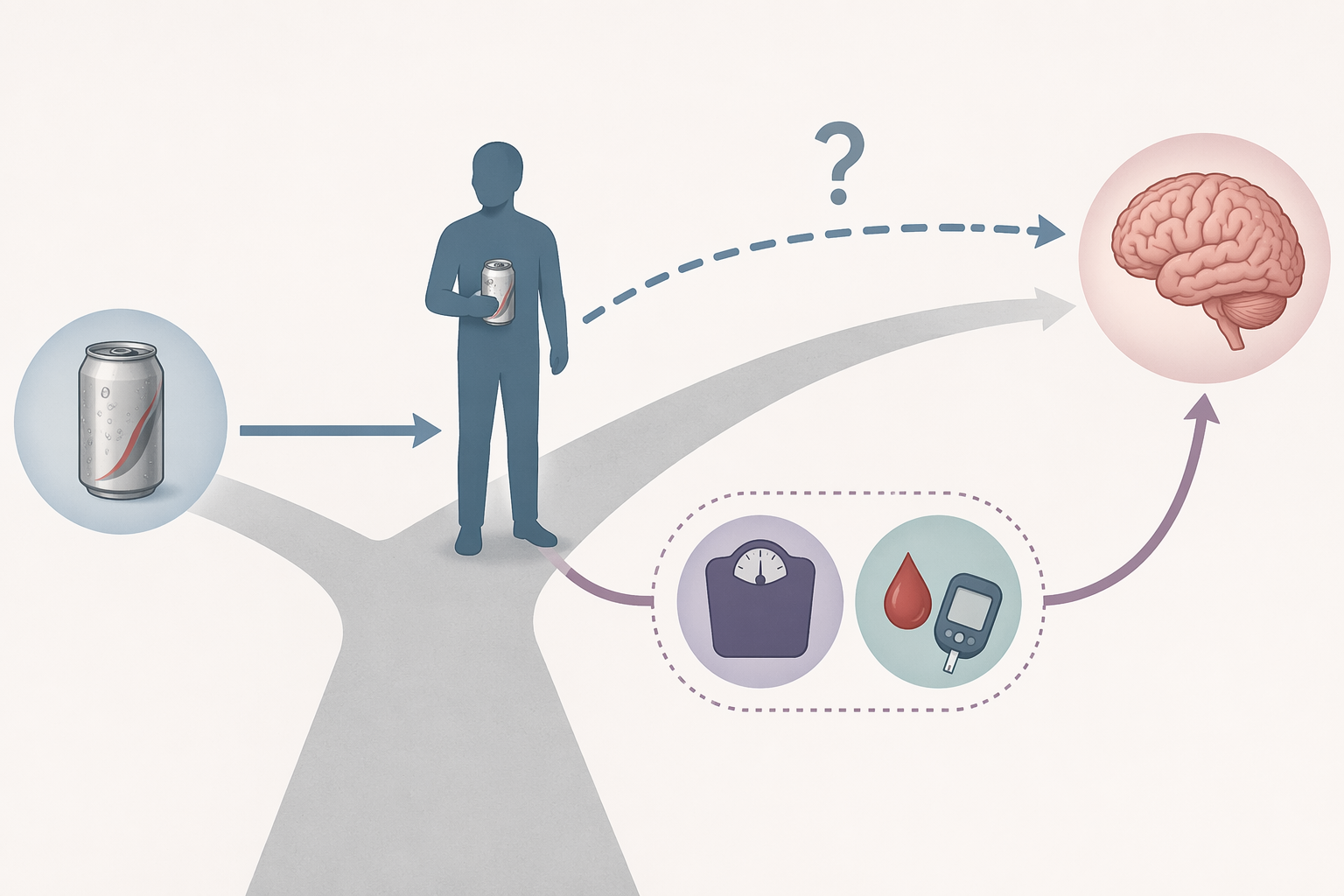
The central methodological problem is reverse causation. People do not choose diet drinks at random. Some switch to them after weight gain, a diabetes diagnosis, a clinician’s warning, or an attempt to reduce sugar intake. Obesity and diabetes independently raise the risk of vascular and cognitive problems, so a study can find more dementia or stroke among diet soda drinkers even if the drink itself is not the cause.
Good observational studies try to adjust for these differences statistically. Adjustment helps, but it is not the same as randomization. It depends on what researchers measured, how accurately they measured it, and whether the relevant difference is current body size, long-term metabolic history, medication use, recent dietary change, or something else that sits partly outside the dataset.
That is why the 2026 Northern Manhattan Study, or NOMAS, matters. In the reported analysis, each additional daily diet soda was linked with a 34% increase in dementia risk. But when participants with obesity or diabetes were excluded, the association disappeared entirely.[4]
This does not prove that obesity or diabetes explain every diet soda finding. It does show that the association can be highly sensitive to who is included in the comparison group. If removing participants with two major metabolic risk factors makes the signal vanish in one cohort, then any broad claim that diet soda independently causes dementia is ahead of the evidence.
The reverse-causation issue also changes how to read the under-60 and diabetes patterns in ELSA-Brasil. Stronger associations in those groups may be a clue to a real exposure window or biological vulnerability. They may also be a clue that artificially sweetened products are marking people already on a different metabolic path. The current studies cannot cleanly separate those explanations.
What the four studies can and cannot support
Taken together, the studies support a cautious conclusion: high intake of artificially sweetened beverages is repeatedly associated with faster cognitive decline, dementia risk, or stroke risk in large prospective cohorts. That pattern is too consistent to wave away as one bad headline or one odd dataset.
| Study | Main outcome | Key finding | Main interpretive limit |
|---|---|---|---|
| ELSA-Brasil 2025 | Cognitive test decline over eight years | High artificial sweetener intake linked with 62% faster global cognitive decline | Baseline self-reported diet; observational design |
| Framingham 2017 | Stroke and Alzheimer’s disease dementia over 10 years | Daily diet soda linked with about threefold higher risk | Residual confounding and reverse causation remain possible |
| Women’s Health Initiative 2019 | Stroke and ischemic stroke in postmenopausal women | At least two diet drinks per day linked with higher stroke risks | High consumers had much higher obesity and diabetes prevalence |
| NOMAS 2026 | Dementia risk | Each additional daily diet soda linked with 34% higher risk | Association disappeared after excluding participants with obesity or diabetes |
What the studies cannot support is the stronger sentence people often remember: diet soda causes cognitive decline. None of the four studies was a randomized controlled trial. None can fully recreate the comparison people usually imagine, where two otherwise similar groups differ only in artificially sweetened beverage intake for years.
Industry groups have issued counter-positions on artificial sweeteners, including from the International Sweeteners Association and the Calorie Control Council, but the available source materials here do not independently verify those claims. They do not change the main evidence problem in either direction: the cohort findings are consistent, and the causal question remains unresolved.
The honest endpoint is narrow but useful. High artificially sweetened beverage intake is repeatedly associated with worse cognitive and vascular outcomes in large observational cohorts. The current evidence cannot yet separate a possible biological effect of the drinks or sweeteners from the health profiles of the people most likely to choose them.
References
- Artificial Sweeteners and Cognitive Decline in the Brazilian Longitudinal Study of Adult Health, Neurology, 2025, PubMed ID 40902134
- Daily consumption of diet soda sweetener may increase risk of dementia, stroke, Boston University School of Medicine, 2017, Boston University School of Medicine press release
- Artificially Sweetened Beverages and Stroke, Coronary Heart Disease, and All-Cause Mortality in the Women’s Health Initiative, Stroke, 2019, American Heart Association journal Stroke
- Diet soda and dementia risk analysis in the Northern Manhattan Study, University of Miami Miller School of Medicine, 2026, University of Miami Miller School of Medicine news article
Back to the exam this applies to
Target exam not specified — see all exam hubs.
Comments
Join the discussion with an anonymous comment.