
Comparison
Step-by-Step Solving Tips for Connections Sports Edition
Learn a repeatable process for solving the daily NYT Connections Sports Edition puzzle, adapted for athlete-name traps, team and venue overlaps, and sports-trivia categories that reward domain knowledge.
Verdict panel
- Compared
- not specified
- Target exam
- not specified
- Best for
- not specified
- Pricing last reviewed
- pricing currency unconfirmed
The fastest way to lose a Connections Sports Edition life is to be a little too pleased with yourself. You see Brown, Green, Rice, and Cook, your sports brain starts throwing out surnames, and your thumb is already near Submit before the rest of the board has had a chance to testify. That is the trap: Sports Edition rewards sports knowledge, but it punishes sports-fan reflexes when they outrun puzzle discipline.
The useful version of Connections Sports Edition solving tips is not “know more trivia.” It is a pre-submit routine. The game still asks you to sort 16 words into 4 groups of 4, using the familiar color scale from Yellow through Green, Blue, and Purple, with Purple usually carrying the hardest connection.[1][2] The sports version adds a different kind of pressure: ordinary-looking words can be athlete surnames, cities can be teams, venues can sound like locations, and one clean-looking set can hide a fifth candidate waiting to wreck the play.
The Five-Step Routine Before You Submit Anything
Treat the board like warmups, not a buzzer-beater. The goal is to make the first correct group create cleaner choices for the next one. General Connections strategy guides consistently recommend scanning the full board before committing, using the easier categories to reduce clutter, and saving the hardest or strangest connection until the board has been narrowed.[2][3]
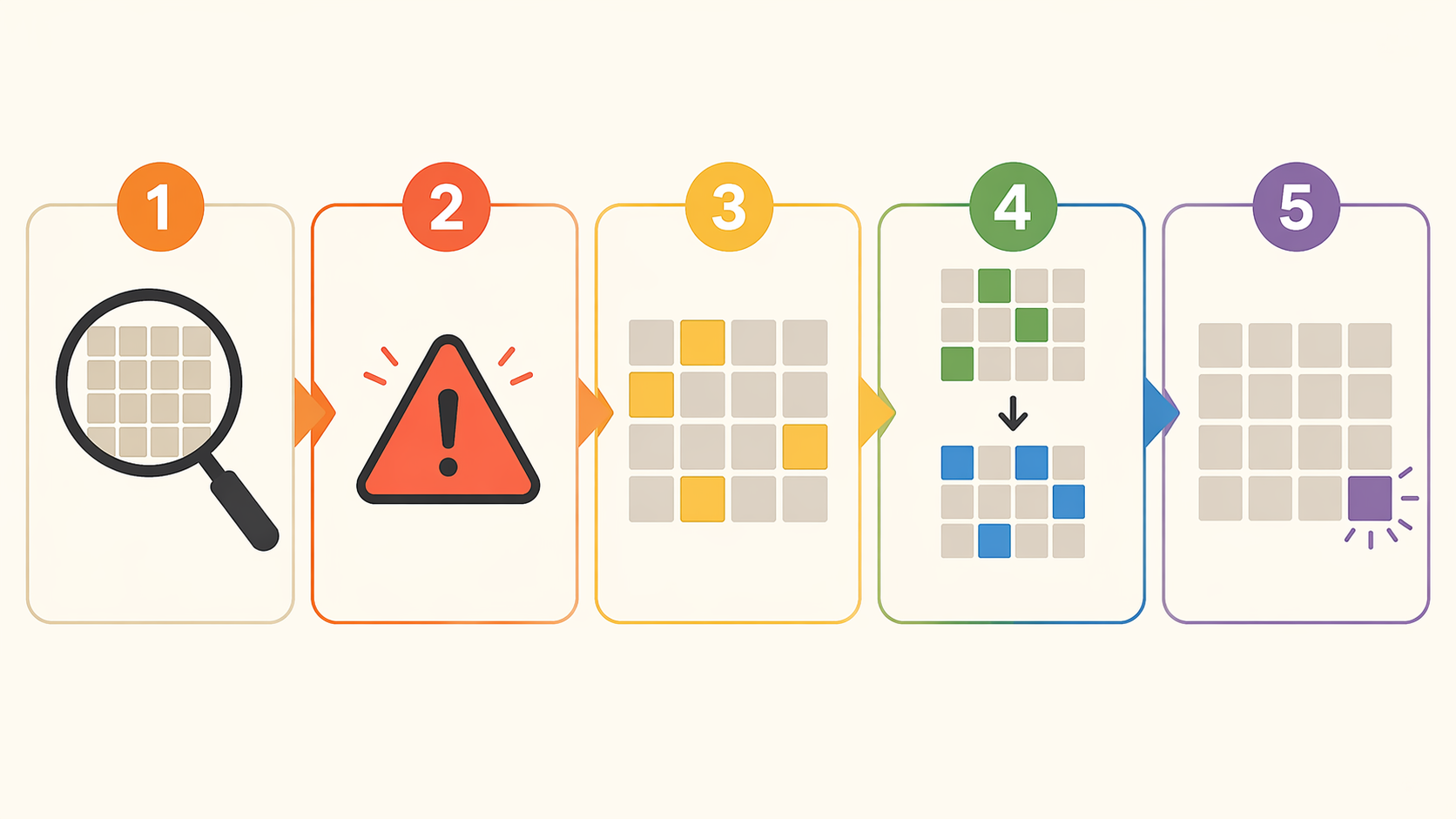
- Scan all 16 words without selecting anything.
- Flag trap candidates: athlete surnames, team names, city names, venues, and words that belong to more than one sport.
- Solve Yellow first when a plain category is genuinely locked.
- Use the reduced board to work through Green and Blue.
- Let Purple emerge by elimination, especially when the remaining words look more linguistic than sports-trivia based.
That sequence sounds almost too basic, which is why players skip it. But the skip is where the damage happens. A sports board gives you more words that feel familiar, and familiarity is not the same as category proof.
Step 1: Scan the Whole Board Like You Are Looking for Matchups
On the first pass, do not solve. Sort. Your eyes should be asking different questions at the same time: Which words are obviously sports terms? Which are ordinary nouns that could also be names? Which words belong to multiple sports? Which ones look too bland to be random?
A clean scan separates the board into loose piles without pretending any pile is final. One pile might be “possible MLB teams.” Another might be “basketball actions.” Another might be “could be last names.” You are not building the answer yet; you are building a scouting report.
If you already use a general Connections process, this is the same foundation with more sports-specific caution. The companion guide on the systematic process for solving NYT Connections is the right baseline: generate candidates first, test them second, submit last.
Step 2: Circle the Words That Can Wear Two Jerseys
Sports Edition has a special class of danger words: they look like common vocabulary, colors, foods, objects, or places, but they can also be athlete names or sports references. Third-party Sports Edition category guides call out examples such as Brown, Green, Rice, Cook, Blue, Rock, and Page as the kind of surface-level words that can pull players into false groups.[4]
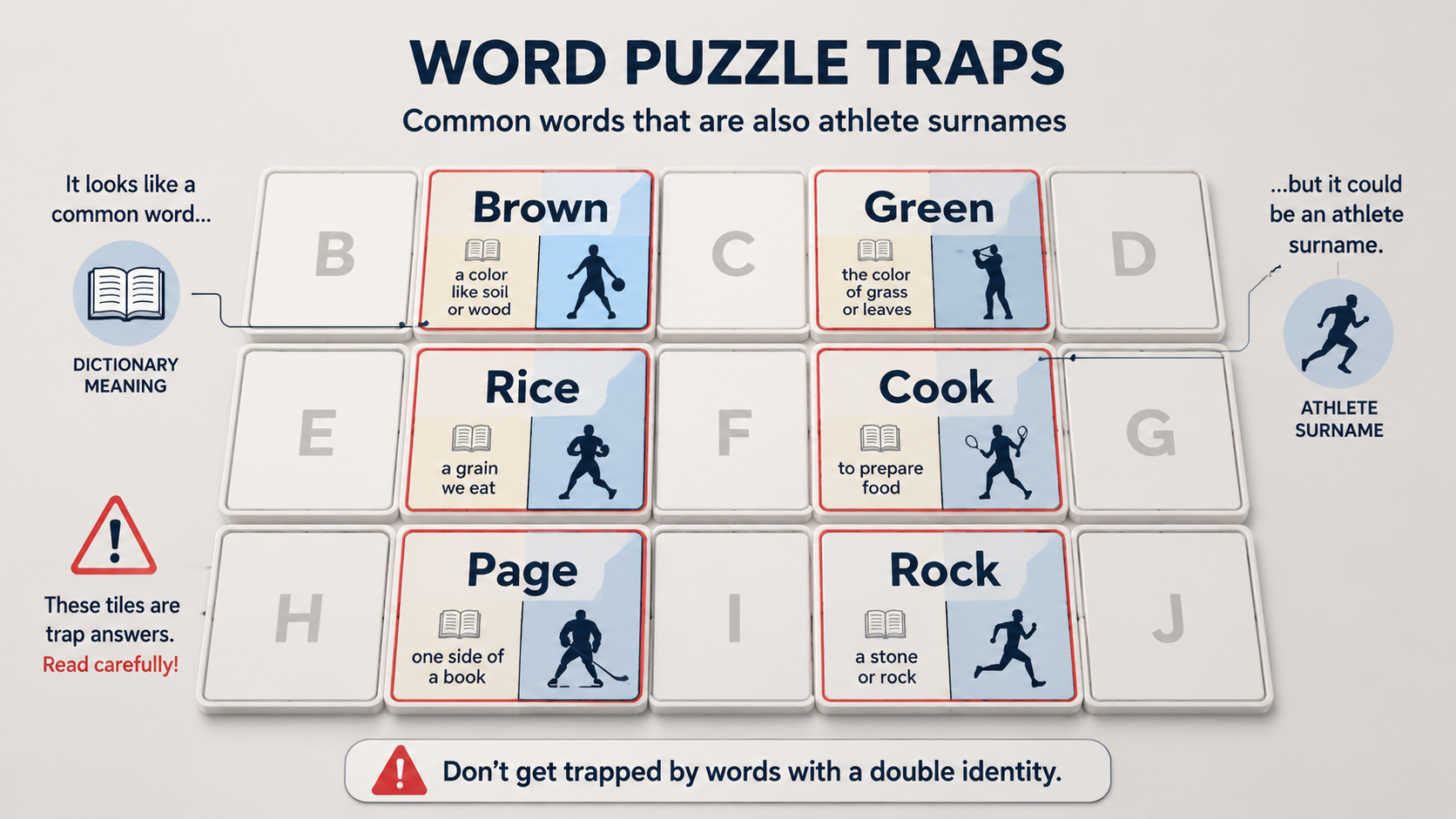
This is where sports knowledge helps and hurts at the same time. If you recognize Rice, you might think of a Hall of Fame receiver. If you recognize Cook, you might think of a running back. If Brown and Green are nearby, the surname pattern starts feeling strong. But the board may be using one of those words as a color, a food, a verb, a team nickname, or part of a phrase.
A practical rule: any word that can be both a normal word and a sports name gets a mental warning label. You are allowed to use the association, but you are not allowed to submit it until the other 12 words have had a say.
Step 3: Take Yellow When It Is Actually Yellow
Yellow is usually the least disguised category, and solving it first lowers the noise on the board.[1][4] In Sports Edition, a Yellow group might be straightforward equipment, common positions, basic scoring terms, or a plainly shared sports concept. The important word is plainly.
Before submitting a supposed Yellow, run two checks. First, can you name the category in fewer than a handful of words? “Things used in baseball” is too baggy if the board contains bat, glove, mound, plate, and diamond. Second, is there a fifth word that also fits? If there is, you do not have a group yet; you have a crowd.
The best early group is not the one that gives you the biggest sports-knowledge rush. It is the one with four members and clean boundaries. If you cannot explain why the fifth candidate is out, you are still in practice reps, not game action.
The 5+ Candidate Check Saves More Lives Than Hints
When a category appears to have five or more possible members, assume at least one of them is bait. Puzzle strategy writers often describe this as one of Connections’ core traps: an obvious set may be obvious because it is almost right, not because it is complete.[5] Sports Edition makes that trap easier to fall for because league, team, and athlete associations come quickly to fans.
| If you see | Do this before submitting |
|---|---|
| Five words that could be teams | Separate city, mascot, nickname, and league before choosing four. |
| Five athlete surnames | Check whether one word is being used as an ordinary noun, color, food, or verb. |
| Five terms used across sports | Ask whether the category is sport-specific or shared vocabulary. |
| Four words that feel right instantly | Look for a hidden fifth candidate elsewhere on the board. |
This check also matches advice associated with Connections editor Wyna Liu: if four words seem to match immediately, verify that no extra word also belongs before committing.[2] That is not overthinking. That is the puzzle asking you to box out.
Step 4: Use Green and Blue to Test the Board, Not Your Ego
After Yellow comes off, the board should feel less like a jumble and more like a rotation. Green and Blue often carry stronger specificity than Yellow: a league-history connection, a category of athletes from different sports, a set of team nicknames, or terms that share a role across games. The Word Finder’s broader strategy guide describes this middle phase as pattern recognition plus elimination rather than pure recall.[3]
This is the stage where confident sports fans burn lives. They know three names in a cluster and talk themselves into the fourth. The better move is to ask what kind of category would make all four necessary. “Great quarterbacks” is probably too broad. “No. 1 overall NFL draft picks” is narrower. “Athletes who hosted a specific show” would be narrower still, but unless the board gives you support, do not force a trivia rabbit hole.
A clean Green or Blue solve usually has a category label that excludes nearby decoys. If your explanation depends on “well, this one also sort of fits,” leave it alone and inspect the other candidates. Connections does not grade your sports takes; it grades the exact four-word set.
Team, City, and Venue Overlaps Need Their Own Pause
Sports geography is messy in exactly the way a word puzzle likes. A word may be a city, a franchise nickname, a stadium reference, a college, a conference, or part of an arena name. The Sporting News explainer frames Sports Edition as a collaboration tied to The Athletic’s sports coverage, which is a clue to the puzzle’s range: it can draw from leagues, teams, athletes, and sports culture rather than only dictionary-style terms.[6]
So when you see a place word, do not immediately file it under geography. Ask whether the board wants cities that host teams, teams named after places, venues with sponsor names removed, college programs, or words that appear in multiple franchise names. Those are different categories. Mixing them because they all “feel sportsy” is how a promising board turns into three lives and a bad mood.
The One-Away Rule: Cancel All Four
When the game tells you that you are one away, the worst habit is to swap one word and fire again. CNET’s Connections strategy advice recommends clearing the selection and rethinking the whole set rather than treating “one away” like a simple substitution drill.[7] Lifehacker gives similar advice in its general Connections strategy coverage.[2]
The reason is simple: you do not know which word is wrong. If you guessed Brown, Green, Rice, and Cook as a surname group and the board says one away, the wrong tile might be the one you trusted most. Canceling all four forces you to rebuild the category instead of protecting your first instinct.
- Clear the selected words.
- Write the category label in your head, not just the shared vibe.
- Find every remaining word that could fit that label.
- Only resubmit when you can explain why each excluded candidate is out.
Cross-Sport Trivia Helps, but It Should Not Drive Blind
Sports Edition can reward knowing more than one league. A category may connect athletes across sports, use terms shared by baseball and cricket, or lean on college and pro naming conventions. Third-party Sports Edition guides and daily-hint sites track these kinds of recurring patterns, but they are unofficial resources rather than NYT/The Athletic category-frequency data.[4][8]
That distinction matters. It is fair to learn from repeated examples. It is not fair to pretend there is already a settled long-term map of Sports Edition category rates. The sports game is newer than the original Connections, with beta coverage reported in 2024 and wider launch coverage in 2025, so claims about “always” and “never” deserve a short leash.[6]
Use trivia as a candidate generator. If a word reminds you of a tennis player, a college mascot, or an old arena, put that association on the board mentally. Then make it pass the same four-word boundary test as everything else.
Purple Is Not Just “The Obscure Sports One”
Purple is usually the hardest color, but hard does not always mean “you need deeper roster memory.” Sports Edition Purple categories often depend on wordplay, hidden words, fill-in-the-blank logic, or abstract patterns rather than direct sports knowledge.[4][3] That is a crucial adjustment late in the puzzle.
If the last eight or four words stop making sports sense, stop forcing sports sense onto them. Look at spelling, prefixes, suffixes, sounds, missing words in phrases, abbreviations, and words that can follow or precede the same term. A remaining set might use sports words as raw language material, not as references to actual games.
This is where the Purple habits from regular Connections transfer cleanly. The article on Mushroom and NYT Connections wordplay is useful because it trains the same late-board shift: stop asking only what a word means and start asking what the word can do.
A Daily Solving Routine That Actually Changes Your Clicks
A good routine should change behavior before the Submit button. This one does:
- Read all 16 words once without selecting.
- Mark dangerous words: surnames, colors, foods, places, nicknames, venues, and multi-sport terms.
- Find the cleanest Yellow, then run the fifth-candidate check.
- After each solve, rescan the whole board instead of chasing the same idea.
- For Green and Blue, demand a category label that excludes decoys.
- On “one away,” cancel all four and rebuild.
- For Purple, test wordplay before inventing obscure sports trivia.
That is the repeatable edge. Not clairvoyance, not memorizing every roster, and not hoping the sports gods hand you four clean nicknames in a row. The steady solvers are the ones who make the board prove itself from more than one angle before they spend a life.
References
- Connections Tips and Tricks, The New York Times, 2023.
- The Best Strategies for Winning NYT Connections, Lifehacker.
- How to Play NYT Connections: Complete Strategy Guide, The Word Finder.
- Connections Categories Explained, ConnectionsSports.com.
- Tips and Tricks for the NYT Connections Puzzle, Puzzle a Day, 2023.
- What is Connections: Sports Edition?, Sporting News.
- NYT Connections Puzzle: Here's a Great Hint to Help You Win, CNET.
- NYT Connections Sports Edition: Hints and Answers for June 1, 2025, Mashable, 2025.
Back to the exam this applies to
Target exam not specified — see all exam hubs.
Comments
Join the discussion with an anonymous comment.