
Comparison
Carlos Alcaraz's 2026 Wrist Tenosynovitis Case Study
A structured case study of Carlos Alcaraz's 2026 right-wrist tenosynovitis, covering diagnosis, conservative treatment, rehabilitation phases, and return-to-play decision-making. Sports science and athletic training students will learn how non-structural overuse injuries are managed and why timing is critical to prevent recurrence.
Verdict panel
- Compared
- not specified
- Target exam
- not specified
- Best for
- not specified
- Pricing last reviewed
- pricing currency unconfirmed
In Carlos Alcaraz’s 2026 wrist injury case, the important detail is not that the injury sounded dramatic. It is that it did not. The publicly reported diagnosis was right-wrist tenosynovitis: inflammation around a tendon sheath, with no public evidence of a fracture, tendon rupture, or surgical lesion. Yet the planned absence from match play still stretched from an April 14, 2026 retirement in Barcelona toward a mid-August Cincinnati Masters target, roughly a 14-week gap if that return plan held.
That mismatch is the case. A non-structural overuse injury can still be serious when the involved tissue belongs to an elite tennis player’s dominant hitting wrist. The problem is not only whether imaging looks reassuring. It is whether the wrist, forearm, grip pattern, and stroke volume can tolerate repeated high-speed loading again without provoking the same tendon-sheath irritation.
| Case element | Reported detail |
|---|---|
| Athlete | Carlos Alcaraz, elite professional tennis player |
| Injury date and setting | April 14, 2026, Barcelona Open match against Virtanen; Alcaraz retired |
| Primary diagnosis | Right-wrist tenosynovitis, described as tendon-sheath inflammation rather than a tear or fracture |
| Associated biomechanical finding | Pronator teres muscular edema discussed in biomechanical commentary |
| Initial management | Conservative care, including wrist immobilization in a splint |
| Approximate immobilization window | Mid-April to mid-June 2026, about nine weeks |
| Progression point | Splint reportedly removed around June 17, 2026, with progressive loading beginning afterward |
| Mid-July status | Spanish reporting cited Dr. Angel Ruiz-Cotorro saying the wrist was "completely healed"; that should not be read as automatic match readiness |
| Planned return | Cincinnati Masters in mid-August 2026, as a target rather than a completed outcome |
What Was Being Managed
Tenosynovitis is inflammation of the sheath that surrounds a tendon, not the same thing as a tendon tear, ligament rupture, or bone fracture. Waterbury Hospital’s orthopedic review of Alcaraz’s case framed the diagnosis in exactly that conservative-care territory: painful tendon-sheath irritation caused by repetitive wrist and forearm demand, rather than a structural injury that clearly points toward surgery. [1]
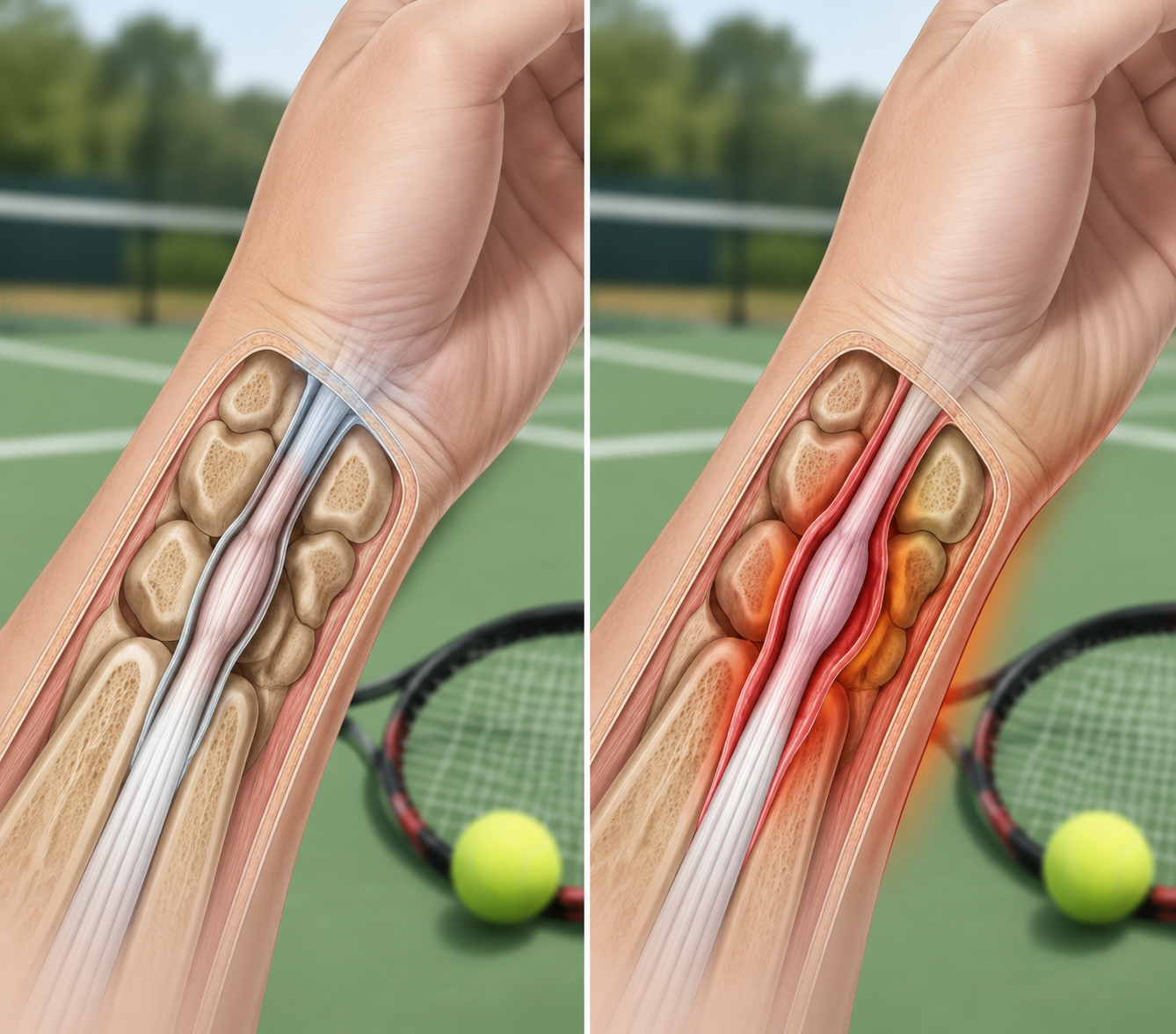
That distinction matters because students often sort injuries too quickly into "minor" and "major" bins. A tear sounds major. Inflammation sounds minor. In a tennis wrist, that shortcut fails. The tendon may remain intact while the sheath becomes irritated enough that each forehand, return, or defensive stretch keeps reloading the same painful interface.
The public record also has limits. Primary medical records, imaging reports, and daily treatment notes have not been released. The case has to be read through team statements, media reporting, and secondary medical commentary. That is normal for a public athlete case study, but it means the diagnosis can be discussed as reported, not audited as if the chart were open.
The Mechanism Was More Specific Than “Sore Wrist”
The biomechanical explanation is what makes this case useful for students. Il Sole 24 Ore quoted Prof. Rodolfo Lisi describing Alcaraz’s forfeit as a "biomechanical case study" connected to the technical transition from hard court to clay after Alcaraz had won four titles on hard courts in early 2026. The same account identified muscular edema of the pronator teres alongside the tenosynovitis. [2]
Pronator teres matters here because it helps rotate the forearm into pronation, and forearm rotation is repeatedly asked to coordinate with wrist position, grip pressure, racquet acceleration, and ball contact. When a player moves between surfaces, the ball response, timing, stance demands, and rally construction can shift. The useful clinical point is not that clay alone "caused" the injury. The narrower, better-supported point is that a surface transition can change loading demands enough to expose a tissue-capacity problem.
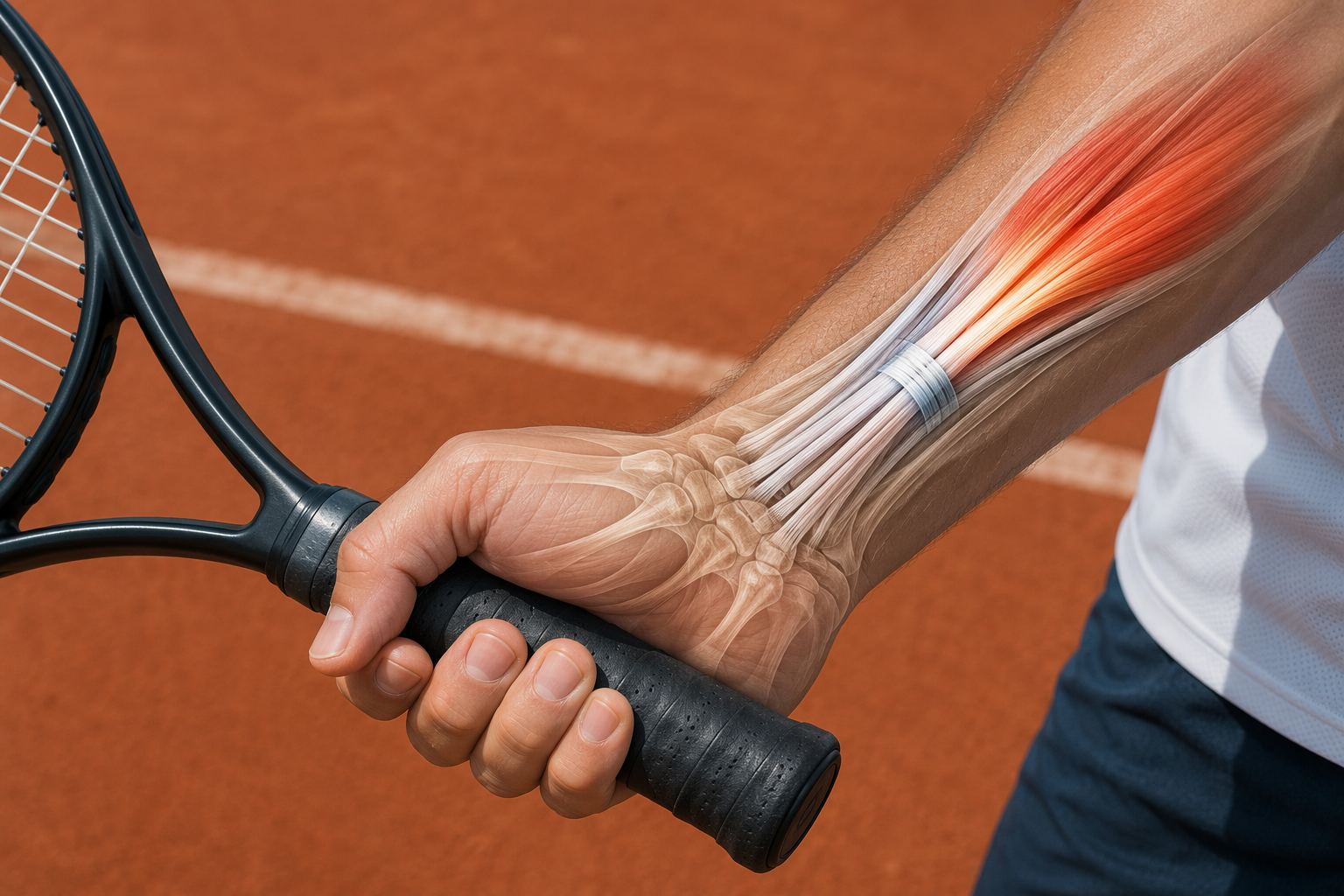
Forehand grip also belongs in the case discussion, but carefully. A review article summarizing Tagliafico and colleagues’ 2009 survey of 370 nonprofessional tennis players reported that 75% of players with wrist injuries used Western or semi-Western grips. [3] That does not prove Alcaraz’s grip caused his tenosynovitis. It does explain why grip style is clinically relevant when the injured area is the hitting wrist and the athlete uses an extreme forehand structure.
The workload context is just as important. Mayo Clinic hand surgeon Dr. Sanj Kakar noted that about 30% of upper-extremity tennis injuries involve the wrist and that an average match includes more than 1,000 ground strokes. [4] In that environment, "no tear" does not mean "low load." It means the clinician is managing a tissue that may look structurally preserved while still being exposed to a large number of forceful repetitions.
Timeline From Retirement to Planned Cincinnati Return
The public timeline begins on April 14, 2026, when Alcaraz retired from his Barcelona Open match against Virtanen because of the right-wrist problem. Clay Tennis later summarized the longest-injury update as a sequence that included immobilization, splint removal around June 17, progressive loading, and a planned Cincinnati return in mid-August. [5]
| Period | Clinical meaning |
|---|---|
| April 14, 2026 | Match retirement establishes that symptoms had reached a level incompatible with competition. |
| Mid-April to mid-June | Splinting reduces irritating motion and gives the tendon sheath a quieter environment. |
| Around June 17 | Splint removal marks a transition point, not a finish line. |
| Late June to July | Progressive loading tests whether the wrist can tolerate increasing force and repetition. |
| Mid-July | A "completely healed" report suggests tissue recovery, but does not by itself prove tennis-specific capacity. |
| Mid-August target | Cincinnati is the intended return window as of mid-July reporting, not an outcome available to evaluate yet. |
The splinting period is not an incidental detail. Immobilization tells you the staff wanted a meaningful unloading phase. For roughly nine weeks, the priority was not to prove toughness or preserve tournament rhythm. It was to quiet an irritated wrist enough that later loading would have a chance to succeed.
Once the splint came off, the problem changed. The athlete was no longer just protecting the wrist from symptoms. He had to regain range, strength, coordination, and tolerance to tennis-specific stress. A healed tendon sheath that has been protected for weeks may still be poorly prepared for match-speed racquet work.
Why Conservative Treatment Was Logical but Not Fast
Conservative management follows from the reported diagnosis. If the public diagnosis is tendon-sheath inflammation without fracture or tear, the first-line logic is unloading, symptom control, immobilization when needed, and gradual reloading. Surgery is not the defining question in that pathway.
The harder question is dose. Too little loading for too long leaves the athlete underprepared. Too much loading too soon reintroduces the same mechanical irritation that created the problem. That is why splint removal is a decision point, not a clearance note.
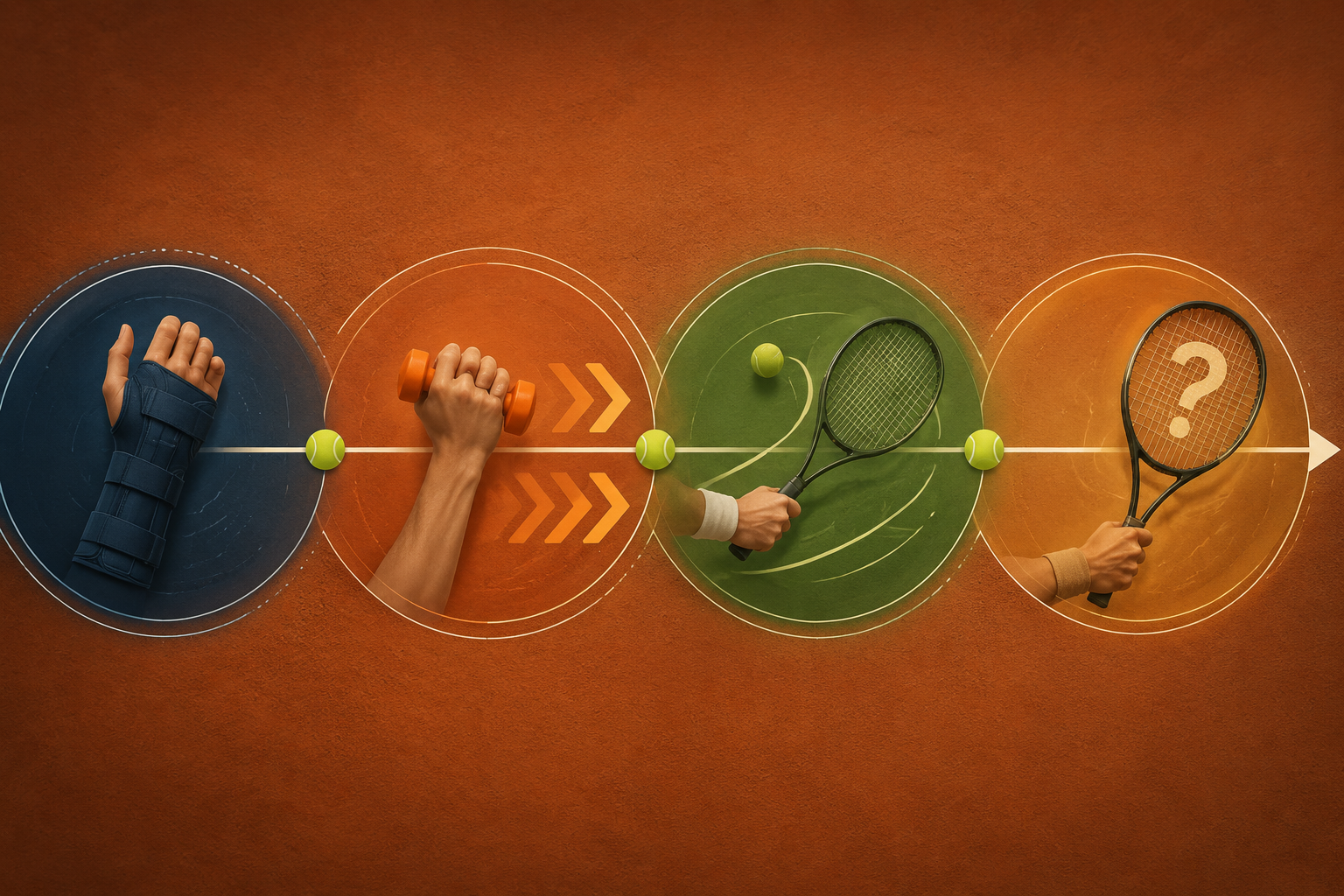
A reasonable progression after immobilization would move from basic motion and isometric tolerance into controlled resistance, then racquet handling, then abbreviated hitting, then fuller stroke volume, then practice sets, and only later tournament exposure. The public reporting does not give Alcaraz’s exact daily protocol, so those steps should be read as a typical clinical progression rather than a documented private plan.
The Four Capacities That Have to Rebuild
- Tissue irritability: the tendon sheath must tolerate motion without repeated inflammatory flare.
- Forearm strength and endurance: wrist control depends partly on the muscles that position and rotate the forearm.
- Stroke-specific load tolerance: the wrist has to survive tennis volume, not only clinic exercises.
- Decision speed under pressure: match play adds late contact, defensive reaches, and emergency grip changes.
- Psychological trust: the player must be willing to accelerate normally instead of protecting the wrist at contact.
Those capacities do not return at the same speed. Pain may settle before endurance returns. Range of motion may look acceptable before the wrist can handle thousands of impacts. A player can also complete a controlled practice block and still hesitate when a live point demands a full-speed forehand from an awkward position.
“Completely Healed” Is Not the Same as Competition-Ready
Mid-July reporting cited Dr. Angel Ruiz-Cotorro as saying the wrist was "completely healed," while still pointing toward Cincinnati as the comeback target rather than an immediate return. [5] That pairing is clinically sensible. Tissue status can improve before the athlete has rebuilt enough sport-specific capacity to compete safely.
For return-to-play purposes, the staff has to answer a different set of questions than a fan or tournament director. Can the wrist tolerate consecutive practice days? Does stroke mechanics remain normal when fatigue rises? Does the forehand speed come back without compensatory elbow, shoulder, or trunk changes? Does the athlete report confidence only during drills, or also during reactive points?
This is where recurrence risk becomes the central teaching point. Tenosynovitis may carry a low surgical risk in a case like this, but premature loading can recreate the same irritated tendon-sheath environment. In elite tennis, the risk is not one dramatic movement. It is the cumulative return of serve returns, running forehands, clay-court rallies, practice repetitions, and match pressure before the wrist has rebuilt capacity.
The Psychology of Hitting Through the Ball Again
Wrist injuries carry a particular psychological load in tennis because the player feels them at the racquet-hand interface. The Athletic reported that tennis players "fear wrist injuries more than any other" and described the hesitation that can appear when players return from them. The same reporting included Dr. Melissa Leber’s emphasis on rebuilding trust, not merely healing tissue. [6]
That hesitation has mechanical consequences. If an athlete protects the wrist at contact, the stroke can change upstream and downstream. Grip pressure may increase. The elbow may take more of the load. The shoulder and trunk may rush compensation. The ball may still go in, but the movement no longer represents the player’s normal pattern.
Tennis365 reported Garbiñe Muguruza warning that Alcaraz would need to control anxiety around the wrist during the return process. [7] That comment is more useful than a vague statement about confidence. Anxiety can change how an athlete accelerates, decelerates, and commits to contact. In a wrist case, the player has to trust the joint at the exact moment the sport asks for speed, precision, and repetition.
Historical Comparisons Belong in the Background
Wrist-injury history in tennis explains why the story attracts anxiety, but it should not be used as a prediction machine. The Athletic discussed Juan Martín del Potro as a player who never fully recovered from wrist issues and Dominic Thiem as a player whose career was derailed after a 2021 extensor carpi ulnaris injury. The same discussion also noted more favorable precedents, including Andre Agassi, Kim Clijsters, and Emma Raducanu returning after wrist injuries. [6]
Those names show the range of possible outcomes, not Alcaraz’s likely outcome. Different structures, diagnoses, surgical histories, ages, styles, and rehabilitation responses make direct comparison risky. For this case study, the historical material is most useful for one reason: it reminds students why return-to-play decisions around the wrist are treated with caution even when the immediate diagnosis is not a fracture or rupture.
Case Lessons for Sports-Medicine Students
- Do not grade severity only by structural damage. Tendon-sheath inflammation can create a long layoff when the sport repeatedly loads the same tissue.
- Separate diagnosis from mechanism. Tenosynovitis names the tissue problem; grip, surface transition, pronator teres involvement, and stroke volume help explain why the tissue became overloaded.
- Treat immobilization as the beginning of management, not the cure. Splinting can reduce irritation, but it also creates the need for careful reloading.
- Distinguish healed tissue from restored sport capacity. A wrist can be medically improved before it is ready for tournament repetition.
- Include psychological trust in return-to-play thinking. A player who cannot swing freely may still be functionally limited even if pain and imaging have improved.
As of July 20, 2026, the Cincinnati Masters remained a planned return target, not a completed test. That is the correct place to stop the case. Alcaraz’s 2026 wrist tenosynovitis shows that conservative management does not mean fast management, and that in elite tennis, a non-structural overuse wrist injury can be clinically serious because the final decision is not whether surgery is needed, but when repeated loading is safe enough to resume.
References
- Carlos Alcaraz’s Wrist Pain: An Orthopedic Look at Tenosynovitis in Tennis, Waterbury Hospital
- From tennis elbow to Alcaraz injuries, champions and fans, Il Sole 24 ORE
- Hand and Wrist Injuries in Tennis Players, Current Reviews in Musculoskeletal Medicine / NIH
- Mayo Clinic Minute: Researching tennis wrist injuries, Mayo Clinic
- Carlos Alcaraz’s longest injury update, Clay Tennis
- Tennis’ worst injury? Why wrist recovery and treatment are so complicated, The Athletic, May 20, 2026
- Carlos Alcaraz wrist injury complicated by need to control anxiety, Tennis365
Back to the exam this applies to
Target exam not specified — see all exam hubs.
Comments
Join the discussion with an anonymous comment.