
Comparison
What Students Can Learn from Warren Buffett's Luck vs. Skill Analysis
This article breaks down the research on luck and skill in Warren Buffett's career and shows students how to apply the same framework to understand their own academic results, reduce anxiety, and focus on what they can control: their study process and habits.
Verdict panel
- Compared
- not specified
- Target exam
- not specified
- Best for
- not specified
- Pricing last reviewed
- pricing currency unconfirmed
The worst time to judge your ability is usually ten minutes after a result arrives. You are staring at a test score, a curved grade, a rejection, or a class rank, and your brain wants a clean answer: was that me, or was that luck?
That question is not self-pity. It is a serious performance question. If the result mostly came from a bad process, you need to change how you study. If it mostly came from randomness — an unusually narrow exam, a harsh grader, a topic mix that missed your strongest areas — then punishing yourself may be as inaccurate as congratulating yourself too much after an easy win.
Warren Buffett is useful here not because students need another billionaire success story, but because his career is extreme enough to make the luck-versus-skill problem visible. Buffett himself has never treated success as a pure merit badge. In discussing the “ovarian lottery,” he has emphasized the role of being born in the United States at the right historical moment, and one account cites his estimate of 30-to-1 odds against that birth circumstance. He has also said, “Through dumb luck, Charlie and I were born in the United States, and we are forever grateful.” [1]
That admission matters because it comes from someone who also built one of the most studied investment records in modern finance. The point is not that Buffett was merely lucky. It is that serious people can admit randomness without becoming passive.

Buffett’s Career Is a Better Study Lesson Than a Success Poster
A sharp version of the luck argument comes from a GuruFocus article discussing Newfound Research’s Buffett analysis. The article reports a simulation of 5,875 independent investors with career lengths similar to Buffett’s, finding that the probability all of them would underperform Buffett was less than 1%. In plain English: in a large enough pool of skilled or semi-skilled participants, an extreme winner can appear partly because chance has to put someone near the top. [2]
That statistic should be handled carefully. The figure is coming through a secondary source, and the original Newfound publication would need to be checked before anyone treats it as the final word. But as a teaching point, it does useful damage to hero worship. If thousands of people are taking similar swings over long careers, the best-looking record may contain more randomness than the story told afterward admits.
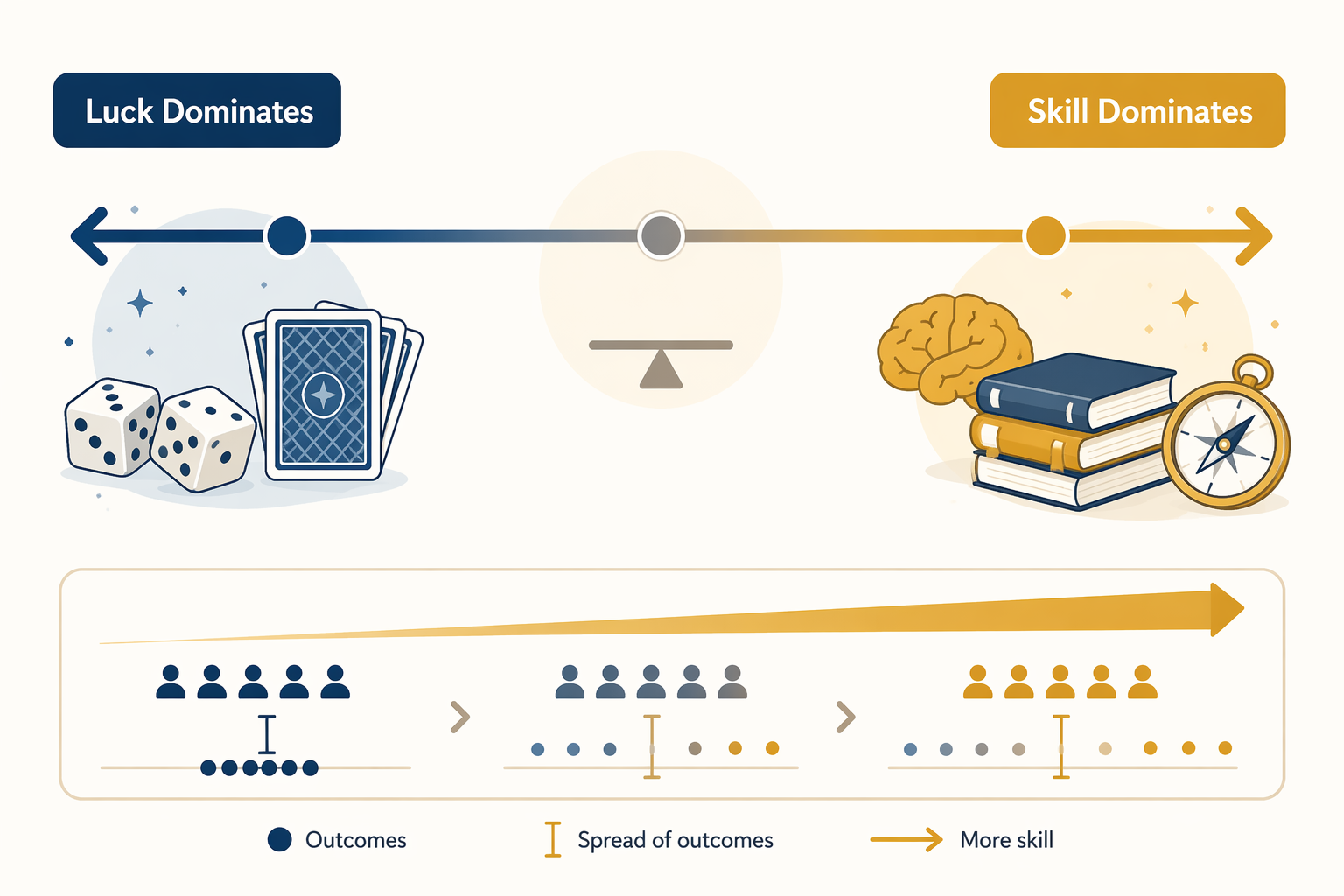
Students live inside a smaller version of that problem. In a competitive course, many people are capable, prepared, and nervous. When the skill level of the group rises, the remaining differences in grades can be pushed around more by smaller factors: which problems appeared, who slept badly, whose professor emphasized one unit, whose calculator failed, whose essay prompt fit the practice they happened to do.
Michael Mauboussin’s luck-skill framework explains why this feels so unfair. On his continuum, some activities are dominated by skill, others by luck, and many important outcomes sit between the two. His “paradox of skill” is especially useful for strong students: as competitors become more skilled, luck can play a larger role in separating final outcomes because the skill gaps have narrowed. [3]
That does not mean the prepared student and the unprepared student are equivalent. It means one exam score is a noisy measurement of preparation. A semester, a transcript, a portfolio of essays, or repeated practice tests usually tells you more than one result taken alone.
Three Layers: Structural Luck, Measurable Skill, and Student Process
The cleanest way to understand Buffett’s career is to separate three layers that often get mashed together: structural luck, measurable skill, and repeatable process. If you skip the first layer, you turn privilege into virtue. If you skip the second, you turn skill into myth. If you skip the third, the student has nothing useful to do on Monday.
Structural Luck: The Starting Line Is Not Even
Buffett’s own “ovarian lottery” language is a direct acknowledgment that starting conditions matter. Birthplace, timing, family environment, legal systems, markets, education, health, and social stability all shape the range of available moves. A student’s version may include school funding, family income, internet access, caretaking responsibilities, disability accommodations, neighborhood safety, or whether anyone at home knows how college admissions works.
No study method can erase those differences. Pretending otherwise is not motivational; it is lazy analysis. Two students can work equally hard and face very different friction. One has quiet evenings and paid test prep. Another studies after a shift and shares a room. The second student does not need a lecture about grit before anyone notices the load they are carrying.
Still, structural luck is not the same as daily helplessness. It defines constraints and advantages. It does not inspect your flashcards, choose your review schedule, or decide whether you learn from a missed problem. For next-week decisions, the useful question is narrower: within the circumstances you actually have, which parts of the process can be improved?
Measurable Skill: Buffett’s Results Were Not Magic
AQR’s “Buffett’s Alpha” study is helpful because it does not describe Buffett’s success as a fog of genius. The authors report a Sharpe ratio of 0.76 and connect his performance to identifiable features: buying cheap, safe, quality stocks and using roughly 1.6-to-1 leverage, aided by insurance float with an estimated cost of about 1.72%. [4]
For students, the finance details matter less than the structure of the explanation. Skill is not just “being smart.” It is a set of repeatable choices made under uncertainty. Buffett’s process had selection criteria, patience, access to capital, and a way to stay in the game long enough for compounding to matter.
The student analogue is not leverage in the financial sense. It is a system advantage. A student with a reliable calendar, a review loop, organized notes, active recall prompts, spaced repetition, office-hour questions, and sleep protection has a form of academic float: a structure that keeps supplying attention and feedback before panic sets in.
That is why scattered productivity hacks rarely hold up. A serious process has to connect the parts. If your notes live in one place, your flashcards in another, your deadlines in your head, and your weak areas nowhere, the system leaks. A cohesive study tool stack is not about owning more apps. It is about making the next right study action easier to find.
Student Process: The Skill Side You Can Actually Audit
Once luck and structure are admitted, process becomes more important, not less. The reason is simple: outcomes are noisy, but process is inspectable.
| Layer | Buffett Example | Student Translation |
|---|---|---|
| Structural luck | Birthplace, timing, market environment, access to insurance float | School quality, family resources, health, time, prior preparation |
| Measurable skill | Cheap, safe, quality investing; discipline; patient compounding | Choosing effective methods, tracking weak areas, reviewing consistently |
| Repeatable process | Reading, thinking, refining decisions over decades | Active recall, spaced repetition, practice testing, feedback loops |
A grade tells you what happened. A process review tells you what to change. Those are not the same task.
Why Strong Students Sometimes Feel More at the Mercy of Luck
The paradox of skill explains a common academic experience: the better the room gets, the less fair the ranking feels. In an easy class with huge preparation gaps, skill differences dominate. The student who studied usually beats the student who did not. But in an honors class, a selective major, a scholarship cohort, or a competitive pre-med course, many students are already doing the obvious things right.
At that point, smaller variables can move the result. One student reviewed exactly the enzyme pathway that appeared. Another knew the broader unit but missed the wording. One essay grader rewards concise structure. Another wants more theoretical framing. A curve can turn a small raw-score difference into a large emotional difference.
This is where students often make the wrong inference. A disappointing result in a high-skill environment does not automatically mean the process failed. It may mean the result is a weaker signal than it feels like in the moment.
James Clear’s distinction helps: “Absolute success is luck. Relative success is hard work.” His framework argues that as outcomes become more extreme, luck’s role grows, while among people facing broadly similar circumstances, habits and choices explain more of the differences. [5]
For a student, that means you should be careful with both comparison and despair. You cannot compare your entire life situation against the top visible result and call the gap a personal failure. But within your actual peer set and constraints, better systems still matter. Relative improvement is where effort has its cleanest job.
Stop “Resulting” After Every Grade
The CFA Institute describes “resulting” as the trap of judging decision quality by outcome quality. In investing, a bad decision can make money, and a good decision can lose money. The same problem shows up in school: cramming can produce an A on a familiar exam, while steady review can produce a disappointing grade if the test samples unexpected material. [6]

Resulting is emotionally tempting because grades are concrete. A 92 feels like proof. A 71 feels like a verdict. But both can hide the quality of the decisions underneath.
After a result, separate outcome review from process review. The outcome review asks what happened: score, curve, missed topics, time pressure, grading comments. The process review asks what you did before the outcome existed.
- Was review spread across days or compressed into one late session?
- Did you practice retrieving answers from memory, or mostly reread notes?
- Did you track weak areas after homework, quizzes, or practice questions?
- Did your practice match the format and difficulty of the exam?
- Did sleep, work, illness, anxiety, or time pressure affect the result?
Those questions are less dramatic than “Am I smart?” They are also more useful. “I reread for six hours and recognized everything” points to a different fix than “I used recall practice but ignored the professor’s old problem style.”
This is where active recall earns its place. It turns studying from recognition into retrieval. You find out what you can produce without the answer in front of you, which is closer to what exams demand. Spaced review then keeps that knowledge alive long enough to use it later, whether through a notebook system, a question bank, or spaced repetition flashcard tools.
Use the Persistence Test: Which Parts Actually Respond to Effort?
Mauboussin’s persistence idea gives students a calmer way to classify academic work. In high-persistence activities, repeated effort tends to produce repeated improvement. In low-persistence activities, the same process can lead to more varied results because luck has more room to interfere. [3]
Studying with retrieval practice is relatively high-persistence. If you repeatedly test yourself, correct errors, revisit weak material, and space the review, your command of the material usually improves. The exact next test grade is lower-persistence. It depends on question selection, grading choices, curve behavior, time limits, and your condition that day.
So do not put all your emotional weight on the lower-persistence signal. Track the higher-persistence inputs.
| What You Are Judging | More Skill-Driven or More Luck-Exposed? | Better Student Response |
|---|---|---|
| Did I complete spaced review sessions? | More skill-driven | Protect the schedule and adjust volume |
| Did I retrieve answers without looking? | More skill-driven | Increase active recall and mixed practice |
| Did this one exam match my strongest units? | More luck-exposed | Note the mismatch, but do not rewrite your identity |
| Did the curve move my grade sharply? | More luck-exposed | Review class context before judging your process |
| Did the same weakness appear across several assessments? | More skill-driven signal | Change the method, not just the mood |
This distinction is especially important for scholarship students, athletes with eligibility rules, international students maintaining status, and anyone whose aid depends on grades. When a number has consequences, it is hard not to treat it as a moral verdict. But consequence and measurement quality are different things. A grade can matter deeply and still be an imperfect signal.
Buffett’s Reading Habit Is About Compounding, Not Aesthetic Productivity
Buffett’s reading habit gets repeated so often that it can become useless advice: read more, become great. The better lesson is about compounding knowledge through a consistent information diet and long periods of thinking.
Farnam Street reports Buffett’s advice this way: “Read 500 pages every day. That’s how knowledge works. It builds up like compound interest.” The same account says Buffett spends about 80% of his workday reading and thinking. [7]
Most students cannot, and should not pretend they can, copy that literally. You have classes, labs, work, family responsibilities, practices, and sleep to protect. The transferable principle is not the page count. It is the habit of feeding the mind with high-quality material before the deadline creates panic.
Investopedia’s account of Todd Combs, who reportedly took Buffett’s reading advice seriously, tracked daily pages, and later became a Berkshire investment officer, is vivid because it shows reading as tracked behavior rather than a personality trait. [8]
For school, passive reading is not enough. A biology chapter, a history monograph, or an economics paper has to be converted into questions, examples, diagrams, explanations, and review prompts. Reading builds the raw material; retrieval and spacing make it available under pressure.
If you are starting from scratch, a simple setup works better than an elaborate one: one place for deadlines, one place for notes, one place for recall prompts, and one review rhythm you can actually maintain. Students who want a flashcard-based system can start with a reliable spaced repetition app; if Anki is the route, use a safe download path rather than grabbing a lookalike from search results. A practical Anki download guide is enough to remove that friction.
A Post-Result Audit That Does Not Lie to You
The useful move after a grade is not instant optimism. It is a clean audit. You are trying to avoid two errors: blaming luck for a weak process, and blaming your character for a noisy outcome.
Use three columns: outcome factors, luck factors, and process factors. Keep the wording plain. You are not writing a courtroom defense. You are building the next version of the system.
| Audit Column | What Goes There | Example |
|---|---|---|
| Outcome factors | What actually happened | Lost points on timing, two conceptual errors, one misread prompt |
| Luck factors | Conditions you could not reasonably control | Exam emphasized a minor topic, grading was stricter than the rubric suggested |
| Process factors | Choices or systems you can change | Started review too late, did too much rereading, skipped practice under time limits |
Then make one process change, not seven. If timing hurt you, add timed sets. If recall failed, replace some rereading with blank-page retrieval. If forgetting hurt you, schedule spaced reviews earlier. If the exam format surprised you, collect old prompts, professor examples, or practice problems that better match the assessment.
This approach also protects you after good results. If you earned a high grade after cramming, do not let the outcome certify the method. Ask whether the same process would survive a harder exam, a busier week, or a cumulative final. Sometimes the grade is real and the process is fragile.
What This Means Before the Next Exam
Before the next assessment, shift attention from predicting the outcome to improving the repeatable inputs. That sounds small, but it changes the week.
- Start review early enough that forgetting has time to reveal itself.
- Use active recall before you feel ready, because recognition is a weak test.
- Space difficult material across several days instead of giving it one heroic night.
- Track repeated misses by concept, not just by assignment.
- Practice in the format that will judge you: essays, proofs, timed sets, oral explanations, lab applications.
For high-stakes tests, the same principle becomes even more important because one score can carry outsized consequences. A structured plan, like a GRE study plan with free tools if that is your exam, helps keep the work attached to a process instead of a mood.
None of this guarantees a specific score. That is the honest part. You can improve the odds without controlling the whole distribution. Buffett’s career makes that tension easier to see: luck shaped the opportunity set, skill shaped the repeated decisions, and time magnified both.
Students cannot audit every piece of luck in their lives, and grades are not perfect measures of worth. But after each academic result, you can separate what happened from what you did, mark the luck factors without worshiping them, adjust the process factors without self-contempt, and keep compounding.
References
- Warren Buffett Describes the Important Role of Luck in his Investment Career — Dr. David Kass, UMD
- Warren Buffett: More Luck Than Skill? — GuruFocus
- Michael Mauboussin: Untangling Skill and Luck in Business, Sports, and Investing — Farnam Street
- Buffett's Alpha — AQR Capital Management
- Absolute Success is Luck. Relative Success is Hard Work. — James Clear
- Luck vs. Skill: Great Investment Leaders Know the Difference — CFA Institute, 2025
- The Buffett Formula: Going to Bed Smarter Than When You Woke Up — Farnam Street
- Transform Your Financial Future With Warren Buffett's Reading Habit — Investopedia
Back to the exam this applies to
Target exam not specified — see all exam hubs.
Comments
Join the discussion with an anonymous comment.