
Comparison
The Budget Europe Travel Toolkit Every Student Needs
Curates the essential apps, transport passes, booking platforms, and discount cards that can cut a student's Europe trip cost by 30–50% compared to ad-hoc planning. From FlixBus to Interrail, find out which tools are worth downloading before you depart.
Verdict panel
- Compared
- not specified
- Target exam
- not specified
- Best for
- not specified
- Pricing last reviewed
- pricing currency unconfirmed
A cheap Europe trip is rarely cheap because of one magic booking. It gets cheaper when the small systems are in place before anyone in the group chat starts panic-buying: route search, booking timing, baggage math, hostel geography, currency fees, shared expenses, student discounts, and a real buffer for the things that go wrong.
Prices in this guide are checked against 2026 travel sources as of July 20, 2026. Treat them as planning ranges, not promises. Bus fares, hostel beds, budget-airline fees, and pass prices can move quickly once weekends, festivals, strikes, school breaks, or luggage rules get involved.
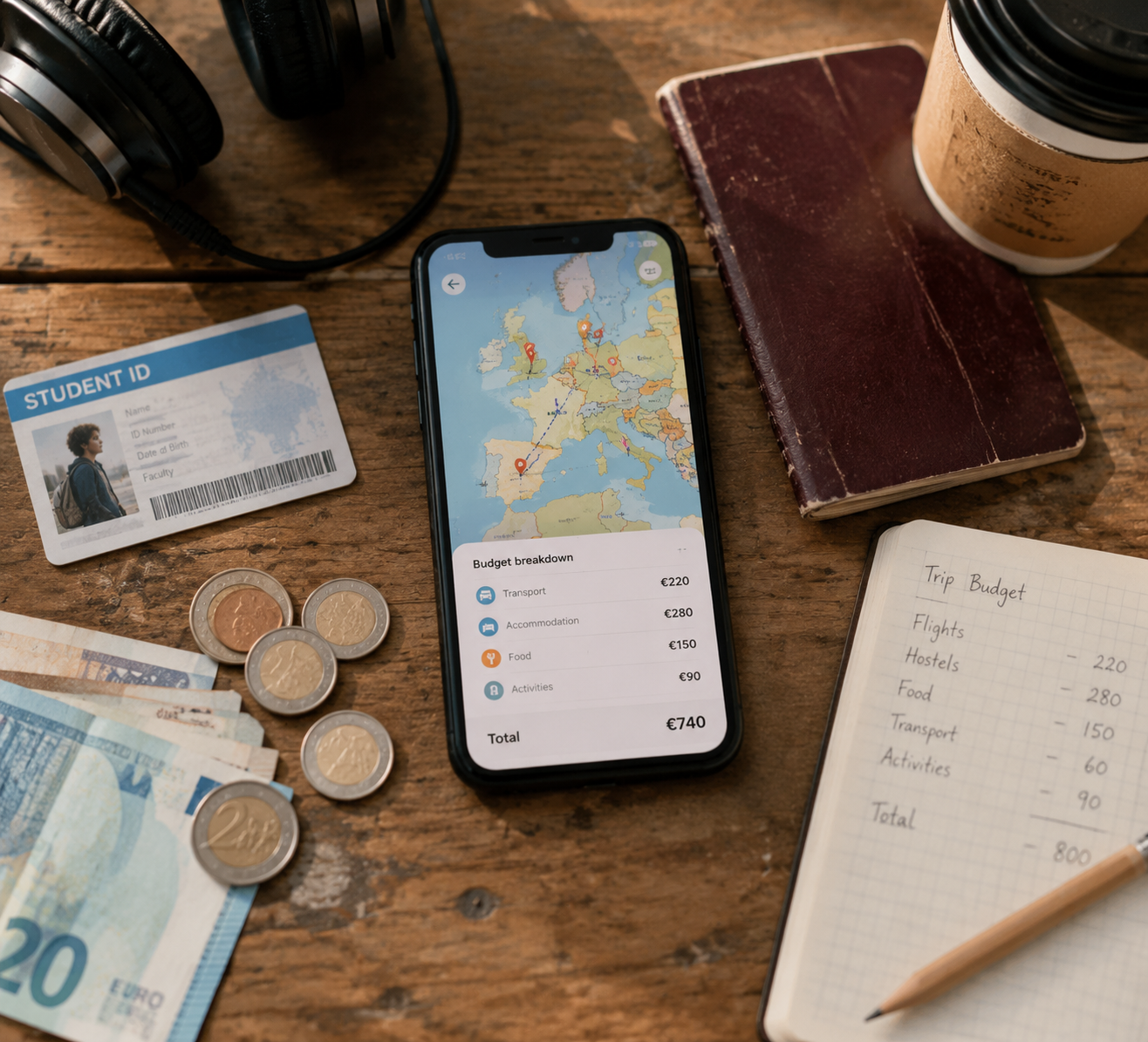
For budget Europe travel for students, the goal is not to download every travel app with a cute icon. It is to leave with a small toolkit that answers six questions fast: Where is cheap to go? What route actually makes sense? Is the bus, carpool, flight, train, or rail pass cheaper after fees? Where can I sleep without wrecking the budget? How do we stop group spending from becoming emotional accounting? Which student discounts are real enough to check before paying full price?
The Student Travel Toolkit, Before Anything Is Booked
This is the lean version: 14 tools and resources, grouped by the decision they help with. Some save money directly. Others only save money if they change your behavior early enough, which is the difference between using Google Flights Explore in March and opening it the night before a Friday departure.
| Decision | Tool or resource | Best use | Main mistake to avoid |
|---|---|---|---|
| Pick a cheap destination | Google Flights Explore | Let price decide the city when your dates are flexible | Choosing a cheap flight to an expensive hostel city |
| Map route options | Rome2Rio | See whether bus, train, flight, ferry, or car routes exist | Treating estimates as final prices |
| Compare and book transport | Omio | Compare buses, trains, and flights in one place | Forgetting to check the operator’s own baggage and ticket rules |
| Cheap buses | FlixBus | Book common city-to-city routes 2–3 weeks ahead | Waiting until the route is full or nearly full |
| Carpool rides | BlaBlaCar | Compare against buses on medium-distance routes | Ignoring pickup location, luggage space, or driver reviews |
| Budget flights | Ryanair and other low-cost airlines | Use only when the total after bags and airport transfer still wins | Believing the headline fare |
| Rail-heavy trips | Interrail or Eurail | Use for multi-country train days with expensive individual tickets | Buying a pass before pricing the actual route |
| Overnight travel | Nightjet | Replace one hostel night with a sleeper or couchette journey | Comparing train fare only against a daytime bus, not against bus plus bed |
| Hostel booking | Hostelworld or Booking.com | Compare dorm price, location, lockers, cancellation, and reviews | Choosing the cheapest bed so far outside the center that transit eats the savings |
| Payments | Revolut | Hold and spend in multiple currencies with lower exchange-fee friction | Assuming every ATM withdrawal or weekend exchange is free |
| Group expenses | Splitwise | Track who paid for rooms, groceries, transport, and tickets | Settling only at the end after people forget what was shared |
| Student discounts | ISIC | Check attractions, transport, food, and local partners | Treating “up to” discounts as guaranteed |
| Local student transport | Semesterticket or university mobility benefits | Use enrolled-student benefits in Germany, the Netherlands, or Austria where available | Paying visitor fares when your enrollment already covers some regional travel |
| Emergency buffer | Separate savings pot | Protect the trip from missed buses, illness, fees, or rebooking | Spending the buffer because the first three days went well |
The toolkit works best in order. Start with destination and route search, then choose transport, then book beds, then set up payments and group tracking, then check discounts. Doing it backward is how students end up with a €19 flight into a city where the dorm bed costs more than the ticket.
Start With Destinations Where the Daily Math Is Already Easier
Google Flights Explore is useful because it changes the first question from “How do we make Barcelona cheap?” to “Where is cheap from here on these dates?” In 2026 budget planning, that matters. A low flight fare can still be a bad deal if the destination turns every night, coffee, local ride, and museum ticket into a negotiation.
Explore mode lets students search from a departure city and scan cheaper destinations instead of typing one dream city at a time. That makes it especially useful for study-abroad weekends, spring breaks, and friend groups that care more about going somewhere good than about checking off one specific capital.[1]
Destination cost differences are not subtle. Hostel dorms in Prague, Budapest, and Kraków are often cited around €10–€16 per night, while Amsterdam or London dorms are more often in the €30–€45 range.[1][2] That gap can erase the advantage of a cheap Western Europe flight in two nights.

Eastern Europe is not automatically cheap in every neighborhood or every season, and Western Europe is not automatically impossible. But for students starting with a fixed semester budget, the region changes the baseline. A city where the normal dorm bed is €14 gives you more room for food, entrance fees, late-night transit, and one mistake.
City rankings can help, as long as they are treated as prompts rather than commandments. Time Out ranked Tirana as the cheapest European city break for 2026 and noted Bulgaria’s euro adoption in 2026, which is worth remembering because some Bulgarian prices may still feel in transition to travelers comparing older lev-based advice with current euro pricing.[3]
Use Rome2Rio and Omio to See the Shape of the Trip, Not to Stop Thinking
Rome2Rio is the “what is even possible?” tool. It is helpful when a route has awkward geography, like trying to connect a smaller university town to a second-tier airport, or when the cheapest-looking trip may involve a bus, regional train, ferry, or airport shuttle. It is less useful as a final price authority. Use it to discover route shapes, then verify with the transport operator or booking platform.
Omio is the cleaner comparison layer for students who want buses, trains, and flights in one place. Its value is speed: one search can show that the flight is faster but not cheaper after bags, or that the bus is cheap but arrives at 4:40 a.m., which is only a bargain if your hostel reception and your nervous system can handle it.
The rule is simple: use comparison tools to narrow choices, then check the original operator before paying. Ticket flexibility, seat reservations, luggage, strikes, refunds, and station location are where “same route” stops meaning “same trip.”
Transport Is Where Most Student Budgets Win or Bleed
Transport deserves the most attention because it is where cheap travel advice gets lazy. “Take the bus” is sometimes right. “Fly budget airlines” is sometimes right. “Buy a rail pass” is sometimes right. The expensive part is assuming one of them is always right.

FlixBus: strongest when you book before the obvious weekend rush
FlixBus is the default student option for a reason: it connects more than 2,500 cities across 40 countries, and common routes can still sit around €10–€25 when booked two to three weeks ahead.[4] That timing is the important part. FlixBus is not magic; it is inventory. The route that looked like a casual €14 decision on Monday can become the whole dinner budget by Thursday if everyone is trying to leave after class on Friday.
Use it for direct or nearly direct city pairs, especially when the bus station is central enough that you do not need a long local transfer. Be more careful with overnight buses that arrive too early, routes with long layovers, or trips where one delay breaks a separate connection.
BlaBlaCar: cheaper when the route and pickup actually work
BlaBlaCar can beat the bus on medium-distance routes. Student travel sources report it as typically 30–50% cheaper than FlixBus on the same route, with examples such as Berlin to Prague for €8 and Paris to Lyon for €12.[4][5] That is real savings, especially for weekend travel where €10 saved on transport becomes lunch, a locker, or a museum ticket.
The catch is that carpooling is less standardized than a bus ticket. Before choosing it, check the driver’s reviews, luggage space, pickup point, drop-off point, cancellation pattern, and whether the timing depends on someone else’s commute. For solo travelers, especially late at night, comfort and safety should outrank saving a few euros.
Ryanair and budget flights: do the bag math before celebrating
Ryanair’s headline fares can start from €9.99, but the more realistic total with a carry-on bag is often around €30–€60.[1] That can still be a good deal. It is just not the same deal as the fare shown in the first screenshot sent to the group chat.
Budget flights become weaker when the airport is far from the city, the cheapest flight leaves before public transit starts, or the bag policy forces everyone into paid carry-ons. Add airport transfers, seat or check-in rules where relevant, and the cost of arriving tired enough to waste the first day. A €24 fare that requires a €17 shuttle and a paid bag is not a €24 trip.
Interrail or Eurail: worth pricing, not worth worshipping
The Interrail Youth Pass can be excellent on the right itinerary. One 2026 student travel source lists the under-27 Interrail option at €185 for four travel days in one month, with potential savings of €50–€120 versus individual tickets on a multi-country trip.[4] That is the kind of pass that can make sense if you are using those travel days on expensive train legs rather than short hops with cheap buses.
The residency distinction matters: Interrail is for European residents, while non-European students generally need the Eurail equivalent, which may have different pricing and conditions. Also check seat reservations. A pass can cover the right to travel while still leaving you with mandatory reservation fees on some trains, especially high-speed or international services.
A pass is strongest when your plan has several long, rail-friendly legs; when you value flexibility; and when individual train tickets are already expensive. It is weaker when your route is mostly Eastern European buses, short regional hops, or cheap point-to-point tickets booked early.
Nightjet: compare it against transport plus a bed
Night trains are one of the few tools that can replace a cost instead of only reducing it. Nightjet fares are cited around €29–€59, and the obvious student logic is that the ride can also save a night of accommodation.[4] The comparison should be against “daytime transport plus hostel,” not against a bus fare alone.
That does not mean every night train is comfortable or cheap. A seat is different from a couchette, and a bad night of sleep has a cost when you only have two days in a city. Use Nightjet when the schedule is clean, the arrival time is usable, and the total beats the daytime alternative after lodging.
Hostels: Price the Bed, Then Price the Location
Hostelworld and Booking.com are not just places to find the cheapest dorm. They are where you prevent a cheap bed from turning into daily transit leakage. A hostel outside the center can be fine if transit is frequent and cheap. It is less fine if every evening ends with a paid ride or a long walk through a neighborhood nobody bothered to research.
Start with the dorm price range for the city, then check four things before booking: distance to the arrival station or airport link, distance to the places you will actually visit, locker and luggage storage rules, and cancellation terms. If your group is split between “cheapest possible” and “please let us sleep,” reviews about noise matter more than another €2 saved.
For students traveling in a group, private hostel rooms can sometimes compete with dorm beds, but only if the room fits the actual group size and does not require prepayment from one unlucky person. This is where Splitwise should already be installed, not introduced after someone has fronted €300.
Stop Losing Money in Payments and Group Expenses
Payment tools do not feel as exciting as finding an €8 ride, but they protect the budget from quiet leaks. Revolut is useful for international students because it lets users hold and spend in 28 currencies at interbank exchange rates with no hidden fees, according to student budgeting app guidance.[6] That is especially helpful on trips crossing currency zones, or for students based outside the euro area.
Read the account limits before relying on it. ATM withdrawals, weekend exchanges, premium features, and local card acceptance can change the result. The useful habit is not “pay with one app forever”; it is checking conversion costs before withdrawing cash at the first airport ATM with a terrible exchange screen.
Splitwise solves a different problem: the slow resentment of group travel. It is widely recommended for splitting shared international-student expenses, and on a Europe trip it belongs on everyone’s phone before the first hostel deposit, grocery run, taxi, or museum bundle is paid by one person.[6]
The best setup is boring: create the trip group before departure, choose one settlement currency, add expenses the same day, and mark what was personal. If someone buys their own airport sandwich, that is not a shared expense. If someone pays the city tax at check-in because the hostel asks for cash, it is.
Student Discounts Are a Checkpoint, Not a Personality
The ISIC card can be worth having, especially for students who visit paid attractions, use transport partners, or spend time in cities where student pricing is common. Student travel sources describe ISIC discounts as reaching up to 50% off attractions, transport, and food across Europe.[4]
“Up to” is doing a lot of work there. Do not build a budget assuming half-off everywhere. Instead, check the official ISIC app or site against your actual itinerary: museums, galleries, local transit, buses, food partners, and occasional tours. Also carry your university ID, because some ticket desks care more about proof of current enrollment than about the specific card brand.
Study-abroad students should also check local enrollment benefits. Semesterticket systems in Germany, the Netherlands, and Austria can give enrolled students free or deeply discounted regional travel, depending on the university and local rules.[5] This is not a tourist hack. It is an enrollment benefit, and it is exactly the kind of thing students miss when they plan weekend trips as if they were short-term visitors.
When Each Tool Is Actually Worth It
The toolkit is only useful if it leads to different choices. If you install everything and still book the first convenient option at midnight, the apps have mostly become decoration.
| Use this | When it is worth it | Skip or question it when |
|---|---|---|
| Google Flights Explore | Dates or destinations are flexible and you can choose a cheaper city first | You already have fixed cities and non-flexible dates |
| Rome2Rio | You need to understand possible route shapes between cities | You are ready to buy and have not checked live operator rules |
| Omio | You want quick comparison across bus, train, and flight options | The operator site offers clearer baggage, refund, or student rules |
| FlixBus | The route is direct, booked 2–3 weeks ahead, and lands at a usable time | Arrival time, layover risk, or last-minute pricing makes it painful |
| BlaBlaCar | Driver reviews, pickup, drop-off, luggage, and timing all work | You feel unsafe, the route is vague, or savings are tiny |
| Ryanair | Total cost after bags and airport transfer still beats bus or train | The fare is only cheap before carry-on, timing, or transfer costs |
| Interrail or Eurail | You have several expensive train legs and need flexibility | Your route is mostly cheap buses, short hops, or requires many reservations |
| Nightjet | It replaces both transport and one hostel night without ruining the next day | You are comparing it only against a daytime bus fare |
| Hostelworld or Booking.com | You compare location, reviews, lockers, and cancellation alongside price | The cheapest bed adds daily transit cost or bad sleep |
| Revolut | You cross currencies or want lower exchange-fee friction | You have not checked limits, withdrawal rules, or card acceptance |
| Splitwise | Two or more people share rooms, groceries, rides, or tickets | Nobody agrees on what counts as shared before the trip |
| ISIC | Your itinerary includes paid attractions or partners with real discounts | You assume every student price requires or accepts it |
The biggest trap is buying a tool because it sounds student-friendly. A rail pass, discount card, or multi-currency account is not automatically frugal. It becomes frugal when it matches the route, country, timing, and actual habits of the people traveling.
Keep a Buffer, Because Europe Will Not Respect the Spreadsheet
A student travel budget without a buffer is just a plan that has not met a missed bus yet. AIFS Abroad recommends setting aside an emergency fund of 15–20% of the total travel budget for unexpected costs.[7] That sounds annoying until the first time someone needs a replacement ticket, medicine, a locker, an extra night, or a taxi after public transit shuts down.
Keep the buffer separate from daily spending. If the trip budget is visible as one big balance, it becomes very easy to decide that the emergency money is actually tapas money. It is not. It is what stops one bad transfer from becoming three days of financial damage.
A Practical Pre-Departure Routine
Before booking, open Google Flights Explore for destination ideas, then Rome2Rio for route shapes, then Omio plus the operator sites for actual transport choices. Check FlixBus two to three weeks ahead where possible. Compare BlaBlaCar on medium routes. Price Ryanair only after bags and airport transfer. Test Interrail or Eurail against the actual train legs, not against the fantasy of unlimited movement.
Before departure, install only what the trip will use: FlixBus, BlaBlaCar, airline apps if flying, rail or Nightjet apps if relevant, Hostelworld or Booking.com, Revolut or your chosen payment app, Splitwise, and ISIC if discounts match the itinerary. Save tickets offline. Screenshot hostel addresses. Put the emergency buffer somewhere separate. Make the group agree, in advance, what counts as shared spending.
Students do not need every cheap travel trick in Europe. They need the small stack that prevents the expensive mistakes: booking too late, trusting base fares, sleeping in the wrong location, forgetting currency costs, letting one person carry group expenses, and assuming student discounts will appear automatically at the ticket desk.
References
- The 6 Cheapest Ways to Travel Europe in 2026 - Happy to Wander
- Europe Budget Travel Guide (Updated 2026) - Nomadic Matt
- The cheapest city breaks in Europe for 2026 – ranked - Time Out
- Cheapest Ways to Travel Europe as a Student 2026 Blog - Study-Abroad.org
- 7 Tips for Student Travel in Europe on a Budget - Transitions Abroad
- Best Budgeting Apps for International Students 2026 - BestStudentHalls
- Money Matters: Budgeting Tips for Student Travel in Europe - AIFS Abroad
Back to the exam this applies to
Target exam not specified — see all exam hubs.
Comments
Join the discussion with an anonymous comment.