Comparison
The Best iPhone for Students Depends on Your Exam
This article helps students choose the right iPhone for their specific standardized exam prep, matching features like Apple Intelligence, battery life, and cost to the demands of SAT/ACT, GRE, MCAT, or ASVAB.
Verdict panel
- Compared
- iPhone 17e, iPhone 17, iPhone 17 Pro Max, iPhone 13
- Target exam
- SAT, ACT, GRE, MCAT, ASVAB
- Best for
- students preparing for SAT/ACT, GRE, MCAT, or ASVAB
- Pricing last reviewed
Ask “which iPhone is best for students” and the answer gets messy fast, because a student is not a single buying category. A junior taking the SAT, a GRE applicant revising essays, an MCAT student living in Anki, and an ASVAB candidate heading to a government-administered test do not need the same phone. Pricing here is reviewed as of July 22, 2026, using Apple’s U.S. pricing context, and it can change quickly with carrier deals, trade-ins, refurbished inventory, or a possible iPhone 18 launch window in September or October 2026.[1][2][3]
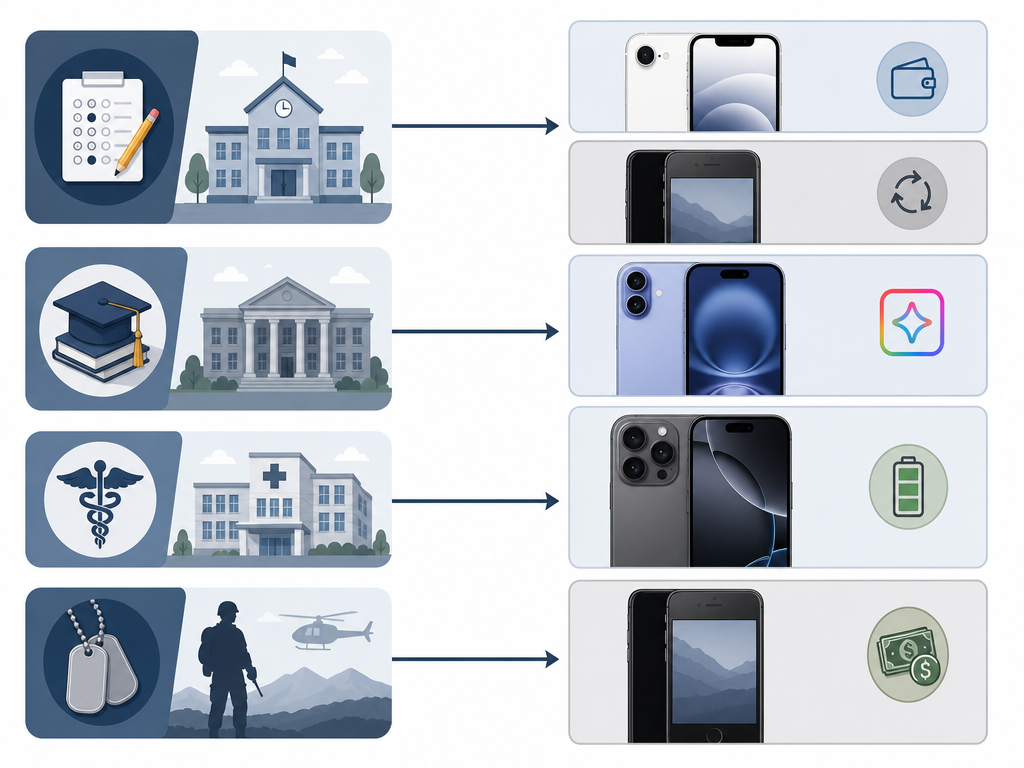
| Exam | Best iPhone fit | Why this fit makes sense | When to change the pick |
|---|---|---|---|
| SAT/ACT | iPhone 17e, or refurbished iPhone 13 if the family budget is tight | Core study apps run well on iPhone 13 and newer; the phone should not crowd out exam fees, prep materials, or tutoring time. | Move up only if a carrier deal makes the newer phone genuinely cheaper over the full contract. |
| GRE | iPhone 17 | Apple Intelligence Writing Tools are the study-relevant difference for essay drafting and revision, and the iPhone 17 gives that without jumping to Pro pricing. | Choose iPhone 17e instead if the student wants Apple Intelligence but does not need the iPhone 17’s other upgrades. |
| MCAT | iPhone 17 Pro Max | The long battery life is the one premium-phone feature that can matter during all-day study blocks away from outlets. | Buy cheaper if the upgrade gap would replace registration money or a serious prep subscription. |
| ASVAB | Refurbished iPhone 13 | The ASVAB is not taken on the student’s phone, so a reliable older iPhone is enough for apps, reminders, and study materials. | Upgrade only if the refurbished phone has poor battery health or a short warranty. |
SAT and ACT: Keep the Phone From Eating the Prep Budget
For SAT and ACT students, the safest recommendation is the iPhone 17e at $599, with a refurbished iPhone 13 as the budget backup. This is usually a parent-and-student purchase, which means the phone has to survive more than a spec comparison. It has to fit around registration fees, prep books, calculator needs, school policies, screen-time rules, and the ordinary reality that someone else may be paying the bill.
The study workflow is not demanding in a phone-performance sense. SAT and ACT prep usually means Khan Academy, Quizlet, a planner, browser-based practice, PDFs, photos of missed problems, and reminders. The research boundary that matters here is simple: iPhones from the 13 series onward run the core study apps named in the brief—Anki, Quizlet, Khan Academy, and UWorld—well enough for exam prep. That makes the newest chip less important than price discipline.
The iPhone 17e still gives students the modern iPhone safety net: current software support, Apple Intelligence availability, and a 48MP main camera class that is more than enough for scanning worksheets, whiteboards, and textbook pages.[4][5] But for SAT and ACT prep, those are mostly eliminators. They tell you the cheaper phone is not a sacrifice in the places that matter; they do not automatically justify moving higher.
A refurbished iPhone 13 makes sense when the family is already juggling test dates, school expenses, and prep materials. The research brief places certified-reseller refurbished iPhone 13 pricing around $250–350, with the important warning that Apple Certified Refurbished, Swappa, and other U.S. sellers can move by $50–100 depending on condition and warranty. At that price, the older phone covers the prep job while leaving more room for the things that actually sit between the student and the test.
If SAT prep is the main concern, start with a tool plan before approving the phone upgrade: SAT study tools guide, Khan Academy SAT prep review, and high school revision timetable template are more useful first checks than another camera comparison.
GRE: Pay for Writing Help Only If You Will Use It
For GRE students, the iPhone 17 is the cleanest middle pick. The reason is not that every graduate applicant needs a shinier phone. It is that GRE prep has a writing workflow where Apple Intelligence can plausibly change behavior: drafting an analytical response, tightening a paragraph, checking tone, rewriting a clumsy transition, and comparing versions before the student sits down for a timed essay.
Apple says Apple Intelligence includes Writing Tools, Live Translation, and Visual Intelligence, and the feature set is available on iPhone 15 Pro and newer models, including the 17e and 17 series, with some features still rolling out and regional availability varying as of mid-2026.[4] That matters because the GRE case is narrower than “AI makes students productive.” The useful version is much more concrete: a student writes a practice issue essay, uses Writing Tools to revise for clarity, then compares the revised draft against the original and a scoring rubric.
The iPhone 17e and iPhone 17 share the study-relevant Apple Intelligence capabilities in the research brief, so the iPhone 17 is not automatically the value winner for every GRE student. It becomes the recommendation when the student also wants the regular iPhone tier’s broader daily-use polish and can afford the $799 level without borrowing from application fees, transcript costs, or test registration. If Apple Intelligence is the only reason for upgrading, the 17e deserves a hard look first.
The GRE phone decision also sits inside a bigger graduate-school money picture. Students already comparing test prep, application costs, and debt should read the site’s GRE financial-context coverage before treating a phone upgrade as an isolated purchase.
MCAT: Battery Life Is the Premium Feature That Can Actually Matter
MCAT prep is the one place where the iPhone 17 Pro Max has a serious argument. Not because medical-school applicants deserve the most expensive phone, and not because a Pro camera helps with amino acids. The argument is battery life across long, repetitive study days: Anki reviews, UWorld blocks, missed-question logs, videos, calendar reminders, and transit time when the charger is not where the student is.
Apple lists the iPhone 17 Pro Max at up to 39 hours of video playback, while PCMag’s testing measured 32 hours and 11 minutes in its real-world battery test. PCMag measured the iPhone 17 at 24 hours and 31 minutes, so the gap is not imaginary; it is just measured differently depending on whether you use Apple’s official estimate or a publication’s test method.[5][3]
That battery headroom can help the student who studies in libraries with scarce outlets, commutes between lab work and review sessions, or keeps the phone open for spaced repetition throughout the day. It does not make the phone a better MCAT teacher. It removes a small, annoying failure point from a very long prep cycle.
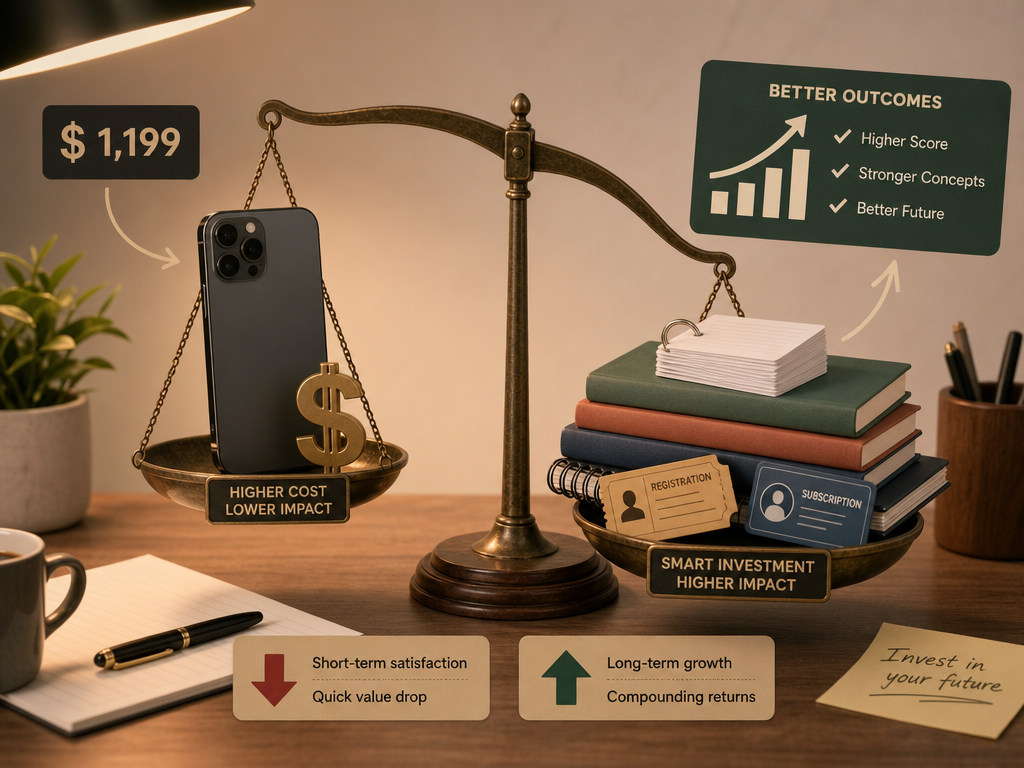
This is also where the money deserves the most adult supervision. The research brief gives a concrete opportunity-cost comparison: MCAT registration is $335, and a major prep subscription such as UWorld or Kaplan can run about $200–300. Together, that competes directly with the upgrade gap between an iPhone 17e and a higher Pro-tier phone. No one should pretend that spending the saved money guarantees a score increase, but it is much easier to defend paying for practice questions than paying for phone features the student will barely touch.
| MCAT purchase choice | What the student gets | What to check before paying |
|---|---|---|
| iPhone 17 Pro Max | The strongest battery case, especially for long study days away from reliable outlets. | Whether the student’s actual study locations make battery life a daily constraint. |
| iPhone 17 or 17e | Enough performance for MCAT apps, lower cost, and Apple Intelligence access. | Whether the saved money should go toward registration, practice questions, or a prep plan. |
| Refurbished iPhone 13 | A lower-cost app-and-reminder device if the current phone is failing and budget is tight. | Battery health, return policy, and whether the screen size is comfortable for long review sessions. |
A student doing hundreds of hours of prep should map the purchase against the study stack first. If the phone upgrade knocks out the question bank, the practice-test budget, or the registration buffer, the cheaper iPhone is probably the better MCAT decision. For broader tool comparisons, use the site’s study tools ranking and focused note-taking app guide.
ASVAB: Buy the Refurbished iPhone and Move On
For ASVAB candidates, the recommendation is blunt: buy a refurbished iPhone 13 if you need an iPhone at all, then keep the saved money for study materials, transportation, paperwork, or whatever else is actually between you and the test date. The ASVAB is administered on government computers at MEPS, not on the student’s personal phone, so there is no exam-day phone advantage to buying new.
The phone’s job is basic but important: run study apps, play review videos, store reminders, photograph notes, and keep communication reliable. A refurbished iPhone 13 in decent condition handles that. The caveat is quality control, not raw performance. Check battery health, seller warranty, return policy, storage, and whether the device is unlocked for the carrier the student actually uses.
ASVAB prep also lacks one single official prep hub that functions like the AAMC does for MCAT or College Board does for SAT. That makes the budget case stronger, not weaker. When the prep landscape is messier, it is better to preserve money until the student knows which book, app, or local support is actually useful.
The Specs That Should Not Decide This Purchase
Camera quality is the easiest trap. The 48MP main cameras on the iPhone 17e, iPhone 17, and iPhone 17 Pro are treated in the research brief as effectively identical for document scanning: notes, whiteboards, textbook pages, and worksheets are not demanding photography subjects.[5][6] If the student is not creating lab content, filming applications, or doing a separate media project, the camera should not be the reason to climb the price ladder.
General performance is the other over-discussed point. For the core study apps named here, iPhone 13 and newer is the practical cutoff. That does not mean every older used phone is a good buy; a weak battery or poor warranty can ruin the deal. It does mean the latest iPhone is not required just to run flashcards, question banks, calendars, PDF readers, or browser-based prep.
- Apple Intelligence matters most for GRE writing workflows, and only if the student will actually revise with it.
- Battery life matters most for MCAT students doing long study blocks away from outlets.
- Price matters most for SAT, ACT, and ASVAB students whose prep budget has more urgent uses.
- Camera upgrades matter least for ordinary document scanning across the recommended models.
Check These Before You Buy
The recommendation can change if the actual price changes. A carrier promotion, family-plan bill credit, trade-in, or Apple refurbished listing can make a higher model cheaper over the full ownership period. Do the full-contract math, not just the monthly payment. A “free” phone that locks the family into a more expensive plan is not free.
Apple Intelligence is also a moving target. Apple’s public feature list includes Writing Tools, Live Translation, and Visual Intelligence, but availability can vary by model, language, region, and rollout timing.[4] For this article’s exam logic, the key requirement is simple: if GRE writing help is part of the reason for buying, verify that the exact iPhone model supports the features the student plans to use.
Battery numbers need the same caution. Apple’s official video-playback estimates are useful for comparing within the lineup, while PCMag’s tested figures give a separate real-world benchmark.[5][3] Neither number guarantees what happens during a student’s actual day with 5G, screen brightness, maps, music, flashcards, and background apps all taking their share.
Finally, verify exam fees against the official testing body before making the purchase. The research brief uses current figures for MCAT, GRE, SAT, and ACT, but fees can change by testing year, location, late registration, and add-on services. Phone money and exam money should never be guessed from memory.
References
- Apple Education Store — Apple
- Best iPhone in 2026 — CNET
- The Best iPhones We've Tested for 2026 — PCMag
- Apple Intelligence — Apple
- Compare Models — Apple
- What's the Best iPhone to Buy Right Now? — WIRED
Comments
Join the discussion with an anonymous comment.