
Comparison
The Best Budget Phone for Exam-Prep Students in India
A guide for Indian students preparing for GRE, MCAT, SAT, ACT, or ASVAB on a tight budget, explaining which phone specs truly matter for studying and recommending the best models under ₹15,000 as of July 2026.
Verdict panel
- Compared
- Moto G64, POCO M7 Pro, realme P3x, Moto G45 5G
- Target exam
- SAT, ACT, GRE, MCAT, ASVAB
- Best for
- Indian students with a budget under ₹15,000
- Pricing last reviewed
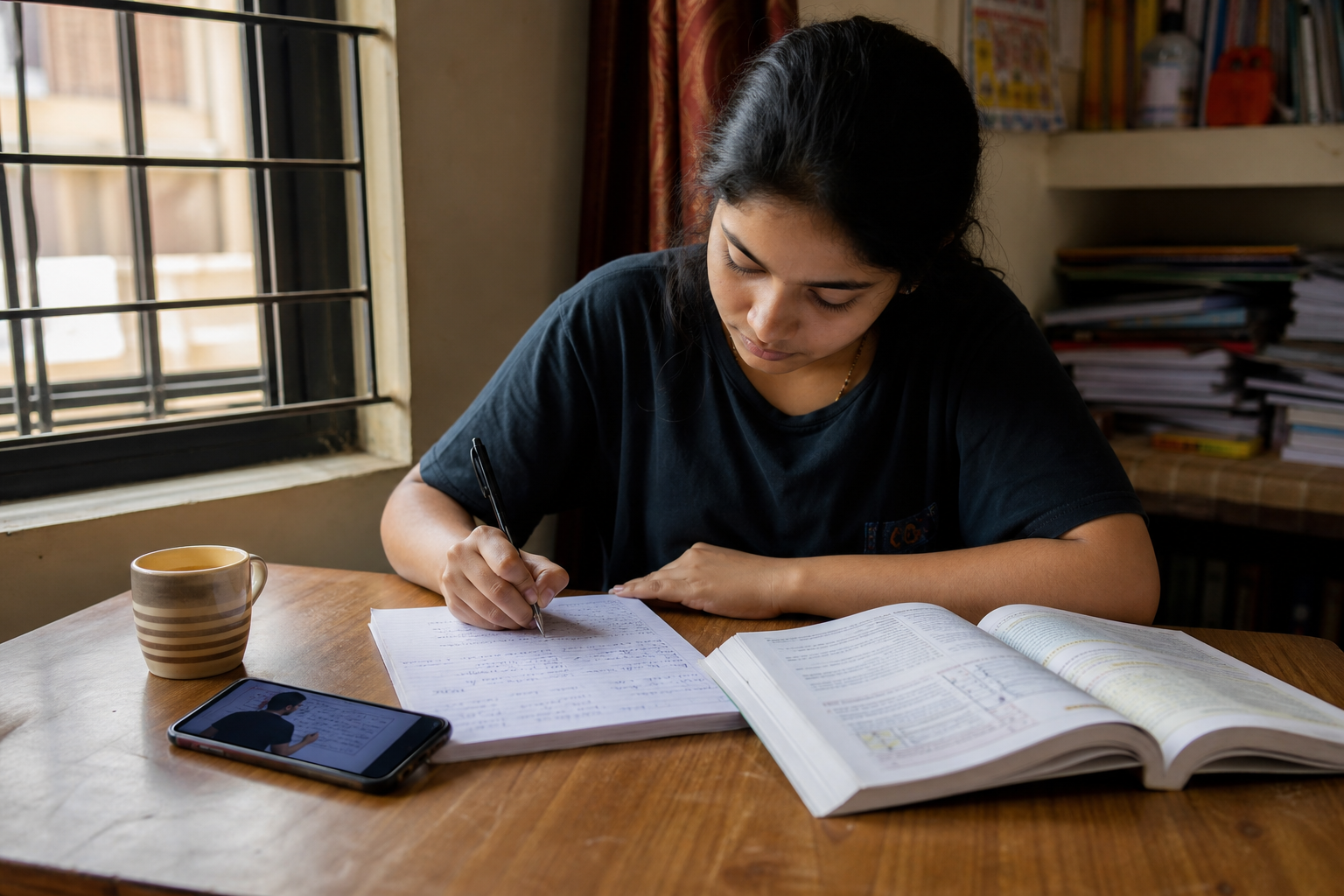
Last reviewed: July 22, 2026. If you are searching for the best budget phone for students in India, the first trap is buying the phone that looks strongest on a shop counter: a big camera number, a glossy back, and a discount sticker. Exam prep is less forgiving. A student preparing for GRE, MCAT, SAT, ACT, or ASVAB needs a phone that keeps a video lecture, PDF, browser practice set, WhatsApp doubt group, and notes app alive without turning every switch into a reload.
For a hard budget under ₹15,000, the safest buying rule is simple: prefer at least 6GB RAM, 128GB storage, a 5000mAh or larger battery, and 5G. Under that filter, the Moto G64 is the best all-round exam-prep pick near ₹14,000; the POCO M7 Pro is the reading-comfort pick; the realme P3x is the value-and-charging pick; and the Moto G45 5G is the lower-cost 5G baseline.
Quick Verdict: Best Phones Under ₹15,000 For Exam Prep
| Phone | July 2026 price | Why it suits exam prep | Main caution |
|---|---|---|---|
| Moto G64 | ₹13,999 | 8GB RAM, 6000mAh battery, clean Android; strongest all-round pick for multitasking and long study days [1] | Not the flashiest display choice |
| POCO M7 Pro | ₹14,999 | AMOLED display and 5110mAh battery; best choice if long PDF reading is the priority [1] | Costs close to the top of the budget |
| realme P3x | ₹12,999 | 6000mAh battery and 45W charging; good value if the budget is tight but endurance matters [1] | Software experience may matter more than raw specs for some students |
| Moto G45 5G | ₹10,997 | Lower-cost 5G option with clean Android; practical baseline for families trying to stay closer to ₹11,000 [2] | Less headroom than the Moto G64 |
This is not a camera ranking. A good rear camera is useful for scanning handwritten notes or a coaching-center whiteboard. After that, paying extra for a 108MP label, a weak macro lens, or a design finish usually does less for marks than buying enough RAM, storage, battery, and software headroom.
Why Study Phones Fail Before They Break
A budget phone used for study does not fail only when the screen cracks. It fails in smaller, daily ways: the video-call app reloads when the student opens a PDF, the browser practice test loses its place, the storage warning appears before a mock-test week, or the battery falls into panic territory during the bus ride home.
That is why 4GB RAM phones, although still common in the lower budget segment, are hard to recommend for serious exam prep. The issue is not that a 4GB phone cannot open YouTube, a PDF reader, or WhatsApp. It usually can. The problem is switching among them for hours. 91mobiles’ July 2026 budget-phone listings still show lower-RAM configurations in the affordable range, while the stronger sub-₹15,000 picks move to 6GB or 8GB RAM [1]. For a student, that extra memory is not a luxury spec; it reduces interruption.
Storage has the same boring-but-important character. A 64GB phone may look acceptable on day one, especially if the family is stretching every rupee. Then come offline lectures, test-prep apps, PDF books, scanned notes, screenshots, vocabulary decks, and WhatsApp files from coaching groups. The student does not need a giant storage tier, but 128GB is the practical floor if the phone has to survive a full prep cycle without constant cleaning.
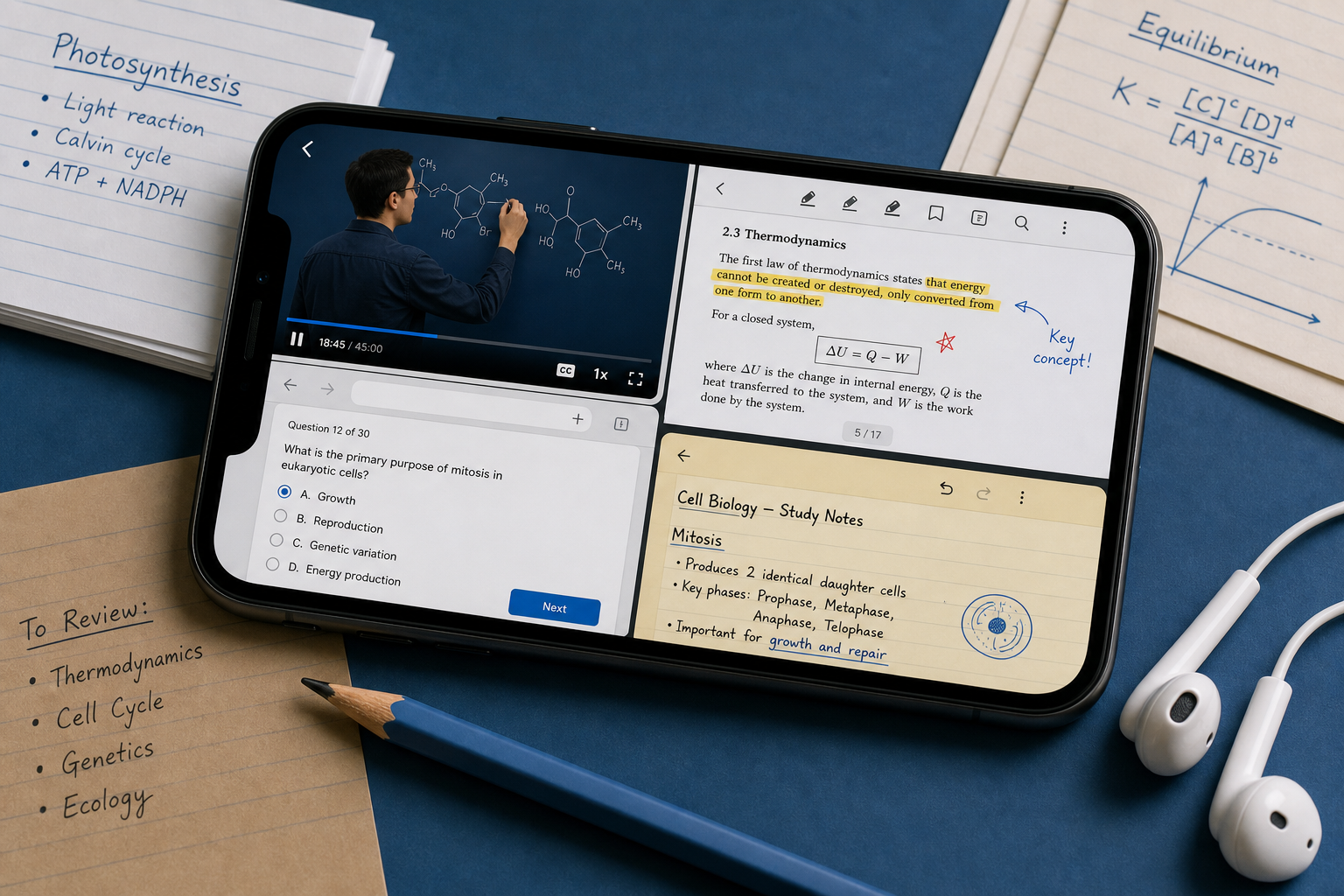
Battery is even less negotiable in India because many students do not study in one neat desk setup. They study on buses, in coaching-center corridors, in college libraries, at shared dining tables, and in rooms where the charging point is already claimed. A 5000mAh battery is the realistic minimum. The 6000mAh batteries in the Moto G64 and realme P3x give a more comfortable safety margin for long days away from a charger [1].
5G is not about showing off speed-test screenshots. It is about buying a phone in 2026 that still feels usable in 2028 or 2029. NDTV Gadgets 360 listed the Moto G45 5G at ₹10,997 in its July 2026 ₹10,000–₹15,000 phone table, which makes 5G available near the lower end of this buying range [2]. Once that happens, a new non-5G phone becomes harder to justify for a student who cannot replace it next year.
The Spec Priorities That Actually Protect Study Time
| Spec | Minimum to target | Study consequence |
|---|---|---|
| RAM | 6GB; 8GB if possible | Keeps video, PDFs, browser tabs, chat, and notes usable without constant reloads |
| Storage | 128GB | Leaves room for offline lectures, PDFs, scanned notes, apps, and mock-test files |
| Battery | 5000mAh minimum; 6000mAh preferred | Reduces charger anxiety during coaching, travel, library sessions, and power-cut days |
| Connectivity | 5G | Improves the phone’s usefulness over a three-year ownership window |
| Display | Good brightness and readability; AMOLED if affordable | Makes long PDF and video sessions more pleasant, though not a guaranteed eye-health solution |
| Camera | Good enough to scan notes | Useful, but rarely worth making the deciding factor |
RAM matters most on the messy days. Imagine a student watching a recorded class, jumping into a PDF formula sheet, checking a browser-based quiz, answering a doubt in WhatsApp, and opening a notes app to copy one correction. If the phone has too little memory, each switch can become a small delay. One delay is tolerable. Fifty delays in a week become lost patience.
Storage matters most when the exam calendar tightens. Students start downloading material because they cannot depend on network quality everywhere. A GRE quant PDF, an MCAT biology video playlist, SAT practice papers, ACT reading passages, or ASVAB arithmetic notes are not individually huge in a way that sounds dramatic. The pile is the problem. Once a student starts deleting lectures to make room for new mock tests, the phone has become another study obstacle.
Battery matters because study plans often assume a stable room and a dedicated charger. Real life does not. A 6000mAh phone is especially useful for students who travel to coaching, attend college during the day, or share a study space at home. It does not make discipline automatic, but it removes one excuse and one anxiety.
Display quality deserves a careful word. AMOLED on the POCO M7 Pro is attractive for long reading because AMOLED panels can offer strong contrast and pleasant perceived black levels, and display-review methodologies from Wirecutter and PCMag both treat readability, brightness, and screen quality as meaningful parts of phone evaluation [3][4]. That does not prove AMOLED prevents eye strain for exam-prep students. It only supports a narrower, practical judgment: if a student reads dense PDFs on the phone for hours, paying a small premium for the better screen can be reasonable.
High refresh rate is less important here than many phone ads suggest. Smooth scrolling feels nice, and some students will enjoy it. But for exam prep, a stable app switch, readable display, and battery that lasts until night matter more than whether the home screen animation looks expensive.
Moto G64: The Safest All-Round Pick Near ₹14,000
The Moto G64 earns the top recommendation because it spends the budget where a study phone should. 91mobiles listed it at ₹13,999 with 8GB RAM and a 6000mAh battery in its July 2026 budget-smartphone table [1]. That combination is exactly what helps when a student cannot afford a phone that feels tired halfway through the prep year.
The 8GB RAM is the main reason to prefer it over cheaper options. For a student using video lectures, PDFs, chat groups, browser tests, and a notes app, 8GB gives more breathing room than the 4GB and 6GB configurations common lower down the price ladder. It will not make a badly built app perfect, and it does not remove the need to close heavy games or junk apps. But it gives the phone a better chance of behaving calmly during normal study multitasking.
The 6000mAh battery is the second reason. A student who attends morning classes, commutes, studies in the library, and revises at home should not have to ration screen time by late afternoon. A larger battery also helps families avoid the false economy of buying a cheaper phone and then immediately adding a power bank because the phone cannot finish the day.
Motorola’s cleaner Android experience also matters. Bloatware is not just untidy; it steals attention and can crowd storage. A cleaner build will not magically make the student more focused, but it starts with fewer distractions and fewer strange preinstalled apps asking for permission.
The Moto G64 is the phone I would point to first for a parent who says, “I do not want to think about this again next year.” It is not the most glamorous answer. That is partly why it is the right one.
POCO M7 Pro: The Better Choice If The Phone Is Also The Reading Device
The POCO M7 Pro is the one to consider when the student reads heavily on the phone itself. 91mobiles listed it at ₹14,999 with an AMOLED display and a 5110mAh battery in July 2026 [1]. At this budget, that screen is its strongest argument.
This matters most for students without a tablet or laptop. If the phone is where they read PDFs, annotate passages, watch recorded lectures, and review screenshots, the display is not decoration. A better screen can make the phone feel less tiring over a long evening. The evidence here should not be overstated: the cited display sources are general phone-review methodologies, not India-specific exam-prep studies [3][4]. Still, when the use case is four hours of reading rather than ten minutes of camera samples, AMOLED is a sensible place to spend extra.
The caution is price. At ₹14,999, the POCO M7 Pro sits right at the ceiling. If a sale brings the Moto G64 and POCO M7 Pro close together, choose based on the student’s real bottleneck: multitasking and battery margin point toward the Moto; long PDF reading points toward the POCO.
realme P3x: Strong Value When Charging Speed Matters
The realme P3x is the practical compromise for students who need endurance but want to stay below the top of the budget. 91mobiles listed it at ₹12,999 with a 6000mAh battery and 45W fast charging [1]. That pair is useful for the student who comes home between classes, plugs in during lunch, or borrows a socket for a short window before the next session.
Fast charging is not a substitute for good habits, but it is helpful in a household where everyone is sharing adapters and extension boards. The 6000mAh capacity also means the phone is not depending only on quick top-ups. For students preparing mainly through recorded lectures and app-based practice, this is a strong value pick if the software experience feels acceptable in-store.
Moto G45 5G: The Lower-Cost Baseline, Not The Winner
The Moto G45 5G is important because of what it says about the market. NDTV Gadgets 360 listed it at ₹10,997 in July 2026, putting 5G within reach for families who cannot stretch to ₹14,000 or ₹15,000 [2]. That makes it a sensible baseline if the budget is closer to ₹11,000.
It is not the overall winner because lower-cost phones usually involve trade-offs in memory, display, charging, or long-term headroom. But clean Android and 5G give it a real role: it is the phone to consider when the choice is not “Moto G45 or Moto G64,” but “Moto G45 or a cheaper phone that may feel old too soon.”
What To Ignore Unless Everything Else Is Equal
- 108MP camera claims: useful photos are nice, but note scanning does not require making camera megapixels the deciding spec.
- Macro and depth lenses: these often look good in a spec table and do little for study work.
- Gaming language: only relevant if the same chip and RAM also improve normal multitasking; otherwise it is a distraction.
- High refresh rate alone: smoothness is pleasant, but it should not outrank battery, storage, RAM, and display readability.
- Design finish: buy durability and grip before buying a shiny back panel.
A camera-heavy phone can still be a good phone if the rest of the package is strong. The mistake is letting the camera headline hide weak RAM, low storage, or a battery that makes the student hunt for a charger before the evening revision block.
Check The Software Side After The Phone Choice
Once the phone is sensible, the next question is the app stack. A strong phone cannot rescue a cluttered study system where lectures, notes, practice tests, and reminders live in five places with no routine. For that side of the setup, compare study apps separately in the Best Study Apps 2026 guide.
ASVAB students should be especially strict about app choice because short daily sessions can work well only when practice is structured. The ASVAB study apps guide and ASVAB app study-plan framework are better places to decide how the phone should be used after purchase.
Students building a full desk setup later can also look at the USB4 dock comparison for dual-monitor study setups. That is a different purchase category. For many Indian students, the phone is still the first and most important study device.
Buying Caveats For July 2026
Indian phone prices move quickly with bank offers, festival sales, exchange bonuses, and stock changes. A model that is a good recommendation at ₹13,999 may be less attractive if it jumps, and a close second can become the better buy after a sale. NDTV’s table itself is dated July 20, 2026, and this article is reviewed on July 22, 2026; do not treat these prices as permanent [2].
The market can also shift within weeks. New budget launches, including models introduced in July 2026, may change the under-₹15,000 comparison before the next exam season. That does not make the buying principles stale. It means the final checkout price must be checked again.
Student-focused phone articles and community snippets can be useful for noticing common concerns, but they are weaker evidence than current price and specification tables. The Smart Innovator’s student-phone framing is useful background, but the model verdicts here rely mainly on 91mobiles and NDTV Gadgets 360 for India-specific pricing and specifications [5][1][2]. Reddit sentiment from Indian phone communities was not fully crawlable, so it should not be treated as proof of reliability or failure rates.
Final Dated Judgment
If the student can spend near ₹14,000, buy the Moto G64 first: 8GB RAM, 6000mAh battery, and clean Android make it the safest all-round exam-prep phone under ₹15,000 as of July 2026 [1]. If the student reads long PDFs on the phone every day and can spend up to the ceiling, consider the POCO M7 Pro for its AMOLED display [1]. If the budget is tighter, the realme P3x gives strong battery value at ₹12,999, while the Moto G45 5G is the practical lower-cost 5G baseline at ₹10,997 [1][2].
Before paying, recheck the July 2026 price on the day of purchase. In this market, a good phone verdict can become stale faster than a study plan.
References
- Budget Smartphones in India (Jul 2026) — 91mobiles, July 2026.
- Mobile Phones Between 10000 to 15000 in India (20th July 2026) — NDTV Gadgets 360, July 20, 2026.
- The Best Budget Android Phone of 2026 — Wirecutter/NYT.
- The Best Cheap Phones We've Tested for 2026 — PCMag.
- Best Budget Smartphones for Students (2026): Top Picks — The Smart Innovator.
Comments
Join the discussion with an anonymous comment.