
Comparison
Balancing High School Football and Academics Using Smart Scheduling
High school football players can manage academics despite rigorous training schedules by using a targeted combination of planner apps, time-blocking strategies, and micro-study sessions designed for post-practice fatigue.
Verdict panel
- Compared
- not specified
- Target exam
- not specified
- Best for
- not specified
- Pricing last reviewed
- pricing currency unconfirmed
At 7:15 p.m., a high school football player can still technically have “homework time.” That does not mean he has the same kind of homework time his planner app imagined when it placed a clean two-hour study block after school. Practice is over. His legs are heavy. He may still need to shower, eat, answer a parent’s question, ice something, find a charger, and remember which teacher moved a quiz. The laptop opens, but the brain that opens with it is not fresh.
That is the real problem in balancing studies and football for young athletes: not whether they care enough, but where schoolwork can fit when energy, not just time, is the limiting factor.

One estimate puts the average high school varsity football commitment at about 21 hours per week when practices, games, and travel are counted together; actual schedules vary by school, state rules, coaching philosophy, and commute time, but the number is useful because it makes the load visible.[1] For comparison, college athletes in season report roughly 32 hours per week on athletics and about 40 hours on academics, which helps explain why even younger athletes can feel like the week is already spoken for before homework begins.[2]
A directional student-athlete wellness statistic often cited through Untapped Learning says 80% of student-athletes report feeling overwhelmed at some point during the academic year; because the original study is not readily traceable from the cited material, it should be treated as a warning light rather than a courtroom exhibit.[3] The lived version is familiar enough: the player is not lazy, the parent is not disorganized, and the teacher’s deadline is not fake. The calendar is simply carrying more than a generic student plan was built to hold.
Why a normal student planner breaks during football season
Most school planners assume assignments are the main fixed objects in the week. Football season reverses that. The fixed objects are school hours, practice, lifting, film, treatment, team meals, bus rides, games, and recovery. Homework has to be placed around those objects without pretending that every open rectangle on the calendar has the same value.
A 30-minute window before practice is not the same as a 30-minute window after a late practice. A bus ride can be useful for reviewing flashcards, but it may be terrible for writing an essay that needs sources, quiet, and a clear head. Game day is usually not the night to rescue a missing lab report. The planner fails when it records time but ignores the condition of the student inside that time.
The system below uses tools only where they earn their place. MyStudyLife tracks academic obligations. Google Calendar shows the whole week. Notion holds the season dashboard. Pomodoro timers help the athlete start tired, small, and honestly. If a family already uses different tools, the names matter less than the jobs they perform.
Start with the week football actually creates
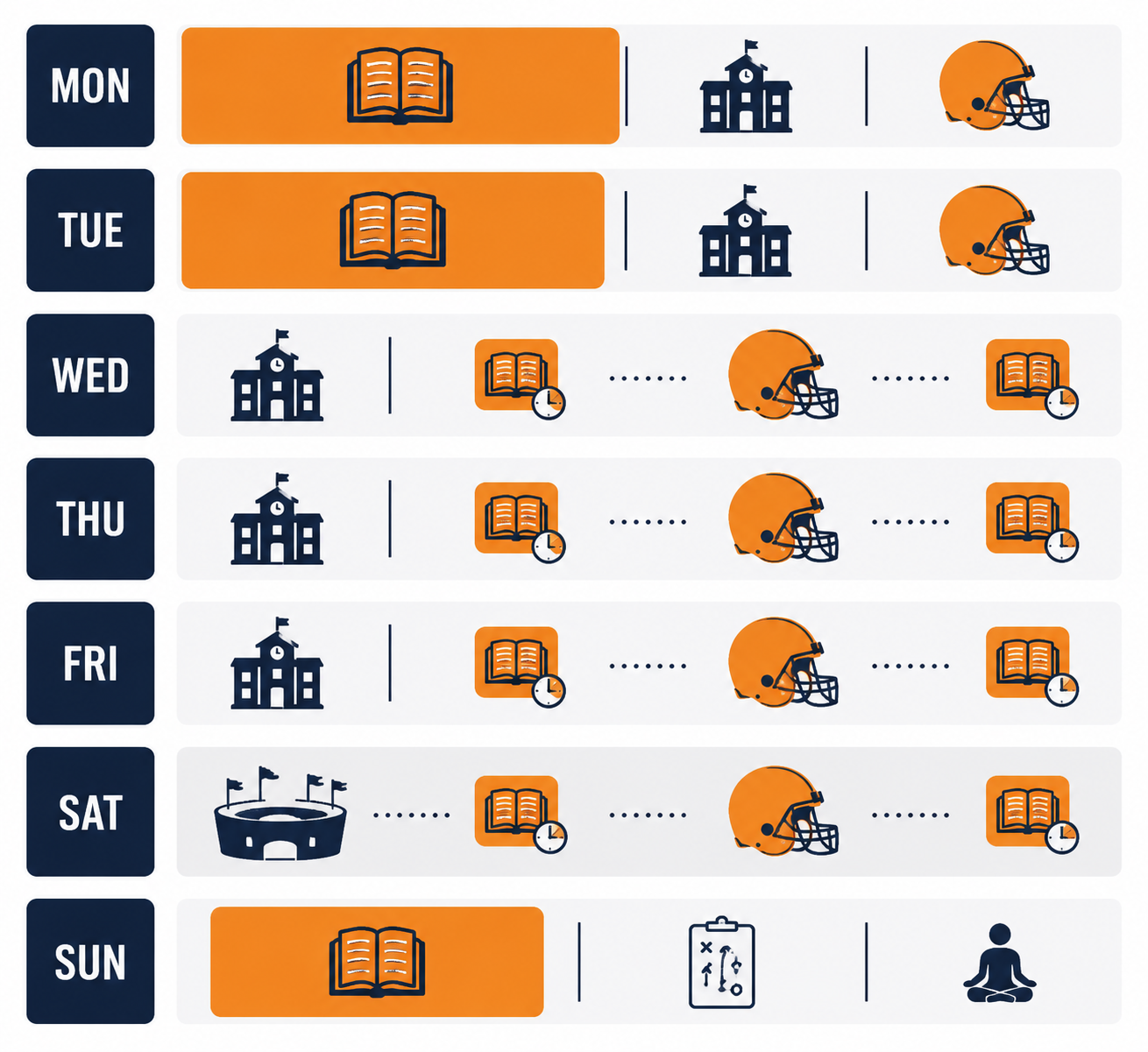
Before choosing apps, build the football week as it really exists. Put school, practice, games, travel, meals, sleep, family commitments, and transportation on one calendar. Do not start with homework yet. The first pass is only to see what is immovable.
| Layer | What belongs there | Why it matters |
|---|---|---|
| Fixed commitments | School day, practice, lifting, film, games, travel, appointments | These blocks determine where academic work can realistically fit |
| Recovery requirements | Dinner, shower, sleep, treatment, decompression | Removing these from the plan usually creates failure later in the week |
| Academic deadlines | Homework, quizzes, tests, projects, reading, make-up work | These need dates, not vague intentions |
| Study windows | Before-practice pockets, bus rides, post-practice blocks, weekend sessions | These should match the athlete’s energy level, not just the clock |
This is where many families discover the real issue. The student may have some open time, but much of it sits after physical strain. That does not make it useless. It means it should be assigned work that belongs in a tired brain: review, problem sets already started, vocabulary, low-stakes drafting, organizing notes, or finishing a clearly defined task.
For a broader method of building a weekly academic plan, families can adapt a general study timetable system, but football season needs one extra filter: every study block should be labeled by energy level before it is filled with work.
Give each tool one job
The fastest way to make a student hate a productivity system is to make him enter the same assignment in four places. The stack should reduce decisions, not multiply them. A workable football-season setup gives each tool a different layer of responsibility.
MyStudyLife: the academic truth list
Use MyStudyLife for classes, homework, tests, and due dates. This is not the place for practice times, carpools, or dinner. It is the place where the athlete can answer, “What do I owe school?” without digging through six classroom portals.
The Sunday setup is simple: enter every known assignment and assessment for the week, mark hard deadlines, and flag anything that requires more than one sitting. Essays, projects, lab reports, and test preparation should never first appear on the night before they are due. If the player or parent is deciding whether MyStudyLife should be the main assignment tracker, a deeper MyStudyLife review can help, but the football-season use case is narrow: capture school obligations in one reliable place.
Google Calendar: the full-life map
Google Calendar should hold the whole week: school, practice, games, travel, meals, sleep targets, family commitments, and the actual study blocks pulled from MyStudyLife. This is where the athlete sees whether Tuesday’s biology test prep can happen before practice, after dinner, or not at all unless something changes.
Color-coding helps only if it stays restrained. One color for football, one for school, one for study blocks, one for recovery is enough. Parents who share the calendar should resist turning every block into a monitoring tool. The purpose is visibility, not a live disciplinary dashboard.
Students who are choosing between an academic planner and a calendar can compare MyStudyLife and Google Calendar. In this system, they are not competitors. One says what is due; the other says where the work fits.
Notion: the season dashboard
Notion is useful when it becomes the season command center rather than another assignment graveyard. Keep it simple: current classes, teacher contact links, weekly priorities, long-term projects, test dates, missing work, and a small “ask for help” list. A freshman backup does not need an elaborate template with twenty views. He needs to know what matters this week and what cannot be allowed to disappear.
A practical Notion dashboard might include three columns: “Due this week,” “Started but not done,” and “Need help or clarification.” That last column matters. A player who is exhausted at night may not have the energy to write a careful email to a teacher, but he can drop a reminder there and handle it during lunch or advisory the next day. Families comparing dashboard formats can look at this homework tracker comparison and choose the least fussy option that the student will actually update.
Pomodoro: the post-practice starter
The Pomodoro Technique is commonly described as 25 minutes of focused work followed by a 5-minute break, and Under Armour presents it as one useful strategy for student-athletes balancing school and sports.[4] After football practice, its value is not that 25 minutes is magical. Its value is that a tired athlete can agree to start without pretending he is about to produce two perfect hours.
Post-practice Pomodoro work should be chosen before the timer starts. “Study English” is too vague. “Annotate two pages,” “complete five algebra problems,” “make flashcards for ten terms,” or “draft the intro paragraph badly on purpose” gives the brain a door to walk through. The break should not become a phone hole if the next block still matters. Stand up, refill water, stretch, reset.
Build the week around energy, not optimism
Carpe Diem Academics recommends matching study length to practice load: shorter focused sessions on heavy practice days and longer blocks on lighter days or weekends.[5] That principle belongs at the center of a football player’s academic schedule. The goal is not to make every day equal. The goal is to stop assigning the hardest schoolwork to the hours when the athlete is least equipped to do it.
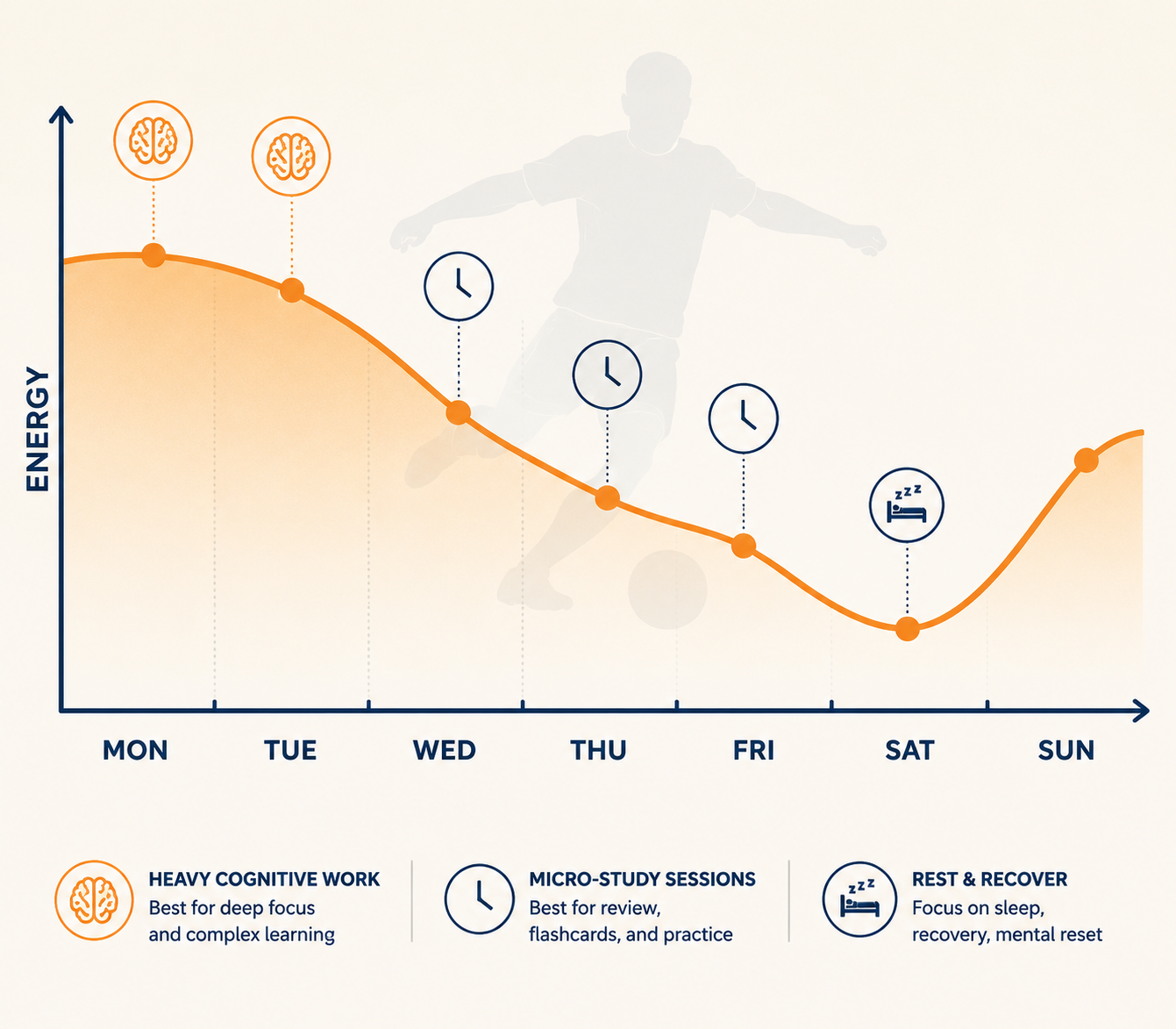
Early-week windows usually deserve the heavier cognitive work: essay planning, test preparation, complex math, reading that requires annotation, and project decisions. These are the tasks that punish a student when they are delayed until Thursday night. If Monday and Tuesday are lighter or more predictable in a particular program, protect part of those days for the work that cannot be done well half-asleep.
Heavy practice days need a different menu. A 10- to 15-minute pocket before practice can handle vocabulary, quiz review, outlining, formula practice, or rereading teacher feedback. A bus ride can support flashcards, audio review, or light reading if the athlete can do it safely and without motion sickness. Post-practice time can handle one or two Pomodoro blocks, but only if the tasks are already defined.
Game days should be treated as minimal-load academic maintenance unless the student’s schedule truly allows more. Maintenance does not mean zero. It might mean checking tomorrow’s due dates, submitting an already finished assignment, reviewing ten flashcards, or packing the right materials for the next school day. It should not mean beginning a major project after the game because the calendar looked open.
The Sunday night setup
A football-season scheduling system works best when it is built before the week starts sliding. Sunday night does not need to become a family meeting with speeches. Fifteen to twenty honest minutes can be enough if the routine is the same each week.
- Open MyStudyLife and enter every known assignment, quiz, test, and project deadline.
- Open Google Calendar and confirm school, practice, games, travel, appointments, meals, and sleep targets.
- Move larger academic tasks into the best available early-week or lighter-day blocks.
- Label small pockets for micro-study instead of leaving them blank and hoping they become useful.
- Update the Notion dashboard with the week’s top priorities, unfinished work, and questions for teachers.
- Choose the post-practice tasks that can be done in one or two Pomodoro blocks.
The parent’s role is to help make the plan visible, not to take ownership of every assignment. A useful question is, “Where does this fit?” A less useful one is, “Why didn’t you just do it?” The first question builds a calendar. The second often starts a fight after the student is already spent.
Micro-study is not fake studying
Short study pockets get dismissed because they do not look serious. They are not enough for everything, and they should not be sold as a replacement for deeper work. But they are excellent for reducing the number of tasks that reach the evening untouched.
| Window | Good use | Poor use |
|---|---|---|
| 10 minutes before practice | Flashcards, formula review, reading teacher comments | Starting a complex essay |
| Bus ride | Audio review, light reading, quizlet-style practice | Work that needs quiet, handwriting, or multiple tabs |
| After shower and snack | One defined Pomodoro task | Opening the laptop with no plan |
| Game day evening | Check deadlines, submit finished work, pack materials | Major catch-up work that requires fresh attention |
| Sunday afternoon or evening | Planning, project setup, longer study block | Ignoring the week until Monday morning |
The “shower-and-snack” transition matters more than it sounds. Going straight from practice gear to a hard assignment can feel like hitting a wall. A short reset gives the body a signal that the next block is different. The routine should be boring enough to repeat: shower, eat something reasonable, put the phone away or across the room, open the task list, start the timer.
If planning keeps failing at the execution stage, the problem may not be the calendar at all. It may be that the student has planned work but not defined the first action. This is the same gap discussed in why a study planner is not enough: a block labeled “homework” still requires the tired brain to decide what homework, where to start, and how to know when it is done.
A realistic post-practice block
A good evening study plan after practice is modest on purpose. For example, a hypothetical Tuesday night might look like this: the athlete gets home, showers, eats, checks the calendar, and starts one Pomodoro block for algebra problems that were already selected on Sunday. After the break, he does one shorter review task for history vocabulary. Then he stops, packs for school, and sleeps.
That plan will not win a productivity contest. It may, however, prevent algebra from becoming a midnight emergency. It also respects a truth adults sometimes forget: consistency during the season often comes from making the next action small enough to start.
A different night might need no Pomodoro at all. If the player has a late game, a long ride, or a physically rough practice, the academic block may only be maintenance: check due dates, submit what is finished, and prepare for tomorrow. Calling that failure is how families train students to hide the calendar instead of use it.
What to do when the schedule changes
Football weeks change. Practice runs long. Weather moves a game. A teacher adds a quiz. A player needs treatment. A system that only works under perfect conditions is not a system; it is decoration.
When something changes, do not rebuild the whole week. Move the affected block, check the next deadline, and decide whether the missed work needs a micro-session, a longer weekend block, or a teacher conversation. The Notion “Need help or clarification” list is useful here because it catches problems before they become vague dread.
Some advice articles cite a Stanford-related claim that effective time-management techniques can reduce study time by 30% while improving grades; because that claim appears indirectly through Untapped Learning, it should be verified against the original Stanford source before being treated as settled evidence.[3] The safer conclusion is still strong enough: better time management can reduce wasted time, but it does not erase the physical cost of the season.
The standard for success
A smart schedule will not create unlimited time. It will not make a sore, tired athlete feel like he just came back from a quiet library retreat. It will not make every teacher deadline convenient or every practice predictable.
It is working if the athlete knows what is due, sees where the work fits before the week collapses, uses low-energy study blocks for the right kind of tasks, and still has protected recovery time. That is a better goal than heroic catch-up. It is also kinder to the student who is trying to be both reliable in the classroom and accountable to the team.
References
- How High School Teams Spend Their Time, Verified Athletics.
- NCAA GOALS Study, NCSA Sports.
- Time Management: The Balancing Act, Untapped Learning.
- Balancing School and Sports: A Game Plan for Student Athlete Success, Under Armour.
- Short focused sessions on heavy practice days and longer focus blocks on lighter days/weekends, Carpe Diem Academics.
Back to the exam this applies to
Target exam not specified — see all exam hubs.
Comments
Join the discussion with an anonymous comment.