AI Study Tool
How to Use ChatGPT for Studying Medicine Safely
Tool: ChatGPT
Learn how to use ChatGPT for MCAT prep without being misled by hallucinations or inaccurate medical claims. This guide presents a research-backed safety protocol including verification steps, prompt guardrails, and clear boundaries for AI use in medical study.
Warning panel
- Verified against official source
- No
- Last reviewed
ChatGPT can help with MCAT review, but it should not become your source of record. Use it for reversible, checkable, non-clinical study tasks: rephrasing a concept, quizzing you, drafting practice questions, or turning a trusted passage into retrieval prompts. Do not use it as a medical authority, a citation generator, or the architect of your entire MCAT plan.
The practical rule is simple: if a wrong answer could be caught quickly against AAMC-aligned material, a textbook, or your own notes, ChatGPT may be useful. If a wrong answer could steer a patient, invent a source, or quietly distort how you study for months, do not outsource it to a chatbot.

What the Evidence Says Before You Start Prompting
The strongest safety warning comes from medical-use studies, not from generic complaints about AI. In a Nature Medicine study of LLMs as medical assistants for the public, participants using LLMs identified relevant conditions in less than 34.5% of cases, compared with 94.9% for LLMs alone; even well-prompted users got emergency disposition right only about 44% of the time in that experimental design.[1] That does not mean MCAT biochemistry review is the same as triage. It does mean a pre-med student should not let a study tool drift into health advice.
Cancer-treatment advice is another hard boundary. A JAMA Oncology study reported that 34% of ChatGPT cancer-treatment responses contained non-concordant recommendations, and 12.5% were full hallucinations.[2] That kind of error is not a harmless wrong flashcard. It is the category of output ChatGPT should never be asked to handle for a student, a family member, or a patient.
Prompting can reduce some errors, but it does not make the model safe by itself. A Mount Sinai / Communications Medicine study found that adding a one-line safety prompt to user queries cut hallucinated elaborations on false medical details nearly in half.[3] That is useful enough to build into your workflow. It is not enough to skip verification.
References are also off-limits unless you independently verify them. In an American Journal of Medicine cautionary case, ChatGPT fabricated a scientific reference with author names, DOI, and journal details that did not exist.[4] The danger is not only that the citation is fake; it is that it looks formatted enough to pass into your notes when you are tired.
Performance benchmarks are mixed enough to justify disciplined use, not blind trust. ChatGPT scored around 60% on the USMLE in a 2023 PLOS Digital Health study, while reported MCAT section performance varied by subject, from 58% in Chem/Phys to 76% in Bio/Biochem.[5] That is good enough to explain and quiz; it is not good enough to become the answer key.
There is one especially relevant positive example: an AAMC workflow for developing practice questions with ChatGPT, tested with GPT-4o from June to August 2025 and published in October 2025, reported improved exam performance at the University of Nebraska Medical Center.[6] The important part is not that ChatGPT wrote questions. The important part is that it was given a bounded job inside an educator-controlled process, and the output was reviewed.
| Use case | Safety judgment | Why |
|---|---|---|
| Explain an MCAT concept in simpler language | Allowed with verification | Useful for first-pass understanding, but factual claims must be checked against AAMC-aligned sources or textbooks. |
| Ask Socratic questions or drill recall | Allowed | The student is retrieving and checking, not passively accepting the model as an authority. |
| Draft practice questions | Allowed as drafts | Best when based on a known source and reviewed before being treated as exam-style practice. |
| Generate medical advice or triage symptoms | Not allowed | Medical studies show serious accuracy and disposition risks in clinical contexts. |
| Create citations or references | Not allowed | Biomedical references can be fabricated convincingly. |
| Design the full MCAT study plan | Not recommended | Planning errors are harder to catch and can compound over weeks. |
The Safety Protocol: Ask, Check, Correct, Then Decide
The safest way to use ChatGPT for MCAT studying is not to find a magic prompt. It is to make every exchange auditable. Before you ask, decide what source will be allowed to overrule the model. For MCAT prep, that usually means official AAMC materials first, then a trusted textbook or established prep resource. ChatGPT comes after those, not beside them.
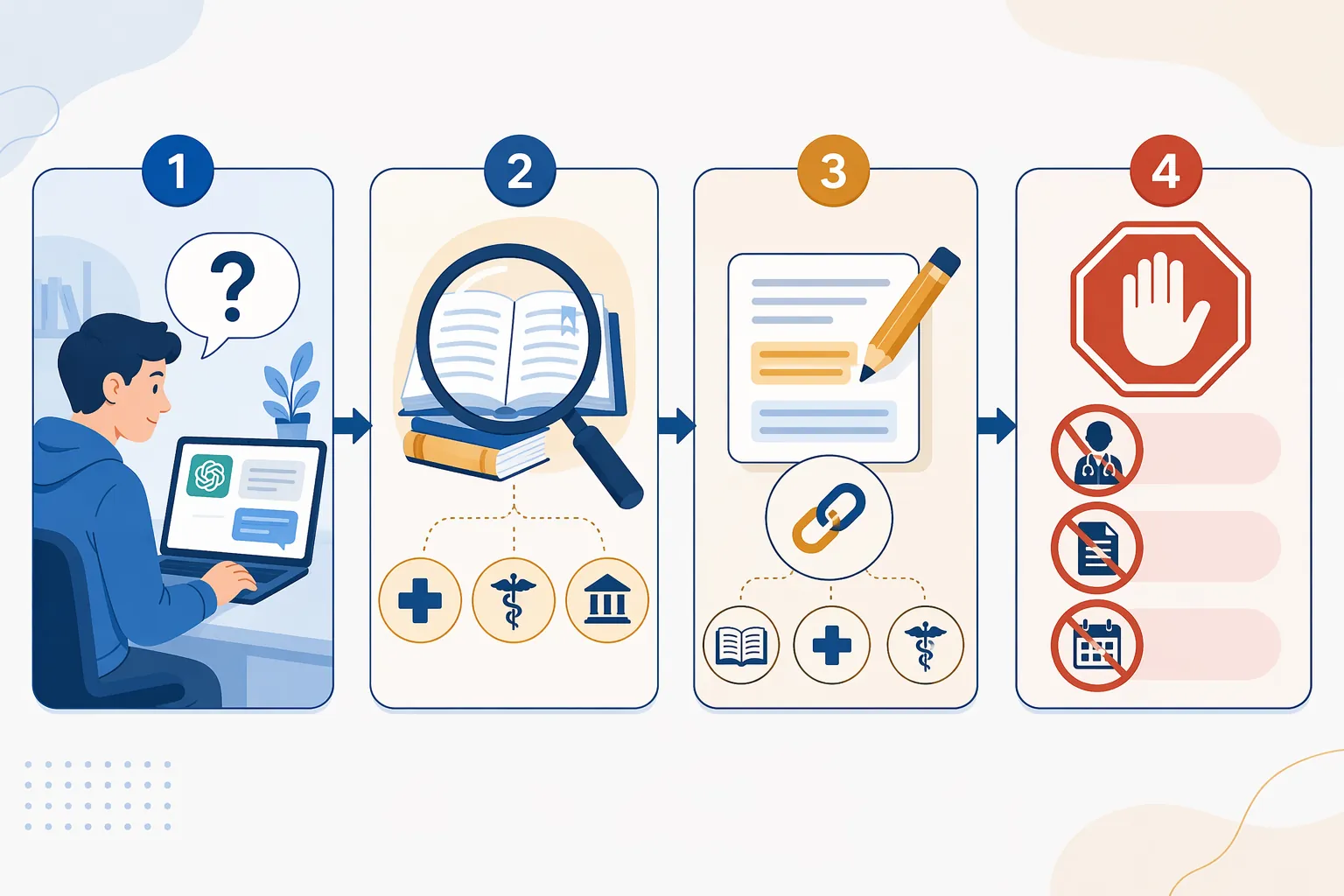
- Define the task: explanation, quiz, practice-question draft, answer-choice reasoning, or retrieval prompt generation.
- Constrain the prompt: name the MCAT, your study stage, the topic, and the sources you want prioritized.
- Ask for uncertainty: require the model to separate known facts, assumptions, and points it is not confident about.
- Verify every factual claim: compare mechanisms, formulas, definitions, and exam claims against AAMC-aligned sources or textbooks.
- Correct your notes, not the model: write the verified version into your study system and discard unverified output.
- Stop when the task becomes clinical, citation-dependent, or plan-level.
That last step matters because the failure modes are not equal. A clumsy analogy for oxidative phosphorylation can be repaired in thirty seconds with a textbook. A false triage suggestion, fake article, or poor study plan can travel much farther before you notice.
Set Guardrails Before the First Question
Custom instructions are boring in the best possible way. They reduce the need to renegotiate context every night, and they make it easier to spot when the model wanders. A Geeky Medics guide recommends telling ChatGPT your stage of study, exam context, and preferred sources to improve response relevance.[7] For MCAT prep, that context should be explicit.
I am studying for the MCAT. Use AAMC-aligned reasoning where possible. Treat your response as a study aid, not as a medical authority. If you are uncertain, say so. Do not invent citations. Separate verified facts from assumptions. Keep explanations test-relevant and flag any point I should check in my textbook or official materials.Then add a precision line to individual prompts when the topic is fact-heavy. The Mount Sinai finding does not prove that one sentence solves hallucinations, but it supports the habit of telling the model not to elaborate beyond confidence.[3]
Answer only if you are confident. If there is any uncertainty, list what I should verify instead of filling in the gap.A second useful follow-up is a separation prompt. It forces the model to stop blending textbook facts, pattern guesses, and smooth prose into one authoritative paragraph.
Separate your answer into three parts: known MCAT-relevant facts, assumptions you made, and points I should verify in an AAMC-aligned source.Use ChatGPT for Concepts, Not Final Authority
The best late-night use is usually explanation repair. If metabolism feels slippery, ask ChatGPT to restate one narrow concept in a different form: compare glycolysis and gluconeogenesis, explain why fatty acid oxidation produces acetyl-CoA, or walk through how enzyme inhibition changes a graph. Then check the mechanism against your source before it becomes a card, note, or answer rationale.
Explain the difference between competitive and noncompetitive inhibition for MCAT purposes. Use plain language first, then give the graph effect. Flag anything I should verify.The model is especially useful when your real problem is not ignorance but language. Many students can recognize a definition once they see it but cannot retrieve it cleanly under pressure. ChatGPT can give you a second phrasing, an analogy, or a quick contrast. The safety check is to move from the model back to the source: does the rephrasing preserve the mechanism, the direction of change, and the test-relevant exception?
Do not let a smooth explanation become a new primary text. If ChatGPT says an enzyme increases, a pressure decreases, a hormone inhibits, or a formula applies, verify that exact claim. MCAT errors often hide in directionality. A sentence can sound right while flipping the relationship that the question is testing.
Turn It Into a Drill Partner
Socratic self-quizzing is one of the safer uses because the model is not simply handing you a finished explanation. It asks, you retrieve, then you compare. Keep the scope narrow: one pathway, one equation type, one psychology term cluster, one CARS passage strategy. Ask for one question at a time so you cannot hide weak recall behind recognition.
Quiz me on beta-oxidation for the MCAT one question at a time. Do not give the answer until I respond. After each answer, identify the specific misconception if I miss it, and tell me what claim I should verify.This works better than asking for a full lecture because it creates retrieval. A chatbot explanation can feel productive while doing most of the cognitive work for you. A short question with delayed feedback exposes whether you can produce the idea before seeing it.
For missed questions, ask ChatGPT to classify the miss without rewriting your whole study life. Was it a content gap, a graph-reading error, a math shortcut problem, or a passage interpretation problem? Then verify the content-specific correction. The classification can help you decide what to review; the factual repair still belongs to your trusted source.
Draft Practice Questions the AAMC Way
Practice-question generation is where ChatGPT can be genuinely useful if you treat its output as a draft. The AAMC workflow is worth paying attention to because it does not ask ChatGPT to become the exam. It uses the model inside a process for developing practice questions, with human review and an explicit educational setting.[6]
For an MCAT student, the safest version starts from a source you already trust. Take a concept from an AAMC explanation, textbook section, or reviewed prep material. Ask ChatGPT to draft a question that tests that concept, then inspect the stem, answer choices, correct answer, and explanation before using it.
Using only the concept I provide below, draft one MCAT-style practice question. Include four answer choices, one correct answer, and a short explanation. Do not introduce facts beyond the provided concept. After the explanation, list any assumptions you made.

Concept: [paste your verified source notes here]
The review step is not optional. Check whether the question tests the intended concept, whether there is exactly one best answer, whether the distractors are plausible without being false in a sloppy way, and whether the explanation matches your source. If a generated question contains a new claim you did not provide, either verify it or delete it.
| Question part | What to check |
|---|---|
| Stem | Does it provide enough information without adding irrelevant clinical detail? |
| Correct answer | Is it supported by your verified source, not just by the model's explanation? |
| Distractors | Are they wrong for clear reasons rather than because of ambiguous wording? |
| Explanation | Does it preserve the mechanism, directionality, formula, or passage logic? |
| Difficulty | Is the challenge MCAT-relevant, or did the model make it obscure? |
Generated questions are best used for extra reps after you have done official or high-quality practice, not as replacements for them. If you need the broader tool stack around practice, review, and AI placement, the MCAT study prep hub is the better place to build the full workflow.
Use It to Convert Trusted Material Into Retrieval
One of the safest patterns is source transformation: you provide the verified material, and ChatGPT changes its format. It can turn a paragraph into recall questions, convert a table into cloze-style prompts, or create a quick oral quiz from your notes. The facts originate outside the model; the model only changes how you practice them.
Turn the notes below into 10 active-recall questions for MCAT review. Do not add any new facts. If a note is unclear, write 'unclear note' instead of guessing.

[paste your notes]
This pairs well with spaced repetition. ChatGPT can help you draft candidate questions, but durable retention still needs scheduling, review discipline, and card quality control. If your next problem is turning verified material into a review system, use the Anki for the MCAT guide rather than trying to keep everything in a chat thread.
The same boundary that protects ChatGPT use also protects flashcard use: a tool that feels efficient can still encode bad thinking if you feed it unverified material. The Trap of Anki for the MCAT is a useful companion if your cards are starting to reward memorization without understanding.
Check Answer-Choice Reasoning Without Outsourcing Judgment
After you finish a practice question, ChatGPT can help you articulate why each answer choice is right or wrong. This is most useful when you already have the official explanation and want to compare your reasoning against it. Paste your own summary first, then ask the model to identify gaps, not to replace the answer key.
Here is my reasoning for this MCAT practice question and the official correct answer. Identify where my reasoning is strong, where it is incomplete, and what content claim I should verify. Do not dispute the official answer unless you can point to an ambiguity in my pasted material.This is a better use than asking, "Why is B correct?" with no context. Without the official explanation, the model may rationalize the wrong answer. With the official answer in view, the task becomes metacognitive: what did you miss, and what pattern should you catch next time?
Hard Boundary 1: Do Not Use ChatGPT for Clinical Advice
Studying medicine is not practicing medicine. Do not ask ChatGPT whether symptoms are urgent, whether a treatment is appropriate, whether a family member should go to the ER, or whether a cancer recommendation makes sense. The Nature Medicine and JAMA Oncology findings are enough to make this boundary non-negotiable for students.[1][2]
This is also a habit issue. A pre-med student who gets comfortable asking a chatbot for clinical judgments during content review may reach for the same tool when the stakes are no longer academic. Keep MCAT study prompts non-clinical unless you are analyzing a bounded exam-style passage from a trusted source.
Hard Boundary 2: Do Not Let It Generate Citations
ChatGPT can format a citation-shaped object. That is not the same as retrieving a real source. The fabricated biomedical reference documented in the American Journal of Medicine case included enough detail to look legitimate, which is exactly why this failure mode is dangerous.[4]
If you need a source, go to PubMed, your school library, the journal site, the AAMC, or the textbook itself. If ChatGPT names a paper, treat the name as unverified until you find the real article through an external database. Do not paste AI-generated references into notes, papers, lab work, or application materials.
Hard Boundary 3: Do Not Outsource the MCAT Plan
A bad explanation is often local. A bad study plan is systemic. If ChatGPT tells you to spend months on content before practice questions, skim CARS passages, or trust a math statement like "sqrt(2)=2," the cost is not one missed card; it is a distorted routine. Blueprint Prep, a commercial test-prep company, documented those kinds of wrong MCAT recommendations in a 2025 audit, so treat it as a useful third-party warning rather than independent academic evidence.[8]
ChatGPT can help you break today’s study block into tasks after you have chosen the plan. It can make a checklist from your schedule, generate warm-up questions for a topic, or help you reflect on missed-question patterns. It should not decide your diagnostic timing, full-length cadence, CARS strategy, or practice-resource hierarchy.
If you are still choosing the tool mix, compare ChatGPT against question banks, Anki, full-length exams, and content resources in the MCAT study tools comparison. ChatGPT belongs in the support layer, not at the center of the plan.
A Safe Late-Night Workflow
Here is what safe use looks like when the exam date is close and you are trying to rescue a weak topic without making a mess of your notes.
- Open the trusted source first: AAMC material, textbook, or reviewed prep notes.
- Choose one narrow target: one mechanism, one equation, one graph pattern, or one passage skill.
- Ask ChatGPT for a rephrasing, quiz, or draft question using a confidence and uncertainty guardrail.
- Compare the output against the source before copying anything into notes or Anki.
- Write only the verified version into your study system.
- If the prompt starts asking for clinical advice, citations, or plan design, stop and switch tools.
That workflow is less glamorous than a viral prompt, but it is faster to audit. You know where the facts came from, what the model was allowed to do, and what you checked before trusting it.
Use ChatGPT as a Checked Rehearsal Partner
The mature version of AI use is not pretending ChatGPT is useless. It is giving the tool jobs where mistakes are reversible and visible. Let it ask one more question, translate a dense paragraph, draft a practice stem, or pressure-test your reasoning. Then make the verified source win every dispute.
For MCAT prep, that means ChatGPT is a rehearsal partner, not a source of record. Use the MCAT study prep hub for the full plan, use Anki or another spaced-repetition system for durable retention, and use ChatGPT only where checking the answer is built into the task.
References
- Reliability of LLMs as medical assistants for the general public — Nature Medicine, 2026.
- New Study Highlights Dangers of Patients Relying on ChatGPT for Treatment Recommendations — Brigham and Women's / JAMA Oncology, 2023.
- AI Chatbots Can Run With Medical Misinformation — Mount Sinai / Communications Medicine, 2025.
- Hallucinations in ChatGPT: A Cautionary Tale for Biomedical Researchers — Am J Med, 2023.
- Performance of ChatGPT on USMLE — PLOS Digital Health, 2023.
- Workflow for Developing Practice Questions Using ChatGPT — AAMC, Oct 2025.
- A Guide to ChatGPT (AI) for Medical Students — Geeky Medics, Oct 2023.
- The 5 Worst MCAT Study Tips I Got from ChatGPT — Blueprint Prep, 2025.
Comments
Join the discussion with an anonymous comment.