AI Study Tool
AI Action Plan and the Federal Spending Squeeze on Universities
Tool: AI Action Plan
The Trump administration's AI Action Plan calls for expanding university-led AI research and workforce development, yet simultaneous federal funding cuts to NSF, NIH, and other agencies are shrinking the research ecosystem. This article examines how this policy contradiction affects graduate programs and STEM career paths for test-takers.
Warning panel
- Verified against official source
- No
- Last reviewed
The federal spending impact of the Trump AI Action Plan begins with an uncomfortable collision. The plan asks universities, federal science agencies, and research infrastructure to help secure U.S. leadership in artificial intelligence. At the same time, the administration’s FY2026 budget request proposed cutting NSF by 57%, NIH by 40%, CDC by 53%, and NASA science by 47%, while more than 3,800 NIH and NSF grants had already been terminated or frozen, representing about $3 billion in unspent funds at the time they were halted.[1]
That is not a small budget footnote. It is the difference between a university being told to train the next AI workforce and a department chair being told there may not be enough grant money to support the next cohort of graduate researchers.

Stanford HAI counted 103 policy actions in the July 2025 AI Action Plan. About one-third did not name a lead agency, and none included implementation timelines or new funding pathways.[2] For a policy document, that may sound like an execution problem. For a student considering a PhD, an MD-PhD, a research-heavy master’s program, or an undergraduate lab path, it is more concrete: who will fund the project, who will hire the graduate assistant, and whether the lab will still be recruiting when applications open.
The plan depends on the same research system now under pressure
The AI Action Plan’s university-facing ambitions are not imaginary. Expanding access to national AI research infrastructure, supporting AI-enabled science, and building workforce hubs all require universities to do work that federal contractors cannot simply replace. Universities train doctoral students, host peer-reviewed research, run specialized labs, and give undergraduates their first supervised experience with research methods.
But those same functions depend heavily on grant stability. A funded project is not just a principal investigator’s line on a CV. It can pay graduate research assistantships, support lab managers, buy compute or equipment, cover summer research positions, and create the preliminary results that make the next grant application credible.
When that system contracts, the effect does not wait politely for national AI strategy to mature. Labs stop taking students. Postdocs look elsewhere. Faculty narrow projects to what can survive. Applicants who planned around a research-heavy path discover that the most important admissions variable was never only their test score; it was whether the lab had money and permission to grow.
Grant uncertainty changes the admissions math before it changes the brochure
Universities rarely announce a research pipeline squeeze in the same language applicants use. A department may still advertise a graduate program. A professor’s website may still list the same research areas. The admissions page may still say that funding is available for admitted doctoral students. The pressure shows up in quieter places: fewer open rotation slots, fewer emails inviting applicants to talk, more cautious language about assistantships, and more faculty saying they are not taking new students this cycle.
This is why the NSF number matters. By June 2026, NSF was awarding grants at roughly 20% of its historical rate, according to reporting from The Conversation.[3] That does not mean every field or campus is hit equally. It does mean a student should be careful about assuming that last year’s funding pattern still describes next year’s admissions reality.
The freeze and termination figures need the same precision. The roughly $3 billion figure refers to unspent remaining funds in grants that had been terminated or frozen, not the full lifetime value of every award.[1] Some halted grants may later be restored. Proposed budget cuts are not the same as enacted final appropriations. Congress had partially restored some requested cuts by early 2026, but the operating environment remained contractionary enough for researchers and departments to behave defensively.[3]
For applicants, defensive behavior is the part that matters. A lab does not need to lose every dollar to stop recruiting aggressively. It only needs enough uncertainty that the PI cannot promise support for a new student over multiple years.
For readers applying to research-intensive graduate programs, the admissions-level version of this issue is covered in How Grant Freeze Cuts PhD Slots and What GRE Test-Takers Should Do. The short version here is that grant conditions can change the number of funded seats before they visibly change a program’s public reputation.
Peer review is part of the training pipeline, not just a governance detail
The May 2026 OMB proposed rule adds another layer of uncertainty. Just Security described the proposal as giving political appointees power to cancel grants for almost any reason, outside normal peer-review expectations.[4] The rule may face legal challenges, and its final effect could change. Still, the signal to universities is already consequential.
Peer review is often discussed as a fairness principle for faculty. It is also part of how students decide whether a research path is worth the risk. If a grant can be cancelled for reasons unrelated to scientific merit, a graduate student’s project can become vulnerable for reasons the student cannot control and may not even understand at the time they accept an offer.
That matters across more than computer science. AI-enabled science touches biology, medicine, chemistry, materials science, psychology, public health, engineering, and social science. A premed student working in a computational biology lab, an engineering major seeking robotics experience, or a psychology student using machine-learning tools for behavioral research may all depend on the same grant ecosystem that the AI Action Plan assumes will be available.
Federal AI spending is rising, but not mainly through universities
There is a tempting counterargument: if federal AI spending is surging, maybe universities will benefit anyway. Brookings reported that federal AI contract spending reached $91.8 billion in potential value, but 98.9% flowed to Department of Defense contractors rather than universities.[5]
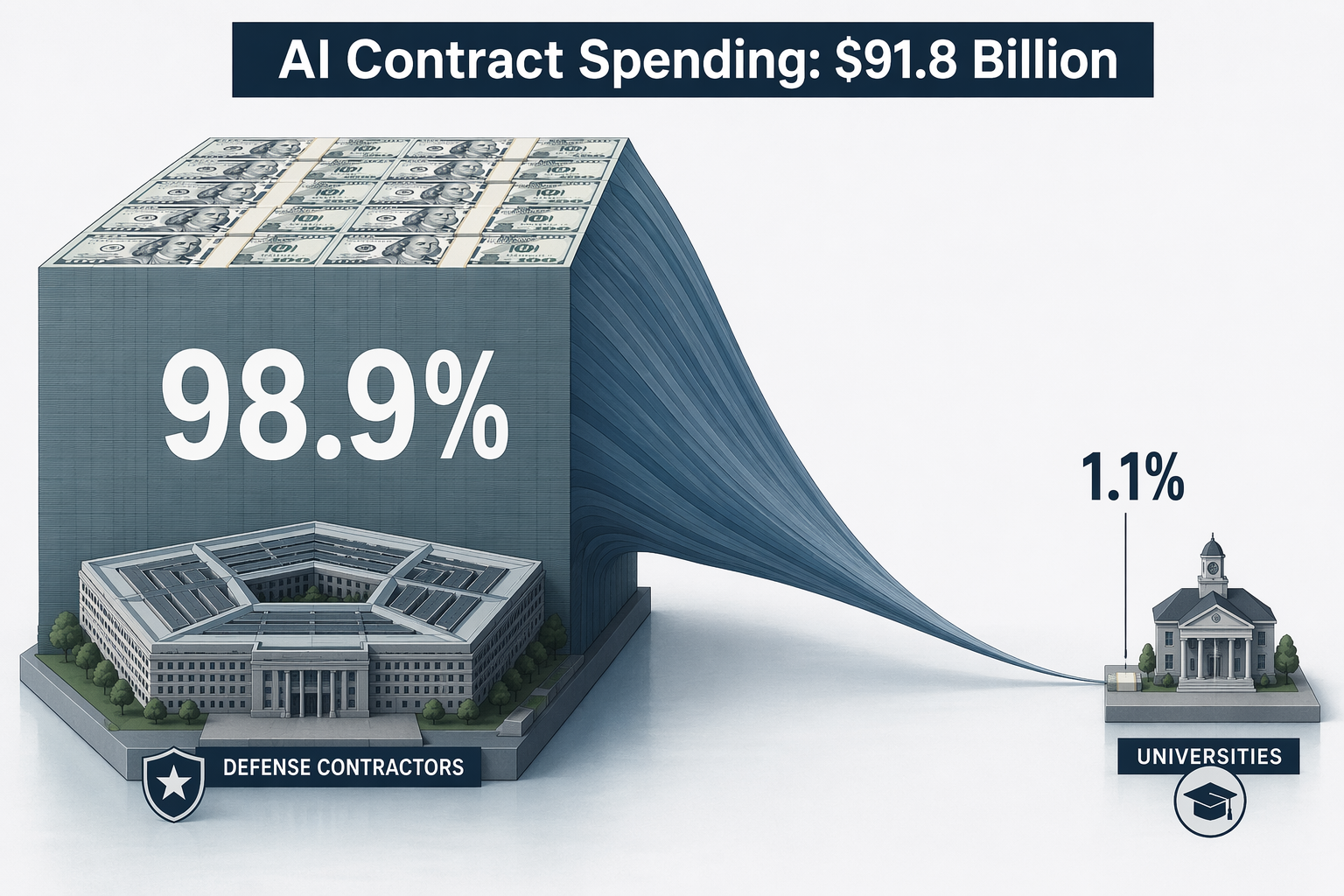
That distinction is easy to miss. Federal spending on AI can grow while university research capacity shrinks. A defense contract may build deployment capacity, procurement capacity, or vendor capacity. It does not automatically create more graduate fellowships, more wet-lab research positions, more faculty-led basic science projects, or more undergraduate research apprenticeships.
This does not make defense AI work irrelevant. The issue is substitution. A national AI strategy that relies on universities cannot assume that contractor-heavy spending will repair a weakened academic research base. The people who eventually staff industry, government, startups, hospitals, and research institutes still need places to train.
The student-facing consequences are uneven but real
The most misleading version of this story would tell every STEM applicant to panic. That is not what the evidence supports. Some labs have durable funding. Some universities have bridge funds. Some fields are closer to AI procurement money than others. Some faculty will still recruit aggressively because they already hold active awards or have institutional support.
The more accurate consequence is volatility. Applicants can no longer treat research capacity as a stable background condition. They need to ask program-level questions that used to feel too blunt: Are faculty in my area taking students? Are assistantships guaranteed or dependent on pending grants? Are first-year rotations funded centrally or by individual labs? Have recent admits had trouble finding funded placements? Are summer research positions still available for undergraduates?
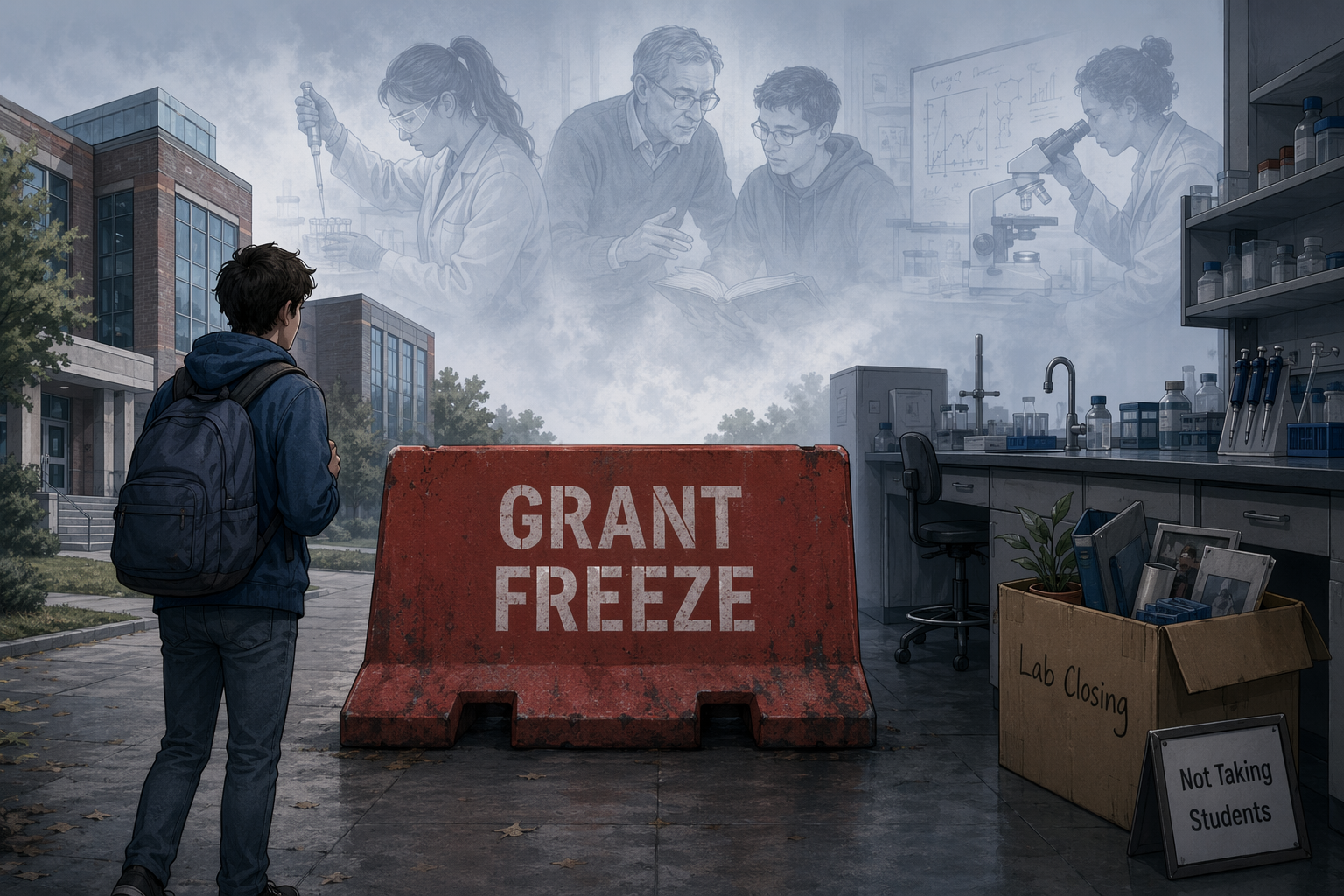
For GRE applicants, that means the test score remains useful but incomplete. A strong quantitative score may help an application clear a screen, especially in competitive STEM programs. It cannot create a funded lab slot where none exists. For MCAT-focused students, the issue may appear earlier: fewer research assistant openings can make it harder to build the kind of sustained lab experience that strengthens applications to research-oriented medical schools or MD-PhD programs.
Undergraduates face a quieter version of the same problem. If faculty reduce lab hiring, a student may still find coursework in AI or data science but lose the mentoring structure that turns interest into credible research experience. That affects recommendation letters, conference abstracts, senior theses, and the confidence to apply to graduate school at all.
Graduate financing is tightening from another direction
Research funding is not the only pressure point. Grad PLUS loans shut off for new students after July 1, 2026, according to Forbes.[6] That change does not affect every student the same way. Fully funded PhD students may rely less on federal graduate borrowing than students in professional master’s programs, unfunded research master’s programs, or expensive health-related graduate pathways.
Still, the timing matters. If grant-funded assistantships become harder to secure while a borrowing route also closes for new students, the risk shifts toward the applicant. A student who might once have used a master’s program to gain research experience before a PhD or medical application now has to examine whether the program offers funded roles, tuition remission, or realistic paid lab work. Prestige alone becomes a weaker answer.
| Student decision | What the funding squeeze changes |
|---|---|
| Applying to a PhD program | The key question becomes whether faculty in the target subfield have stable funding for new students. |
| Choosing a research master’s program | The student needs to know whether assistantships and paid lab roles are available, not only whether research is advertised. |
| Preparing for MD-PhD or research-heavy medical paths | Sustained undergraduate or postbacc lab access may become more competitive if grants and staff positions shrink. |
| Selecting an AI or engineering major | Course availability may remain strong while hands-on research opportunities become more uneven across campuses. |
| Considering a near-term job instead of graduate school | The tradeoff shifts if graduate funding is uncertain and debt options narrow after July 1, 2026. |
Researcher exit talk is a warning signal, not a completed exodus
The human side of the squeeze is visible in researcher sentiment. A Nature poll found that 75% of U.S. researchers reported considering leaving the country.[7] That figure should not be inflated into proof that three-quarters of researchers will actually leave. Intent is not behavior, and relocation depends on jobs, visas, family constraints, and funding abroad.
But it is still a serious signal. A training system depends on people believing there is a future in staying. If enough faculty, postdocs, and advanced graduate students spend their planning energy on exit options, students behind them experience the consequences as slower mentoring, fewer ambitious projects, and less confidence that a field is expanding.
What applicants should verify before betting on a research-heavy path
The practical response is not to abandon STEM. It is to stop treating national AI ambition as proof of local research capacity. A university can be in a country with an aggressive AI strategy and still have individual labs that are frozen, shrinking, or waiting on uncertain grants.
- Ask whether the specific faculty you hope to work with are taking new students in the next admissions cycle.
- Check whether funding is guaranteed by the department, tied to individual grants, or decided after rotations.
- Look for recent evidence of active lab work: new publications, current graduate students, open positions, and updated project pages.
- For master’s programs, separate research branding from paid research access and tuition support.
- For premed and MD-PhD planning, verify whether undergraduate research roles are still being filled rather than assuming prior availability continues.
This kind of verification may feel awkward, especially for applicants trained to sound grateful and flexible. But it is reasonable to ask. Graduate school is not only an academic choice; it is a multi-year labor and financing arrangement. If the grant base is unstable, the applicant deserves to know where the risk sits.
The credibility gap
The AI Action Plan’s university-centered goals require more than ambitious language. They require stable research funding, protected peer-review norms, functioning federal science agencies, and graduate financing routes that allow students to enter long training pipelines without absorbing all the uncertainty themselves.
Right now, the evidence points in the other direction. The plan assigns universities important work, but the surrounding federal spending environment makes that work harder to carry out. Until those conditions improve, test-takers should treat research-intensive STEM paths as more volatile and verify program-level funding realities before committing.
References
- See the alarming extent of NIH and NSF funding cuts in 2025, ScienceNews, November 2025.
- Inside Trump’s Ambitious AI Action Plan, Stanford HAI, July 2025.
- National Science Foundation cuts mean researchers like me are losing grants, The Conversation, June 2026.
- The Trump Administration’s Multi-Front Assault on Federal Research Funding, Just Security, May 2026.
- Where does federal AI spending stand in 2026?, Brookings, May 2026.
- Grad PLUS loans shut off for new students after July 1, 2026, Forbes, August 2025.
- Trump Slashed Science Funding. Now the U.S. Could Face a Costly Brain Drain, The New York Times, 2025.
Comments
Join the discussion with an anonymous comment.