
I Tested Claude for Exam Prep — Does It Work?
Accuracy Warning — Claude
Claude can hallucinate and overpraise; all answers and grades must be checked against official answer keys or source material.
- Accuracy:
- Limited
- Tested:
- Exam-prep workflow assessment: explanations, source synthesis, practice drills, Socratic tutoring, grading
- Last tested:
- 2026-08-01

Verdict first: this is not a real Claude scorecard
A useful answer to whether Claude works for exam prep should be a scored, task-by-task trial: exam target named, test window disclosed, prompts saved, Claude’s answers checked against official material, and every result labeled by evidence quality. I did not run that trial for this article, and no saved Claude transcript or verified output is available to audit. So I am not going to invent a Tuesday-night study session, fake a percentage, or pretend an AI-generated score means something it does not.
That matters because a fake Claude review is worse than no review. A student with a fixed test date does not need another smooth paragraph about how impressive AI can be. They need to know whether Claude helped them review a missed concept, drill a weak skill, or avoid wasting an hour on a confident wrong answer.
| Prep task | Result available here | Evidence label | What would be safe to conclude |
|---|---|---|---|
| Explaining official answers | Not scored | No hands-on Claude output available to audit | Potentially useful, but only after checking Claude’s explanation against the official key or source text. |
| Long-source synthesis | Not scored | No uploaded-source trial available | Potentially useful for turning dense source material into review notes, but source-bounded checking is required. |
| Generating practice questions | Not scored | No generated-question set available | Useful as extra drilling material, not as official-format evidence or a diagnostic score. |
| Socratic drilling | Not scored | No transcript available | Potentially useful if it forces the student to retrieve and correct reasoning instead of passively reading. |
| Checking answer choices | Not scored | No answer-key comparison available | Risky unless the official key is treated as the authority. |
| Grading student-written answers | Not scored | No rubric comparison available | Should be treated as feedback, not a reliable grade, unless checked against an official rubric or human-scored examples. |
If this feels unsatisfying, it should. A real review of Claude for exam prep should make the model earn its place in the study plan. The bar is not “Can Claude sound like a tutor?” The bar is “Did Claude’s output survive contact with an official answer key, a disclosed rubric, or the source document it was supposed to explain?”
What a valid Claude exam-prep trial would need to disclose
A publishable test should be bounded before the first prompt is sent. Otherwise the review becomes too easy to massage: keep the nice examples, ignore the ugly ones, and call the model “promising.” For exam prep, that is not enough.
| Trial element | Minimum disclosure |
|---|---|
| Date and version context | Run date in Q3 2026, plus the Claude product tier and tools available during the test. |
| Exam target | One named exam, such as GRE, MCAT, SAT, ACT, or ASVAB, rather than a generic “standardized test” trial. |
| Test window | The amount of time allowed for the trial and whether prompts were revised after bad answers. |
| Materials | Official questions, official explanations, uploaded source passages, rubrics, or clearly labeled nonofficial drills. |
| Tasks chosen before testing | Explanation, synthesis, question generation, drilling, answer checking, and grading should be defined before seeing results. |
| Verification method | Official answer keys, official explanations, uploaded source text, or a disclosed rubric should decide whether Claude was right. |
| Evidence labels | Every score should say whether it came from official-key verification, source-text verification, rubric comparison, or reviewer judgment. |
That evidence label is the difference between a useful trial and a marketing anecdote. “Claude explained this well” is not the same as “Claude’s explanation matched the official reasoning and helped identify the missed concept.” “Claude generated ten practice questions” is not the same as “those questions matched the official format.” And “Claude gave me a 5 out of 6” is definitely not the same as “this is my expected test-day score.”
The scorecard I would trust
Here is the structure a real hands-on scorecard should use. The point is not to make Claude look good or bad. The point is to separate tasks where AI can reduce friction from tasks where one wrong confident answer can damage a study plan.
| Task | What to test | Verification authority | Pass condition | Failure that matters |
|---|---|---|---|---|
| Explanation quality | Ask Claude to explain missed official questions and identify the underlying concept. | Official explanation and answer key. | The explanation matches the official reasoning and names the skill to review. | Claude invents a rule, skips the official logic, or explains the right answer for the wrong reason. |
| Long-source synthesis | Upload a dense official or source-bounded document and ask for a study outline. | The uploaded document. | The summary preserves key distinctions and does not add unsupported facts. | Claude smooths over exceptions or introduces claims not present in the source. |
| Practice-question generation | Ask for new drills based on a specific weak skill. | Official format guide and reviewer inspection. | Questions target the intended skill and are clearly labeled nonofficial. | Questions feel exam-like but test the wrong skill or imply a fake diagnostic value. |
| Socratic drilling | Have Claude ask one question at a time and wait for the student’s reasoning. | Student answer plus official concept check. | The session forces retrieval, correction, and another attempt. | Claude praises vague reasoning or gives away the answer too early. |
| Answer checking | Give Claude selected answer choices and ask it to evaluate the reasoning. | Official key. | Claude agrees with the key and explains why distractors fail. | Claude confidently disagrees with the official answer or overfits to the student’s explanation. |
| Grading student responses | Give Claude a written response and a rubric. | Official rubric or scored examples. | Feedback points to rubric-linked improvements without overstating precision. | Claude gives generous scores, inconsistent scores, or unsupported certainty. |
The tasks worth expanding are the ones that change what the student does next. If Claude explains an official math solution in plain language and the student immediately drills the missing algebra step, that is a win. If Claude produces five extra reading questions that expose a pattern-recognition weakness, that can be useful too. But if Claude grades a practice essay generously and the student moves on too soon, the pleasant feedback has become expensive noise.
A usable explanation test
For explanation quality, the cleanest trial starts with an official missed question. The student already has the answer key. Claude’s job is not to decide the answer from scratch; it is to translate the official reasoning into something teachable.
Hypothetical prompt:
I missed this official practice question. The official answer is C. Explain why C is correct, why my choice B is wrong, and name the exact skill I should drill next. Do not introduce any rule that is not needed for this problem.
The scoring here should be strict. Claude does not get full credit for sounding clear. It gets credit only if the explanation matches the official answer, handles the student’s wrong choice correctly, and points to a drillable skill. A good result changes the next study block: review the rule, do targeted repetitions, and reattempt a similar problem later.
The dangerous failure is subtler than a completely wrong answer. It is the smooth explanation that lands on the official answer while using a shortcut, assumption, or rule that the official source does not support. That kind of answer feels helpful in the moment and makes a mess later.
A source-synthesis test that does not reward bluffing
Long-source synthesis is one of the places Claude may be genuinely useful for exam prep, especially when the student is staring at a dense explanation, a science passage, or a long set of notes. The test should be source-bounded: upload the material, tell Claude to use only that material, then audit the output against the source.
Hypothetical prompt:
Use only the uploaded document. Make a one-page study outline for a student who missed questions on this topic. Separate: facts to memorize, concepts to explain in your own words, common traps, and five self-quiz prompts. If the document does not say something, write “not stated in the source.”
This is where verification needs to be part of the product verdict. A source-bounded Claude answer is useful only if the student can trace important claims back to the uploaded text. If the model adds outside facts without warning, the study outline becomes contaminated. That may not matter for casual learning; it matters a lot when the exam rewards the official framing.
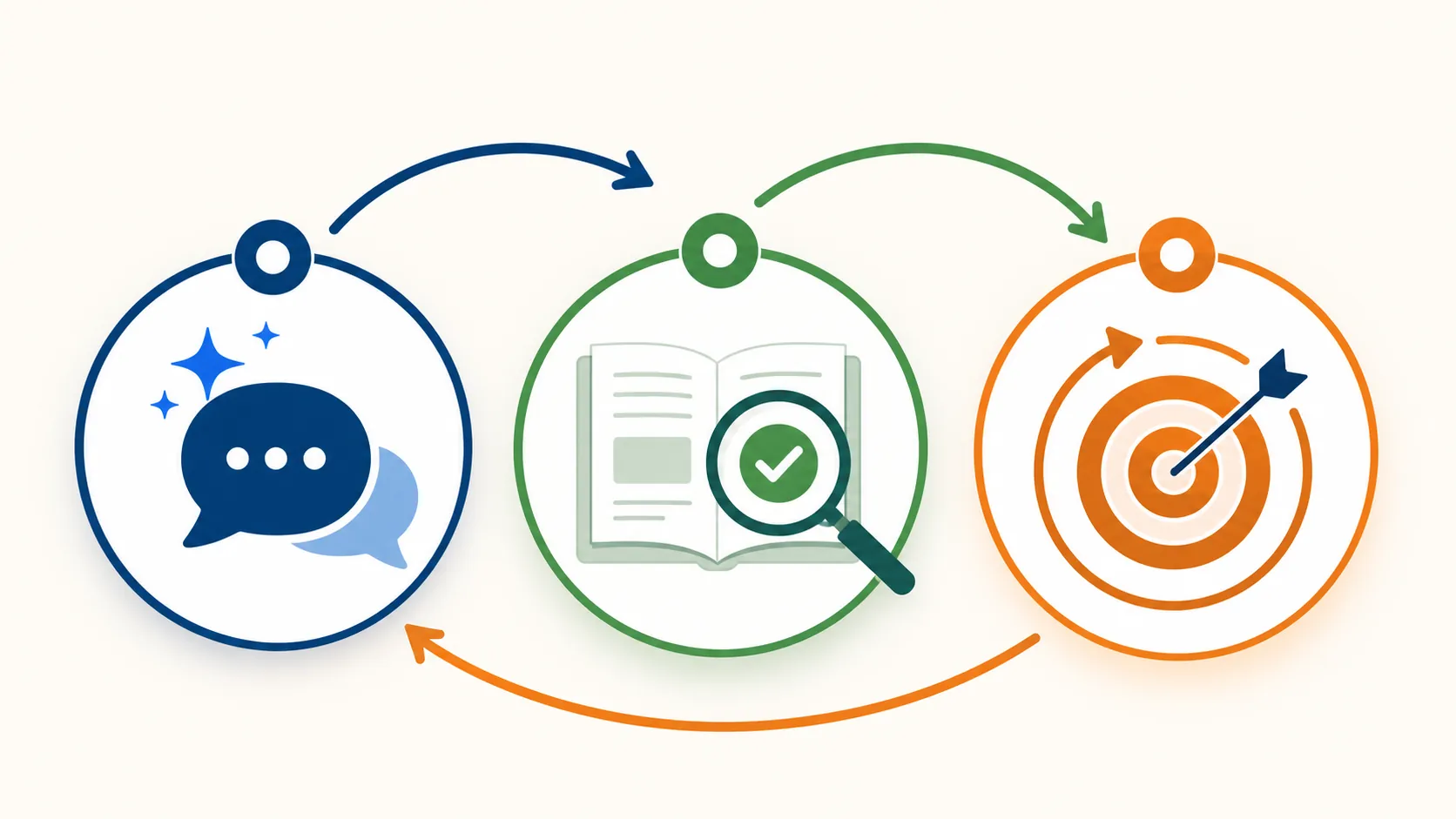
Practice questions are drills, not diagnostics
Claude-generated practice questions can be useful in the same way homemade flashcards can be useful: they create repetitions. They should not be treated like official practice tests. The difference is not cosmetic. Official material carries format evidence, difficulty calibration, and scoring meaning. Claude-generated items do not automatically carry any of that.
A responsible trial would ask Claude to generate questions for one narrow weakness, then label them as nonofficial drills. The review should check whether the questions target the intended concept, whether the answer key is internally consistent, and whether any explanation contradicts official material. A generated set can still be worth using even if it is not perfectly exam-like, as long as the student knows what it is for.
Hypothetical prompt:
Create six nonofficial drill questions for this exact weak skill: [skill]. Keep them short. After each question, provide the correct answer, a brief explanation, and the specific mistake the question is designed to catch. Do not estimate a score or difficulty percentile.
The phrase “do not estimate a score” belongs in the prompt. AI-generated practice can help a student get more reps, but it should not become a scoreboard. If a student wants a diagnostic, the source should be an official or otherwise validated practice test, not a batch of fresh AI questions.
Socratic drilling is useful when Claude waits
A patient AI tutor has real study value when it makes the student retrieve, commit, and revise. The best version of Socratic drilling is not Claude lecturing for eight paragraphs. It is Claude asking one question, waiting for the student’s reasoning, identifying the first wrong turn, and asking for a corrected attempt.
Hypothetical prompt:
Tutor me Socratically on this missed concept. Ask one question at a time. Do not reveal the final answer until I have explained my reasoning. If I am vague, ask me to be specific. If I make an error, name the error and give me a smaller follow-up question.
The failure mode is praise that arrives too early. If Claude tells the student “yes, exactly” when the reasoning is incomplete, the session feels encouraging but does not sharpen the skill. That is why a real trial transcript matters. The question is not whether the model was friendly. The question is whether it caught the weak step before the student practiced it again.
Answer checking and grading need the tightest leash
When Claude checks an answer, the official key should be in the room. Without it, the model can sound more certain than the evidence deserves. With it, Claude can still be helpful: explain why the keyed answer is right, diagnose the student’s distractor choice, and turn the miss into a short review plan.
Grading is even more fragile. For written answers, essays, constructed responses, or free-response explanations, Claude may provide useful comments, but the grade itself should be treated as provisional. If the prompt includes a rubric, Claude’s feedback should quote or paraphrase the rubric criteria it is using. If it cannot tie a criticism to the rubric, the criticism may still be interesting, but it is not scoring evidence.
| Claude output | How to treat it |
|---|---|
| “Your answer is correct.” | Check against the official key before moving on. |
| “This would likely score high.” | Treat as morale or feedback, not as a score. |
| “Here are three rubric-linked weaknesses.” | Use as a revision checklist, then compare with official examples if available. |
| “This practice set suggests you are ready.” | Ignore as readiness evidence unless based on an official diagnostic. |
Use Claude for these jobs
- Turn an official explanation into plainer language after you already know the official answer.
- Summarize uploaded source material into a review outline, then spot-check the claims against the source.
- Generate extra nonofficial drills for one narrow weakness.
- Run Socratic practice that makes you explain your reasoning before seeing the answer.
- Convert missed-question patterns into a short review plan.
- Rewrite confusing notes into flashcards, self-quiz prompts, or teach-back questions.
These are friction-reduction jobs. Claude can make it easier to start, easier to keep drilling, and easier to see the concept hiding underneath a missed question. That is a legitimate role in a study plan.
Do not trust Claude for these jobs
- Replacing official answer keys.
- Deciding whether an official key is wrong without strong external verification.
- Producing a practice score that you treat like an official diagnostic.
- Grading essays or free responses with high-stakes precision.
- Creating “exam-like” question sets that you assume match official difficulty.
- Confirming your reasoning just because the answer sounds plausible.
The pattern is simple: Claude is safer when the authority is outside Claude. It is less safe when the model becomes the answer key, the grader, and the confidence meter at the same time.
A verification routine that fits a real study night
The guardrails cannot be so elaborate that a tired student ignores them. A workable routine needs to take minutes, not become a second exam-prep curriculum.
- Start with official material when possible. Use the official question, answer key, explanation, passage, or rubric as the scoreboard.
- Tell Claude what authority to follow. If the official answer is C, say so. If the uploaded document is the only allowed source, say so.
- Ask for the missed concept, not just the answer. The output should tell you what to review or drill next.
- Check one or two critical claims before trusting the explanation. Look for invented rules, unsupported facts, or a mismatch with the official reasoning.
- Use generated questions only as drills. Label them nonofficial and do not convert the result into a predicted score.
- For grading, ask for rubric-linked feedback instead of a final score. If Claude gives a score anyway, treat it as provisional.
- End with an action: redo the missed concept, make flashcards, complete a short drill set, or schedule an official practice section.
That routine is the difference between using Claude as a study assistant and letting Claude run the study plan. The first can save time. The second can quietly move the scoreboard away from the exam you are actually taking.
So, is Claude worth using for exam prep?
The honest verdict is conditional: Claude is worth considering as a supplement, but I would not accept a real “I tested it” claim without a documented trial. The strongest likely use cases are explanations, source-bounded synthesis, Socratic drilling, and extra practice generation. The weakest are unverified answer checking, self-contained grading, and any claim that AI-generated questions produce an official-style score.
If you are choosing whether to spend study time or pay for access, do not ask whether Claude is impressive. Ask whether it will reduce confusion and increase useful repetitions this week. Use it where it helps you understand official explanations faster, drill weak skills more often, and review uploaded source material without adding unsupported claims. Keep official materials as the scoreboard.
Authoritative source
No specific exam hub matched
Browse the exam hubs directory for the authoritative plan on any of the five exams.
Report an error in this tool's output
Found something this tool got wrong beyond what's documented above? Report it so the accuracy log stays current.
Comments
Join the discussion with an anonymous comment.