On-Device AI Smartphones Tested for Student Productivity
Accuracy Warning — iPhone 17 Pro Max
Android NPU access limited; Tensor G5 time to first token 16.5x slower
- Accuracy:
- High
- Tested:
- On-device AI summarization and transcription
- Last tested:
- 2026-07-25
Last reviewed: July 25, 2026.
A useful on-device AI smartphone for student productivity is not the phone that can say the most dramatic thing about artificial intelligence. It is the phone that keeps the study chain from snapping: record the lecture, identify who said what, turn the recording into usable notes, summarize the messy parts, and help make review material before the student is too tired to clean it all up manually.
That is where the 2026 flagship gap becomes hard to ignore. In Beebom's April 2026 on-device AI test, the iPhone 17 Pro Max's A19 Pro generated 51.28 tokens per second on the Gemma 4 E2B model, while the Snapdragon 8 Elite Gen 5 reached 48.56 tokens per second and Google's Tensor G5 reached 10.42 tokens per second. Tensor G5's time to first token was also 16.5 times slower than the iPhone result in that test.[1]
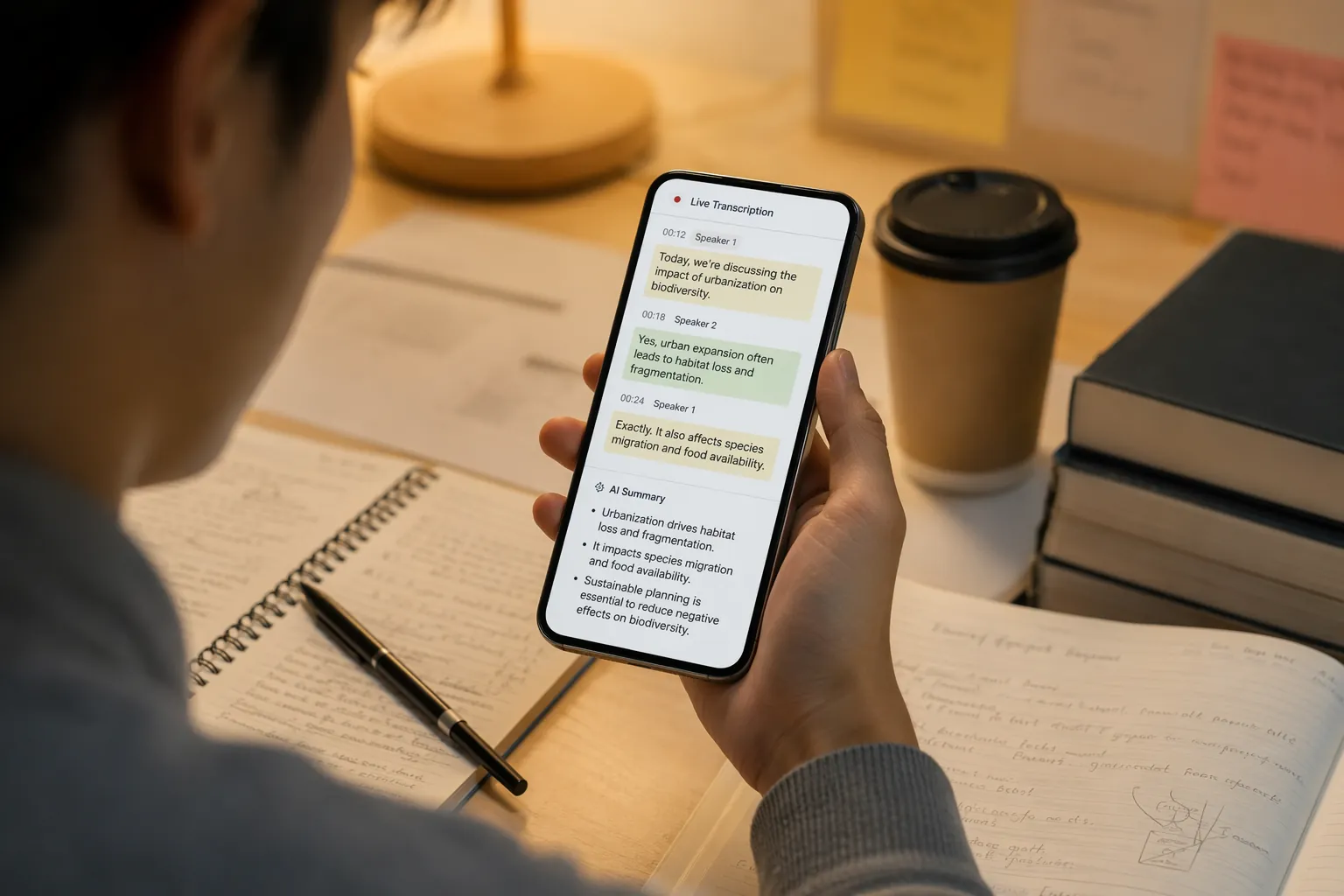
For a student, tokens per second are not abstract. They show up as waiting after class, lag while summarizing a recording, and whether a phone can produce a rough study sheet while the topic is still fresh. The benchmark does not prove every student app will behave the same way, because it tested one model through Google's Edge Gallery and LiteRT-LM engine. But it does expose a practical split: some phones are already close to making local AI feel immediate, while others still make the student wait.
The Benchmark Gap Is Big Enough To Change The Study Session
The cleanest way to read the benchmark is not as a brand ranking. Read it as a delay ranking. A phone generating around 50 tokens per second can start turning a lecture segment into a summary quickly enough that the student may still be in the same study context. A phone generating around 10 tokens per second can still produce text, but the waiting becomes part of the workflow.
| Phone or chip | Benchmark result | What it means for study work |
|---|---|---|
| iPhone 17 Pro Max / Apple A19 Pro | 51.28 tokens/sec on Gemma 4 E2B | Best tested local inference speed for quick summaries and AI responses |
| Galaxy S26 Ultra class / Snapdragon 8 Elite Gen 5 | 48.56 tokens/sec on Gemma 4 E2B | Very close to the iPhone result on raw generation speed |
| Dimensity 9500 phones | 41.02 tokens/sec on Gemma 4 E2B | Still strong in the same test, though not the main U.S. buying comparison here |
| Pixel 10 Pro / Tensor G5 | 10.42 tokens/sec on Gemma 4 E2B | Much slower local generation in this specific benchmark |
The part that matters most during exam prep is not just final output speed. It is time to first token. When a student asks for a summary of the last 20 minutes, a delayed first response makes the phone feel stalled even if the final answer eventually arrives. Beebom found Tensor G5's time to first token was 16.5 times slower than the iPhone in its test conditions.[1]
That delay has ordinary consequences. A student reviewing a lecture recording on a subway ride may not have time to re-run a failed or lagging summary. Someone turning slides into flashcards before bed may abandon the AI pass if the phone keeps pausing between chunks. A student trying to compare two explanations from a review session needs the result while the confusion is still active, not after they have moved on to another subject.
The Android caveat is important. In Beebom's test, consumer apps could not access the NPU on the Android flagships and instead fell back to CPU or GPU execution. Apple's Neural Engine, by contrast, has been available to third-party developers since iOS 11 in 2017.[1] So the issue is not only whether a chip contains AI hardware. It is whether normal apps can actually use the fast path.
That distinction is exactly where student buyers can get misled. A phone can be described as AI-focused and still leave the student's note app, flashcard app, or transcription app running on a less efficient route. Until app-level benchmarks exist for tools such as Notion, Quizlet, Otter, and the built-in recorder apps, the chipset score is a strong signal, not a complete student workflow test.
Transcription Is Where Software Can Beat A Faster Chip
Lecture transcription is a different problem from raw text generation. It is capture, diarization, search, cleanup, and export. A fast local model helps, but the student still needs a reliable recorder, speaker labels, and offline behavior when the campus Wi-Fi drops or the commute goes underground.
This is the Pixel 10 Pro's best argument. In T3's lecture-transcription testing, republished by Yahoo Tech, Pixel Recorder stood out because it offered real-time transcription, speaker differentiation, and offline operation as a built-in cross-brand solution.[2] That matters more than it sounds. A student does not always get to choose the room acoustics, the professor's microphone discipline, or whether the recording can be uploaded to a cloud service immediately.
The Pixel result creates an uncomfortable but useful split. Tensor G5 looks weak in the Beebom local-generation benchmark, especially beside A19 Pro and Snapdragon 8 Elite Gen 5.[1] But Pixel Recorder can still be the more dependable daily tool for a student whose main job is capturing lectures accurately and searching them later.[2]
That does not erase the speed problem. If the next step after transcription is local summarization, outline cleanup, or flashcard drafting, the benchmark gap can reappear. The Pixel workflow is strongest when the recording product itself is the center of the study session. It is less convincing when the student expects heavy on-device generation immediately after capture.
Samsung's Advantage Is Not A Benchmark Number
The Galaxy S26 Ultra is the easiest phone to undervalue if the only thing on the page is tokens per second. Its expected Snapdragon 8 Elite Gen 5 class performance is close to Apple's A19 Pro in Beebom's benchmark data, at 48.56 tokens per second versus 51.28 tokens per second.[1] But the more student-specific reason to consider Samsung is the S Pen.
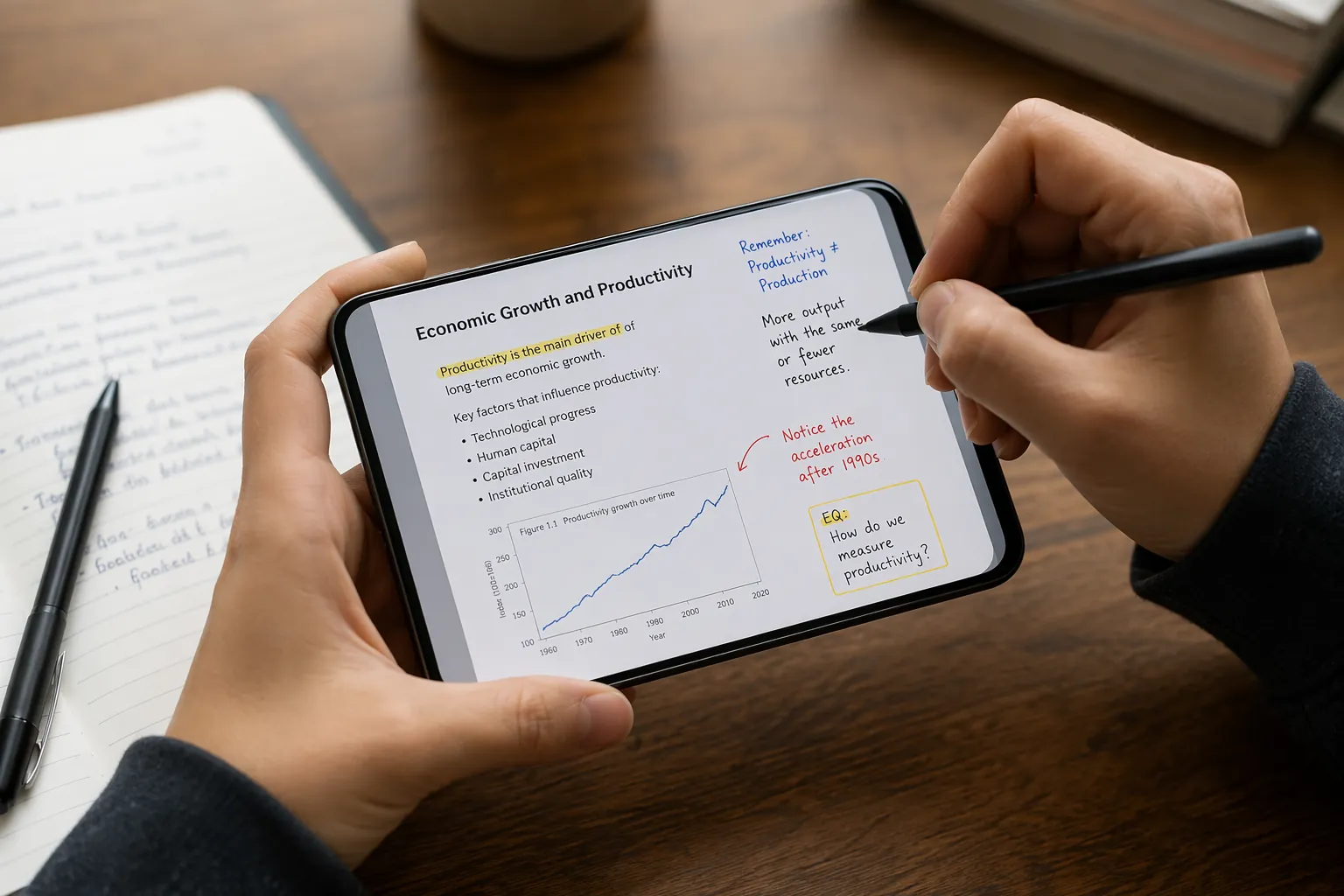
Plenty of real studying is not typing. It is circling a formula on a slide, writing a missing step next to a chemistry mechanism, marking which paragraph in a reading passage explains the answer, or drawing a quick diagram because the typed version would take longer. Samsung's S Pen plus Galaxy AI workflow gives that kind of student a more natural bridge between annotation and cleanup.
Samsung also uses a hybrid Galaxy AI model, routing simpler tasks on-device and more complex ones to the cloud.[1] For study work, that can be useful or annoying depending on the setting. A quick note cleanup may feel seamless. A more complex summary may depend on connectivity, account settings, or cloud processing rules. The phone can still be a strong study device, but its strength is not purely local independence.
For students who mark up slides every week, that trade-off is reasonable. The S Pen reduces the friction at the point where notes are created, not just after notes exist. A faster model can summarize bad notes quickly; a better capture-and-annotation workflow can prevent some of those bad notes from happening in the first place.
Google's Study Ecosystem Is A Real Counterweight, With Rollout Caveats
Google's broader study ecosystem gives the Pixel 10 Pro another defense beyond Recorder. Google announced student-facing Gemini study notebooks, NotebookLM integration, and free Princeton Review practice-test access through Gemini in June 2026.[3] For a student preparing for standardized tests, that bundle is more relevant than another generic AI photo feature.
The caution is that announcements are not the same as measured study outcomes. The available materials do not show independent testing of those June 2026 features across real exam-prep routines. They also do not prove that the Pixel 10 Pro can run every part of that study flow locally or faster than the iPhone and Galaxy alternatives. Google may have the most coherent study software story, while still trailing badly in this specific on-device inference benchmark.
Circle to Search also belongs in this conversation because it supports a common student behavior: checking a problem, diagram, term, or passage without breaking the current screen. It is not a replacement for a tutor or a full solution walkthrough, but it can reduce the number of small context switches that make a short study block fall apart.
So the Pixel decision is unusually task-dependent. If lecture capture, searchable recordings, and Google's study tools are the center of the workflow, the Pixel 10 Pro remains defensible. If the buyer mainly wants fast local summaries, offline generation, and quick flashcard drafting, the Tensor G5 benchmark result is a serious warning.
Long Study Sessions Add One More Variable
Sustained performance matters when the phone is not answering one prompt but processing a long review block. ZanexaTech reported 82.4% sustained performance stability for Snapdragon 8 Elite Gen 5 under its AI stress testing, compared with 68.1% for A18 Pro.[4] That supports the idea that Snapdragon-based phones may handle longer AI workloads well.
It should not decide the whole recommendation. The source does not fully disclose enough about the workload duration, model, and exact test setup to treat that figure like a student-session benchmark. It is useful supporting evidence, especially for the Galaxy S26 Ultra, but it is not a substitute for testing a full 90-minute lecture recording, summary pass, and flashcard export on the same apps.
Which Phone Fits Which Student Workflow?
The buying decision narrows once the phone is matched to the study bottleneck. Camera quality, peak display brightness, and broad ecosystem loyalty may matter personally, but they do not answer the main productivity question unless they change how the student captures, processes, or reviews material.
| Primary study bottleneck | Best fit | Why |
|---|---|---|
| Fast local summaries and AI responses | iPhone 17 Pro Max | A19 Pro led the cited on-device Gemma 4 E2B benchmark at 51.28 tokens/sec, with much faster time to first token than Tensor G5. |
| Slide annotation and handwritten explanations | Galaxy S26 Ultra | Near-iPhone benchmark speed plus the S Pen workflow for students who mark up PDFs, slides, and diagrams. |
| Lecture recording and searchable transcription | Pixel 10 Pro | Pixel Recorder's real-time, speaker-labeled, offline transcription can outweigh weak raw generation speed for lecture-heavy students. |
| Lowest-cost AI phone shopping | Not decided by these tests | Budget AI features may be tempting, but the sourced materials do not provide comparable on-device benchmark data. |
For most students who are buying specifically for on-device AI responsiveness, the iPhone 17 Pro Max is the safest pick from the available evidence. The A19 Pro has the strongest benchmark result here, and Apple's developer access to the Neural Engine reduces one of the practical risks seen on Android: powerful AI hardware that ordinary apps cannot fully reach.[1]
The Galaxy S26 Ultra can be the better study phone for a student whose notes are visual and handwritten. If the weekly routine is opening lecture slides, writing missing explanations, circling weak spots, and then cleaning up those notes later, Samsung's S Pen changes the front end of the workflow in a way a benchmark table cannot capture.
The Pixel 10 Pro is the hardest recommendation, but not a bad one. It performs poorly in the cited local-generation benchmark, and that matters. Still, lecture-heavy students who depend on built-in offline transcription, speaker labels, Recorder search, Circle to Search, Gemini study notebooks, NotebookLM, and Google's announced Princeton Review access may reasonably choose the software ecosystem over raw speed.[2][3]
The clean answer is workflow-first. Choose the iPhone 17 Pro Max if fast on-device summarization and AI responsiveness are the priority. Choose the Galaxy S26 Ultra if the study day revolves around handwritten notes and S Pen annotation. Choose the Pixel 10 Pro if lecture capture and Google's study software matter more than benchmark speed. App-level performance may change as AI tools, SDK access, and vendor integrations evolve, so the strongest recommendation today is still tied to the task the phone has to keep moving.
References
- I Tested On-Device AI on Android and iPhone, Results Not Even Close, Beebom, April 2026.
- Want to Transcribe Lectures With AI?, Yahoo Tech.
- ISTE Students 2026, Google Blog, June 2026.
- On-Device AI vs Cloud AI Phones: Which One Actually Wins in 2026?, ZanexaTech.
Authoritative source
No specific exam hub matched
Browse the exam hubs directory for the authoritative plan on any of the five exams.
Report an error in this tool's output
Found something this tool got wrong beyond what's documented above? Report it so the accuracy log stays current.
Comments
Join the discussion with an anonymous comment.