
I Tested DeepSeek V4's Coding Agent to Learn Programming
Accuracy Warning — DeepSeek V4
DeepSeek V4 produces plausible code that can contain confident errors; relying on it to generate solutions instead of practicing yourself weakens retention and debugging skill.
- Accuracy:
- Limited
- Tested:
- Using the coding agent as a primary way to learn programming
- Last tested:
- 2026-08-01
If you arrived looking for “I tested DeepSeek V4 coding agent to learn programming,” the honest version starts with scope. I did not run a private two-week trial where DeepSeek V4 was my only Python teacher, and I am not going to invent cold-recall scores to make this read more hands-on than it is. This is a date-stamped, evidence-labeled review of the claim behind the phrase: whether a beginner can use DeepSeek V4’s coding agent as a primary way to learn programming, rather than just as a cheap way to get code written.
| Item | Scope used in this article |
|---|---|
| Last reviewed | August 1, 2026, UTC |
| Pricing snapshot | DeepSeek docs checked as a dated snapshot on August 1, 2026, UTC; promotion and cache pricing may change |
| Personal two-week learner trial | Not run; no fabricated personal retention numbers |
| DeepSeek-specific evidence | DeepSeek docs and pricing snapshot, Thomas Wiegold’s third-party hands-on review, and Hacker News community cost logs |
| Learning-outcome evidence | Anthropic randomized trial on AI assistance and coding skills; supporting education guidance from JetBrains, Pluralsight, and the University of Toronto |
| Verdict boundary | This evaluates V4 as a programming-learning tool, not as a production coding model for experienced engineers |
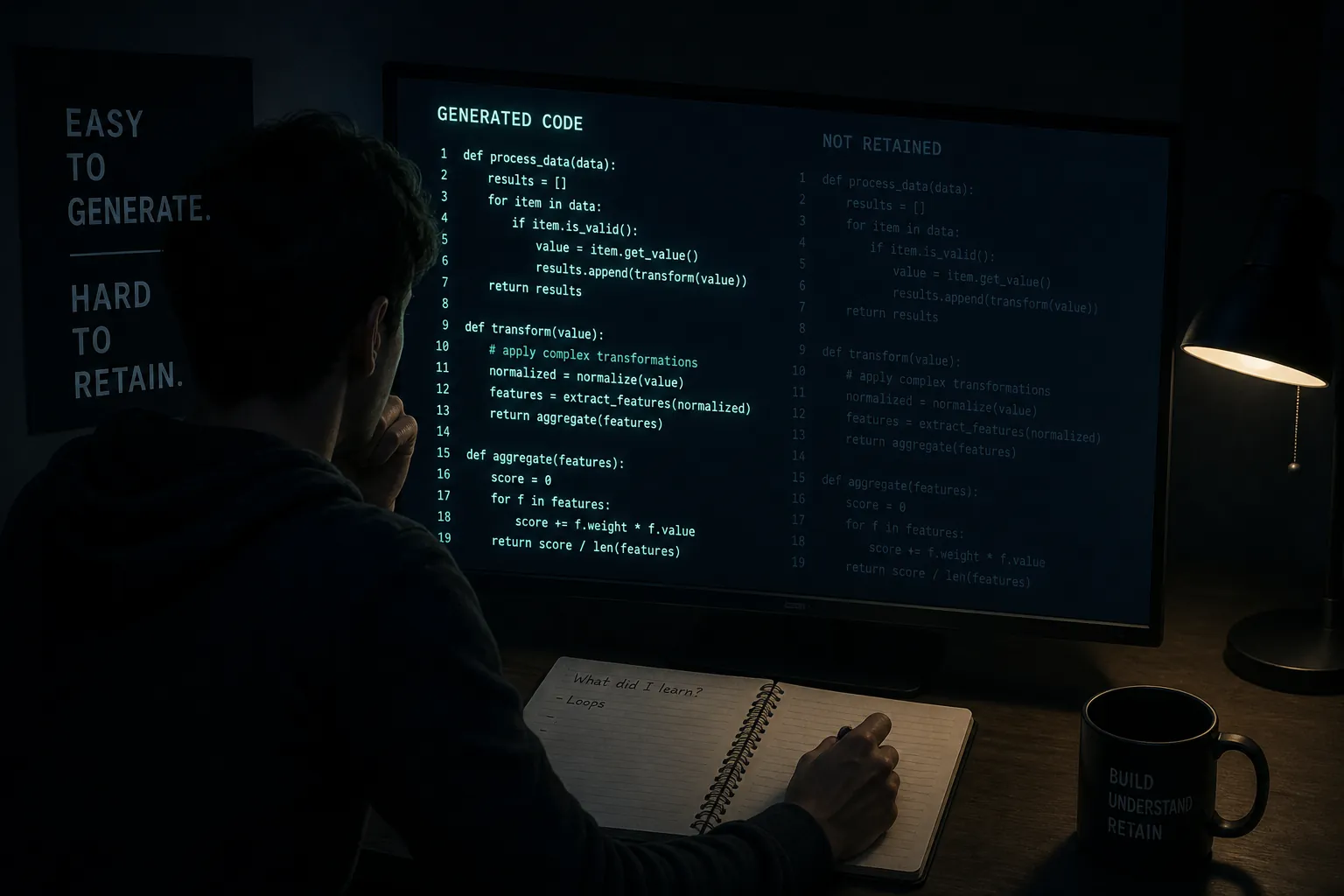
That distinction matters because DeepSeek V4 is exactly the kind of tool that makes caution sound fussy. It can produce working-looking code quickly, it is priced low enough that a student can stop thinking about cost, and the early public discussion is full of long-session anecdotes that would make any tired beginner think: why fight the blank file?
The tempting part: V4 makes code feel almost free
DeepSeek announced V4 on April 24, 2026 as MIT-licensed open-weight preview models: V4-Pro at 1.6T total parameters with 49B active, and V4-Flash at 284B total with 13B active. The same release describes a 1M-token context window and up to 384K max output, while also making clear that V4-Pro was still preview-positioned and that an official version would follow later. That is the snapshot to keep in mind, not a timeless model identity. [1]
The pricing snapshot is the harder thing to ignore. DeepSeek’s pricing page listed V4-Flash at $0.14 per 1M input tokens and $0.28 per 1M output tokens, while V4-Pro was listed at $0.435 input and $0.87 output per 1M tokens under a 75% promotional discount from the stated standard rate of $1.74 input and $3.48 output. Cache-hit input was listed around $0.0036 per 1M tokens. Pricing like this should be treated as dated, especially because a temporary promotion and cache behavior can change the real bill. [2]
The community cost logs are even more seductive, but they need the right label: self-reported, not audited. In one Hacker News thread, a user reported a full TypeScript endpoint audit costing $0.09 on V4-Pro versus an estimated $9–13 on Claude Opus, roughly a 100x ratio. Another reported about 250M tokens for roughly $10, and long agent-session comments described cache-hit rates near 99%. These are not controlled benchmarks. They are still important because they describe the adoption psychology: when the meter barely moves, beginners will ask the agent again instead of stopping to think. [3]
That is not a moral failure. If you are learning alone at night and a model can produce a Python script in seconds for pennies, of course you will use it. The question is whether the code you receive becomes something you can reproduce, modify, and debug tomorrow.
What V4 looks like as a coder
Thomas Wiegold’s hands-on review lands in a useful practical category. He describes DeepSeek V4 as “competent on everything, outstanding on nothing,” calls it “the best value model, not the best coder,” and frames its output as a “competent junior engineer’s first pass.” That is a much more helpful description for learners than a leaderboard trophy. A competent first pass can unblock you. It can also hide the decisions you were supposed to learn how to make. [4]
The benchmark picture is mixed once the labels are kept attached. DeepSeek’s 80.6% SWE-bench Verified result is a vendor-reported number. Wiegold reports SWE-bench Pro placing V4-Pro around 55%, behind Claude Opus 4.7 at 64.3%, Kimi K2.6 at 58.6%, and GLM-5.1 at 58.4%. He also notes that V4 is verbose, burning 4–5x the median output tokens on the Artificial Analysis Intelligence Index. Low per-token prices soften that, but they do not erase it. [4]
There is also an independent reality check worth keeping in the frame. The U.S. government CAISI evaluation at NIST placed V4-Pro closer to GPT-5, described in the coverage as roughly eight months old, than to GPT-5.4 or Opus 4.6. That does not make V4 weak. It means vendor launch numbers should be treated as an upper-bound view of the model, not as the whole story. [4][5]
For a beginner, the important conclusion is narrower than “V4 is good” or “V4 is bad.” It is good enough to produce plausible, runnable code often enough that you may stop practicing the parts that feel slow: decomposing the task, naming variables, choosing data structures, reading error messages, and making a small fix without help.
The learning evidence is where the verdict changes
The strongest evidence here is not DeepSeek-specific. It is Anthropic’s January 2026 randomized trial on AI assistance and coding skills, with 52 junior engineers. Participants were assigned either to hand-code or to use an AI assistant, then took an immediate quiz. The AI-assisted group scored 50%, while the hand-coding group scored 67%. Anthropic describes that as roughly two letter grades lower, with Cohen’s d=0.738 and p=0.01. The largest deficit appeared on debugging questions. [6]
The speed gain was not the rescue people usually imagine. The AI-assisted group finished only about two minutes faster, and that difference was not statistically significant. That is the most irritating kind of result for an AI coding assistant: not dramatically faster, and worse on the thing learners most need to internalize. [6]
The interaction patterns explain more than the headline score. Anthropic found that low-scoring patterns such as AI delegation, progressive AI reliance, and iterative AI debugging averaged below 40%. Higher-scoring patterns such as conceptual inquiry, hybrid code-explanation, and generation-then-comprehension averaged 65% or higher. In plain terms: asking the assistant to do the work correlated with worse immediate understanding; using it to interrogate ideas or explain generated code looked less damaging. [6]
There are limits. The trial used a sidebar code assistant, not a fully agentic DeepSeek V4 workflow. The sample was small, and the quiz was immediate rather than a long-term retention test. Anthropic also notes that agentic products are “likely to have more pronounced” effects on skill formation, but that is an expectation, not a measured result from this trial. Still, the trial names the behavior that matters for learners: delegation feels like progress while it is quietly replacing practice. [6]
A hypothetical Python example makes the mechanism obvious. Suppose the exercise is to read a CSV file, group rows by category, and print a summary. If V4 writes the whole script, explains it, fixes the import error, and then rewrites the grouping logic when the output looks wrong, the learner may end the session with a clean file and almost no ownership of the sequence. The next day, with the agent off, the same learner still has to know where to start, what object is being looped over, and why the summary dictionary changes inside the loop.
This is also where hallucination becomes a practical debugging hazard rather than a dramatic “AI lies” warning. Wiegold reports V4-Pro at 94% on the AA-Omniscience hallucination evaluation, a measure of how often the model answers when it should admit uncertainty. For experienced programmers, a confident wrong answer is annoying. For beginners, it can become the lesson. [4]
So can DeepSeek V4 teach programming?
| Question | Evidence-supported answer |
|---|---|
| Can V4 write code for you? | Yes. Third-party review and community reports support treating it as a capable, cheap first-pass coder, though not the strongest coder available. |
| Can V4 explain code? | Yes, with verification. Explanation-oriented use is more defensible than delegation, especially when the learner has already attempted the problem. |
| Can V4 safely replace your own programming practice? | No. The best learning evidence here points the other way: AI-assisted delegation produced worse immediate quiz scores, especially on debugging. |
That middle row is the useful one. V4 is not useless for learning. It is just dangerous when the learner’s first move is “build this for me.” The safe version is closer to having a very cheap reviewer who is sometimes wrong, not a teacher whose solution becomes your understanding.
This matches the more conservative advice from programming-education sources. JetBrains puts it bluntly: “the more of a beginner you are, the less you should use AI to generate code for you.” Pluralsight’s guidance emphasizes write-first learning practices before leaning on AI feedback. The University of Toronto’s CHI 2023 work on Python learning with a GPT-3-era Codex generator found that active use transferred while passive use did not, though that study involved 10–17-year-olds and is analogical evidence rather than evidence about V4 itself. [7][8][9]
The learner workflow I would trust
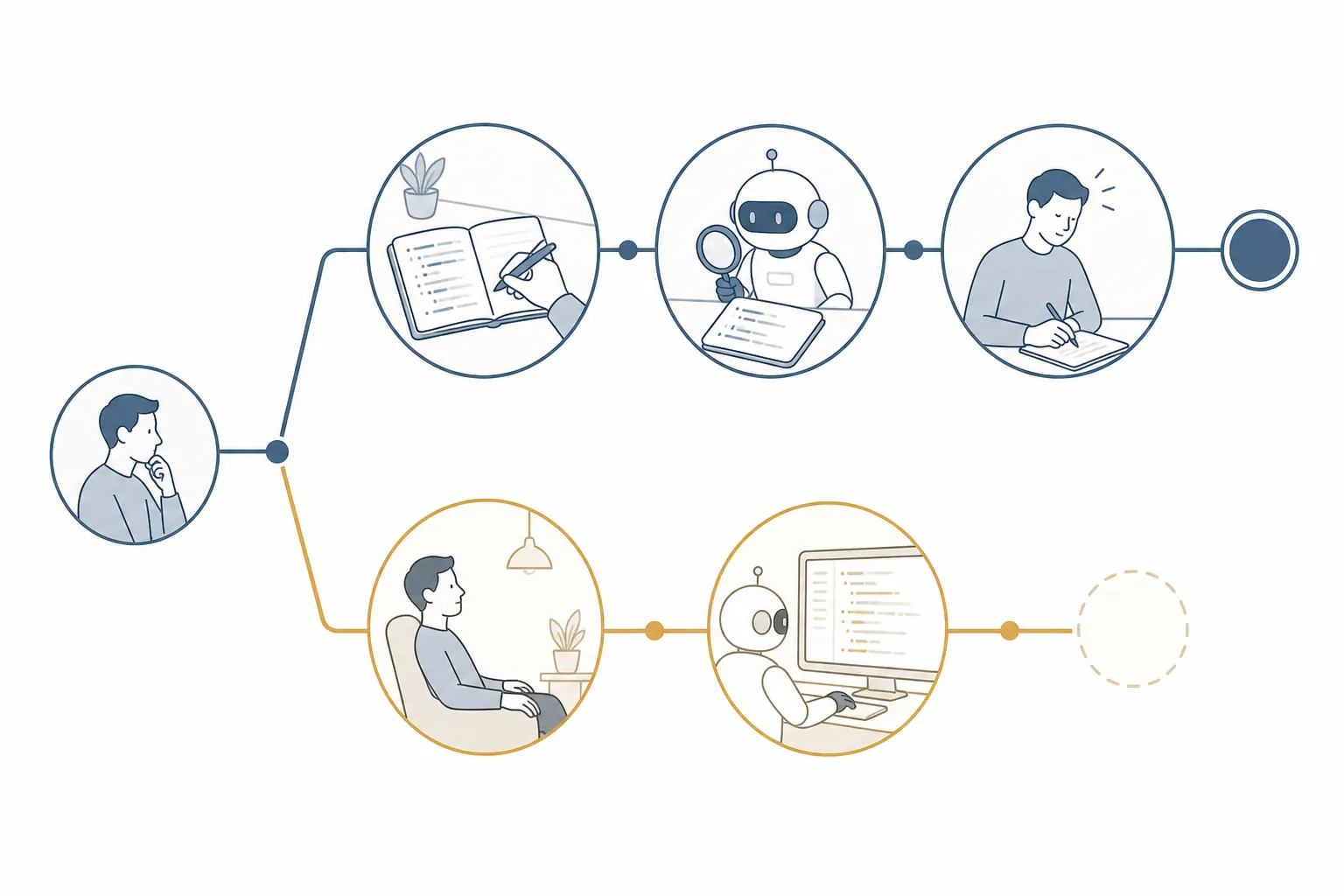
If I were using DeepSeek V4 to learn Python, I would not make it my only teacher. I would make it enter after the first attempt, not before. The workflow is deliberately a little inconvenient because the inconvenience is where the learning happens.
- Pick a small exercise and write the first version yourself, even if it is ugly or incomplete.
- Ask V4 to review what you wrote without rewriting the whole solution.
- Ask for one concept explanation tied to your code, not a generic lecture.
- Make the smallest correction yourself.
- Close the agent and recreate the same task from memory.
- Only then ask V4 to compare your cold attempt with the earlier version.
The prompt should make the boundary explicit. A useful first prompt is not “solve this.” It is closer to this:
I am learning Python. Review my attempt below.

Rules:
1. Do not rewrite the whole program yet.
2. Identify the first bug or misconception that will block me.
3. Explain why it is wrong in terms a beginner can test.
4. Give me one small hint, not the full solution.

My code:
[Paste code here]

The exercise goal:
[Paste goal here]
After you fix the first issue, a second prompt can move from correction to understanding:
Explain the part of my code that changed.

Use this format:
- What my original code was trying to do
- Why it failed
- The smallest idea I need to remember
- One new practice question that tests the same idea without copying this solution
The cold attempt is the part people skip because the model is cheap. Do not skip it. Open a blank file. Rebuild the exercise without chat history. If you cannot start, write the first three comments that describe the algorithm. If you still cannot start, that is useful information: the earlier session produced output, not ownership.
Where V4 fits best
- Explaining an error message after you have tried to interpret it yourself.
- Reviewing a short function you wrote and pointing out the first misconception.
- Generating a second practice problem that tests the same concept in a different surface form.
- Comparing two versions of your own code and explaining the tradeoff.
- Producing a reference implementation after your cold attempt, not before it.
Where I would not use it
- As the first author of every exercise solution.
- As the final judge of whether an explanation is true.
- As an unlimited debugging loop where you paste each error and wait for the next patch.
- As a substitute for reading documentation or running small experiments.
- As a way to speed through fundamentals you cannot yet reproduce without the agent.
The real test is not whether V4 can finish your file. It usually can. The test is whether you can close it, rebuild the idea, and debug one broken version without the model carrying the whole mental stack.
Verdict
DeepSeek V4’s coding agent is worth using as a nearly free programming assistant. It is not a good primary programming teacher. The evidence-supported adoption rule is simple: write first, ask V4 to review or explain, make the correction yourself, then redo the task cold with the agent off.
That places this article in the same evidence-labeled lane as StudyMethod’s DeepSeek V4 Flash studying trial and the site’s Claude exam-prep testing: no invented trials, no unlabeled anecdotes, and no pretending that cheap generated output is the same thing as durable skill.
References
- DeepSeek-V4 Release, DeepSeek API Docs, April 24, 2026.
- Models & Pricing, DeepSeek API Docs.
- Hacker News thread, item 47977026, Hacker News.
- DeepSeek V4 Review, Thomas Wiegold.
- DeepSeek V4: Features, Access, Benchmarks, and More, DataCamp.
- AI assistance and coding skills, Anthropic, January 2026.
- Should You Use AI to Learn?, JetBrains, July 31, 2025.
- Learning coding with AI, Pluralsight.
- AI code generators for programming education, University of Toronto.
Authoritative source
No specific exam hub matched
Browse the exam hubs directory for the authoritative plan on any of the five exams.
Report an error in this tool's output
Found something this tool got wrong beyond what's documented above? Report it so the accuracy log stays current.
Comments
Join the discussion with an anonymous comment.