
How Claude Opus 5 Benchmarks Translate to Study Productivity
Accuracy Warning — Claude Opus 5
50% factual hallucination rate; verify all fact-dependent output with official answer keys
- Accuracy:
- Moderate
- Tested:
- Essay revision and concept explanation
- Last tested:
- 2026-07-24
If you are studying for a fixed test date, the useful question is not whether Claude Opus 5 looks impressive on a launch-week chart. The useful question is whether the benchmarks tell you which study tasks you can safely hand to it, which tasks still need official material, and where a confident answer can quietly become a wrong flashcard.
Start with the trust boundary. Claude Opus 5 was released on July 24, 2026, so the evidence is still fresh and indirect: there is no published benchmark yet that specifically measures Opus 5 on GRE, MCAT, SAT, ACT, or ASVAB prep content.[1] The study-productivity case is a translation from general benchmarks into test-prep workflows, not proof that your score will rise because you used the model.
The second boundary is sharper. In AA-Omniscience reporting cited from Anthropic’s system card, Opus 5 showed a 50% factual hallucination rate, 6% higher than Opus 4.8.[2] That does not make the model useless. It does mean it should not be treated as an answer key, a test-rules authority, or a factual verifier for science claims, official exam policies, enlistment rules, or passage details you have not supplied.

What The Benchmarks Actually Map To
A Claude Opus 5 benchmark for study productivity needs a translation layer. A benchmark can be relevant to studying without being a test-prep benchmark. Self-verification can matter for essay revision. Knowledge-work Elo can matter for multi-step feedback. Novel problem-solving can matter when your question does not look like the textbook example. Hallucination rates matter anywhere the answer depends on a fact.
| Benchmark signal | What it measured or reported | Best study use | Where the mapping breaks | Evidence level for exam prep |
|---|---|---|---|---|
| Frontier-Bench self-verification | Opus 5 checks and iterates on its own work before finalizing an answer.[3] | Essay revision, problem-feedback loops, explanation repair after a confusing first answer. | Self-checking is not the same as official correctness on facts or test rules. | Useful indirect evidence |
| AA-Briefcase knowledge-work Elo | Opus 5 at max effort scored 1,720, ahead of Fable 5 at 1,574.[2] | Multi-step coaching: essay scaffolds, passage reasoning, problem decomposition, study-plan adjustments. | Knowledge-work performance is not a direct GRE, MCAT, SAT, ACT, or ASVAB score predictor. | Useful indirect evidence |
| ARC-AGI 3 | Opus 5 scored 30.2% versus GPT-5.6 Sol at 7.8%.[3] | Handling unusual follow-up questions when the student’s confusion does not match a canned explanation. | Novel reasoning benchmarks do not prove mastery of official test content. | Supporting evidence |
| AA-Omniscience hallucination rate | Reported 50% factual hallucination rate, 6% higher than Opus 4.8.[2] | A warning signal: use the model beside official keys and source passages, not instead of them. | This is not a measure of essay-coaching quality; it is a factual-reliability warning. | Critical limitation |
| FrontierCode effort data | Medium effort reached 53.4% at about 1.5x compute, while high effort was about 53% at about 3x compute.[4] | Save higher-effort settings for hard reasoning; use medium effort for routine explanations and drills. | Coding compute patterns are not the same as study-session token use. | Practical but uncertain |
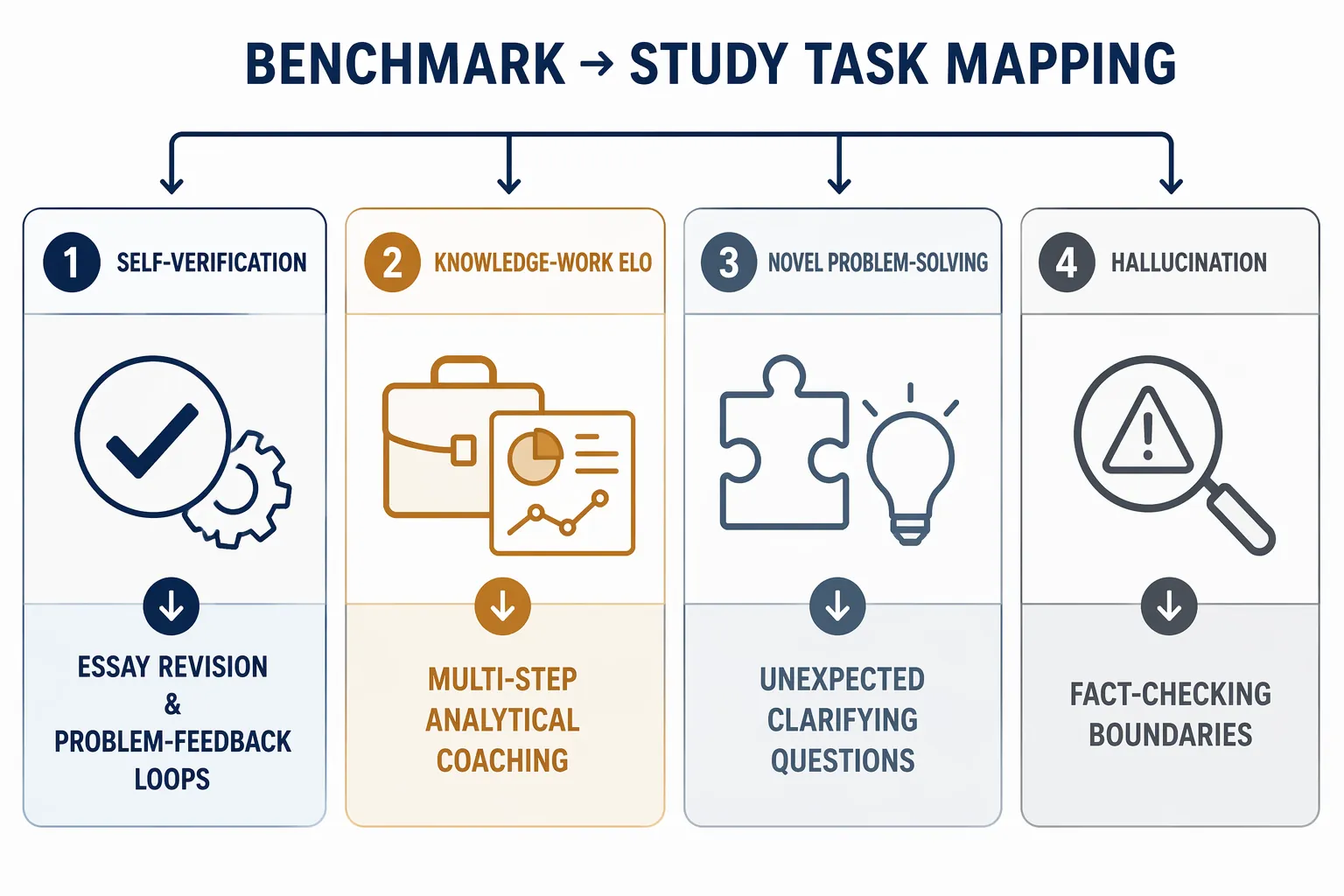
Self-Verification Is The Most Study-Relevant Good News
Self-verification is the benchmark behavior that most cleanly resembles a productive tutoring session. A weak AI tutor gives a polished first answer and waits to be believed. A stronger study assistant checks whether its explanation holds together, revises the route, and can compare its own feedback against the stated goal before handing it to the student.
That matters most in tasks where the student is not asking for a hidden fact. GRE Analytical Writing is the cleanest example. A student can paste an issue essay draft and ask Opus 5 to identify the thesis, map each paragraph to the prompt, flag unsupported leaps, and propose a revision order. If the model catches that its first critique ignored a counterargument or overstated the strength of an example, the revision loop improves.
The same behavior helps when a practice problem goes wrong. Instead of only saying, “Here is the correct solution,” Opus 5 can be used to inspect the student’s work: identify the first invalid step, explain why that step looked tempting, and produce a second explanation with a different route. In a real study session, that is often more valuable than generating more questions. Students usually do not need infinite practice; they need to know which mistake pattern keeps repeating.
The safe version of this workflow keeps the official answer visible. For example, a SAT Math student can provide the official answer and their own scratch work, then ask the model to reconcile the two. That is different from asking the model to decide the answer from scratch and trusting it. If you are experimenting with math prompting, a code-execution or verification step is still safer than a fluent chain of algebra alone; this is the same reason hands-on prompt tests matter more than model vibes in math problem solving.
The Hallucination Result Sets The Hard Boundary
The uncomfortable part is that self-verification and factual hallucination can coexist. A model can be good at checking the internal logic of an argument and still be unsafe when it supplies an external fact from memory. That distinction is not academic. It decides which study tasks are reasonable.
Use Opus 5 to improve the structure of a GRE essay. Do not use it as the source for current ETS policies. Use it to explain why an ACT Science graph supports one interpretation over another. Do not use it to invent background biology you think the passage implied. Use it to compare two MCAT CARS answer choices against quoted lines. Do not let it add missing context about an author, theory, or historical setting unless you have supplied that context from the passage or an official explanation.
This is where many students lose time. A wrong fact in a chat window feels less damaging than a wrong official answer because it appears in a helpful voice. Then it becomes a flashcard. Then it becomes a reason for choosing the wrong option two weeks later. The AA-Omniscience number is a warning against that pipeline.[2]
For fact-dependent work, the safer prompt pattern is simple: provide the source, require line-by-line grounding, and ask the model to mark uncertainty instead of filling gaps. On MCAT science review, that means using AAMC explanations, your notes, or a trusted textbook excerpt as the source material. On ACT Science, it means giving the figure, table, or passage text and forbidding outside assumptions. On ASVAB, it means checking military-specific format rules and enlistment-related claims against official sources, not a generated summary.
Knowledge-Work Elo Helps With Coaching, Not Authority
AA-Briefcase is useful because test prep is full of small project-management tasks that students pretend are just “studying.” You have to decide whether a missed question was content, timing, reading precision, or trap-answer attraction. You have to turn a diagnostic score into a weekly plan. You have to compare two explanations and decide which one you can reproduce under time pressure.
Opus 5’s reported AA-Briefcase Elo of 1,720 at max effort, compared with Fable 5 at 1,574, is relevant to that kind of layered work.[2] It supports using the model as a coach that can hold multiple constraints in mind: your test date, your weak section, the official materials you have left, and the kind of mistakes you keep making.
It does not prove that Opus 5 knows the best answer to a specific exam item. That distinction matters for tool comparisons too. If you are weighing Opus 5 against Fable 5, the useful comparison is not just which model has the higher headline number, but which one behaves better in the study task you repeat every night: reviewing missed questions, planning the next practice set, or explaining a concept without drifting into unsupported claims. That is the more practical way to read Claude-versus-Fable study comparisons.
ARC-AGI 3 Matters When The Student’s Question Gets Weird
A lot of tutoring time is spent on questions that do not look elegant. The student does not ask, “Please explain proportional reasoning.” The student asks why answer choice C is wrong when it sounds “more specific,” or why a graph trend matters if the passage never says the word increase, or why an essay example that felt persuasive received a flat critique.
That is where ARC-AGI 3 is at least directionally interesting. Opus 5’s reported 30.2% score, compared with GPT-5.6 Sol at 7.8%, suggests stronger performance on novel problem-solving than the cited competitor.[3] For study productivity, the likely benefit is not that the model magically knows your exam. It is that it may handle the odd second or third follow-up better, especially when the student’s confusion is not already packaged as a standard lesson.
That is a real advantage for late-night remedial work. A patient model that can explain the same idea three ways can keep a student moving. The caution is that novelty handling still needs rails. If the question involves a passage, include the passage. If it involves a data table, include the table. If it involves an official explanation, include the explanation and ask the model to stay inside it.
Use The Effort Dial Like A Study Setting, Not A Prestige Setting
The effort setting is one of the easiest places to waste money or attention. SitePoint’s FrontierCode v1.1 reporting found that medium effort reached 53.4% at about 1.5x compute, while high effort was about 53% at about 3x compute.[4] That is coding-benchmark data, not a measurement of GRE or MCAT study sessions, so it should not be converted into exact savings math. Still, the usage lesson is sensible.
- Use medium effort for routine concept explanations, first-pass essay comments, flashcard cleanup, and simple study-plan edits.
- Use higher effort for multi-step problem diagnosis, dense passage analysis, essay restructuring, or comparing several missed-question patterns.
- Do not use higher effort to make unsupported facts feel more reliable; verify those with official sources instead.
This is the same basic caution behind tokenmaxxing: longer, heavier, more elaborate AI output is not automatically better studying. If the task is small, keep the model’s job small.
Exam-By-Exam Verdicts
GRE Analytical Writing: High Fit
GRE Analytical Writing is the best match for Opus 5’s current benchmark profile. The task is mostly reasoning, organization, evidence use, and revision. A model with strong self-verification and knowledge-work behavior can help a student turn a rough draft into a clearer argument without needing to be a source of external facts.
The best workflow is multi-draft. First, ask for a structural diagnosis: thesis, paragraph role, logical gaps, and counterargument handling. Then ask for a revision plan, not a rewritten essay. Finally, ask the model to compare the revised version against the original prompt and identify what changed. That sequence uses the model’s reasoning strength without training the student to outsource the actual writing.
MCAT CARS: Moderate Fit With Passage-Grounded Caution
MCAT CARS can benefit from Opus 5, but only if the passage remains the authority. The model can help separate main idea, author attitude, evidence, and tempting wrong answers. It can also explain why an answer that sounds sophisticated is unsupported by the passage.
The danger is invented context. If Opus 5 supplies background about the author, the historical period, or a theory that is not in the passage, the student may start reasoning from information the test did not give. For CARS, a good prompt says: use only the quoted passage and answer choices; cite the exact phrase that supports each claim; mark any outside inference as outside the passage.
SAT Math: Moderate Fit, Stronger With Verification
SAT Math is a good use case for explanation and error diagnosis. Opus 5 can break down a missed algebra or functions question, compare the student’s method to a faster route, and generate a small set of similar practice items. The safest version includes the official answer or uses a verification method rather than treating the model’s first solution as final.
For practice-problem generation, keep the stakes low. Generated questions can be useful for drilling a pattern, but they should not replace official College Board material when you are measuring readiness. A model-generated problem that is slightly off-format may still teach a concept; it just should not be counted as evidence that you are test-ready.
ACT Science: Moderate Fit With A Science-Fact Caveat
ACT Science sits between two signals. On one side, Opus 5’s knowledge-work and reasoning benchmarks make it promising for interpreting tables, experimental setups, competing hypotheses, and graph relationships. On the other side, the hallucination result is a serious warning for any explanation that drifts into outside science facts.
The practical rule is to make the passage do the work. Ask Opus 5 to identify variables, controls, trends, and contradictions using only the supplied figures and text. If it starts adding biology, chemistry, or physics background that the question did not require, treat that as tutoring noise unless you can verify it elsewhere.
ASVAB: Limited Evidence
The ASVAB case is thinner because the available benchmark evidence does not speak directly to military-specific exam formats or enlistment-related rules. Opus 5 can still help with general arithmetic, mechanical concepts, vocabulary review, and study scheduling. It should not be trusted for official military policy, eligibility details, or test-administration rules without checking official sources.
Pricing Changes The Decision Only If You Use The Tool Correctly
The pricing context is simple enough not to overbuild. Anthropic lists Opus 5 at $5 per million input tokens and $25 per million output tokens, the same as Opus 4.8.[1] Existing Claude Pro subscribers at $20/month, or $17/month annually, get the upgrade at no extra monthly cost.[1] Sonnet 5 is listed at $3/$15 introductory pricing, so not every student needs to default to the most expensive model for routine work.[1]
If you already pay for Claude Pro, Opus 5 may improve AI-assisted studying without changing your monthly bill. If you are subscribing only for exam prep, the value depends on whether you are using it beside official ETS, AAMC, College Board, ACT, or ASVAB materials. It is much easier to justify as an essay reviewer, reasoning coach, concept explainer, and study-plan helper than as a replacement for a prep course or official question bank. That question is broader than benchmarks alone; it is the same tradeoff behind asking whether a Claude subscription can replace a test prep course.
A Working Rule For Using Opus 5 In Test Prep
Move reasoning tasks to Opus 5 when you can inspect the output: essay feedback, explanation repair, missed-question diagnosis, passage-grounded analysis, concept review, and study-plan design. Keep authority tasks with official material: answer keys, test-format rules, scoring policies, factual science verification, enlistment-related claims, and anything you plan to memorize.
The benchmarks support excitement in a narrow, useful way. Opus 5 looks like a better study companion for multi-step reasoning and revision than a generic chatbot. The same evidence says not to let it become the source of truth. A student who keeps that line visible can get real productivity from the model without turning launch-week benchmark theater into test-day risk.
References
- Introducing Claude Opus 5, Anthropic, July 24, 2026.
- Claude Opus 5 costs well below Fable 5, The Decoder.
- Claude Opus 5 Benchmarks Explained, Vellum.ai.
- Claude Opus 5 Is Most Efficient at Medium Effort, SitePoint.
Authoritative source
No specific exam hub matched
Browse the exam hubs directory for the authoritative plan on any of the five exams.
Report an error in this tool's output
Found something this tool got wrong beyond what's documented above? Report it so the accuracy log stays current.
Comments
Join the discussion with an anonymous comment.