
GRE Vocabulary Flashcard Decks Compared: Magoosh, Anki, Brainscape, and Quizlet
A deck-by-deck evaluation of the most-used GRE vocabulary flashcard options — comparing word count, SRS support, cost, and post-2023 test alignment — so you can choose the right deck for your timeline and learning style before committing study time.
Deck Sources

Why the 2023 GRE Format Change Makes Deck Choice Matter More
When ETS shortened the GRE in September 2023, the scored Verbal section dropped from 40 questions to 27. That reduction sounds manageable until you do the math: each Sentence Equivalence (SE) or Text Completion (TC) question now carries significantly more weight per-question on your final score band.
Before 2023, a single missed vocabulary question was a small drag. Now it can push you into a lower score band entirely. This shifts the stakes from "study more words" to "study the right words from a well-maintained, format-aligned source."
The flashcard deck you choose determines which words you drill, how often you see them, and whether the definitions you're memorizing match how words actually appear in SE and TC questions. That's the practical lens for every evaluation in this guide.
Three Criteria for a GRE Vocab Deck Worth Your Time
Word count alone is a poor proxy for deck quality. Before reviewing any specific platform, apply these three filters:
- Current-test alignment. Has the deck been reassessed against post-2023 GRE content? Decks that haven't been touched since 2019 or 2021 may overweight question types or word frequencies that ETS has since de-emphasized. Look for a verifiable last-updated date from the publisher — not a community estimate.
- Contextual definitions and example sentences. GRE SE questions test nuance between near-synonyms. A bare definition ("lucid: clear") gives you recognition but not the contextual feel you need to choose between two almost-identical answer options. Decks that include usage examples and synonym clusters prepare you for actual question mechanics.
- Active maintenance with a verifiable last-updated date. ETS occasionally adjusts difficulty distributions and the prominence of certain vocabulary domains. A deck published once and never revisited is a snapshot of one person's opinion about GRE words from whenever they made it. Verify the update date before committing.
Deck-by-Deck Breakdown
Magoosh GRE Flashcards — Free, Actively Maintained
Magoosh's free GRE vocabulary flashcard app covers 1,000 words on the web version, organized into common, basic, and advanced difficulty tiers. The mobile app may show a slightly higher count — approximately 1,500 words — though the exact number can vary by platform version; verify the current count inside the app itself.
The deck tracks which words you've mastered and resurfaces the ones you've missed — a lightweight spaced repetition approach without the full SRS configurability of Anki. Word selections are curated by GRE expert Chris Lele and were reassessed against current GRE content as recently as May 2026, making it one of the most recently verified free options available. Available on web, iOS, and Android.
- Best for: Students who want a well-maintained free starting point without setup overhead.
- Trade-off: Not a full SRS system — interval scheduling is limited compared to Anki. The web and mobile word counts differ; check your platform.
Anki Community Decks — Most Comprehensive, Steepest Curve
Anki's spaced repetition algorithm is widely regarded as the gold standard for long-term vocabulary retention. The most comprehensive free option available is a community-created combined deck drawing from GregMat, Magoosh, and Manhattan Prep word lists with duplicates removed. Definitions are primarily sourced from Oxford Learner's Dictionary.
The deck was originally published in June 2023 as a community contribution — it is not an official release from any of the three named sources. Before downloading, verify the last-update date on AnkiWeb directly, as community decks are not guaranteed to be maintained on any schedule.
Anki's algorithm excels at raw recall but does not natively group synonyms the way SE questions demand. GregMat's approach — organizing roughly 1,110 words into 47 meaning-based semantic clusters — is particularly effective for SE preparation because it mirrors how those questions test near-synonym discrimination rather than isolated word recall.
- Best for: Power users willing to configure the system and commit to daily reviews over 2+ months.
- Trade-off: Significant setup time; community deck maintenance is not guaranteed; requires understanding SRS settings to use effectively.
Brainscape — ETS-Endorsed, Adaptive SRS, Paid Full Access
Brainscape's GRE deck contains 1,600+ flashcards covering 840+ vocabulary words across nine subject decks, with ETS endorsement and expert curation. Cards test both word-to-definition and definition-to-word recall, and each card includes a sample sentence and synonyms — directly addressing the SE question format.
Pricing comes through two separate paths:
- Direct from Brainscape: free to start (limited access), $8/month for full access to all nine decks.
- Through the ETS official GRE preparation page: $50 for 6-month access, marketed as 58% off retail. Same deck content, different purchase path.
- Best for: Structured learners who want a professionally curated, ETS-aligned deck with adaptive repetition and dual-direction testing built in.
- Trade-off: Full access requires a subscription; $8/month adds up over a multi-month study period.
Quizlet — High Variance, High Curation Risk
Quizlet hosts hundreds of GRE vocabulary sets, but the platform's open authoring model means quality varies dramatically. There is no editorial review process — anyone can publish a GRE deck with 50 words, incorrect definitions, or outdated content.
If you use Quizlet for GRE prep, only use decks that are explicitly mapped to a trusted source list — Magoosh, GregMat, or Manhattan Prep. Avoid decks without a clear stated source or decks with fewer than 500 words unless they're intended as supplemental topic sets.
- Best for: Supplemental drilling when you've already found a trustworthy source deck mapped to Magoosh or Manhattan Prep.
- Trade-off: No native SRS scheduling in free tier; deck quality is entirely dependent on the individual who made it.
Kaplan 900 and Manhattan Prep 1,000
Both Kaplan's 900-word list and Manhattan Prep's 1,000-word list are time-tested, high-frequency focused collections that have been used by GRE test-takers for many years. They prioritize the words most likely to appear on the exam rather than trying to be encyclopedic.
Neither has a confirmed post-2023 update date in current sources. They remain respectable options for high-frequency word coverage but should be treated as static lists rather than actively maintained decks until confirmation of a recent revision is available.
Feature Comparison at a Glance
| Deck / Platform | Word Count | Cost | SRS Algorithm | SE/TC Contextual Alignment | Last-Updated Confirmed | Platforms |
|---|---|---|---|---|---|---|
| Magoosh | ~1,000 (web) / ~1,500 (mobile) | Free | Basic missed-word tracking | Yes — tiered difficulty, active curation | May 2026 | Web, iOS, Android |
| Anki (GregMat+Magoosh+Manhattan community deck) | ~1,100+ combined | Free (Anki app is free) | Full SM-2 SRS (gold standard) | Yes — GregMat semantic clusters suit SE format | June 2023 (community deck — verify before download) | Windows, macOS, iOS, Android, Web (AnkiWeb) |
| Brainscape | 840+ words / 1,600+ cards | Free to start / $8/mo or $50/6-mo via ETS | Adaptive proprietary SRS | Yes — dual-direction, includes synonyms and example sentences | Verified active as of June 2026 | Web, iOS, Android |
| Quizlet (curated decks only) | Varies widely | Free / Plus subscription | None (free tier); some scheduling in paid tier | Varies by deck author | Varies — no guarantee | Web, iOS, Android |
| Kaplan 900 | ~900 | Included with Kaplan materials | None (list format) | Moderate — high-frequency focused | Not confirmed post-2023 | Varies by format |
| Manhattan Prep 1,000 | ~1,000 | Included with Manhattan Prep materials | None (list format) | Moderate — high-frequency focused | Not confirmed post-2023 | Varies by format |
What to Avoid: Barron's 3,500, Nova 4,500, and Random Internet Lists
Large sprawling word lists like Barron's 3,500 and Nova's 4,500 were built for an older version of standardized vocabulary testing and carry three problems for the current GRE:
- No frequency tagging — every word is presented as equally likely to appear, which is not how the GRE works. You end up spending time on obscure words that haven't appeared on the exam in years.
- Outdated definitions — some entries use archaic usage that doesn't match how words appear in modern GRE passages or question stems.
- False comprehensiveness — 3,500+ words creates a sense of thoroughness, but most test-takers can't maintain deep recall for that many words under exam conditions. A smaller, well-targeted list drilled thoroughly outperforms a massive list studied shallowly.
How to Pick the Right Deck for Your Timeline and Learning Style
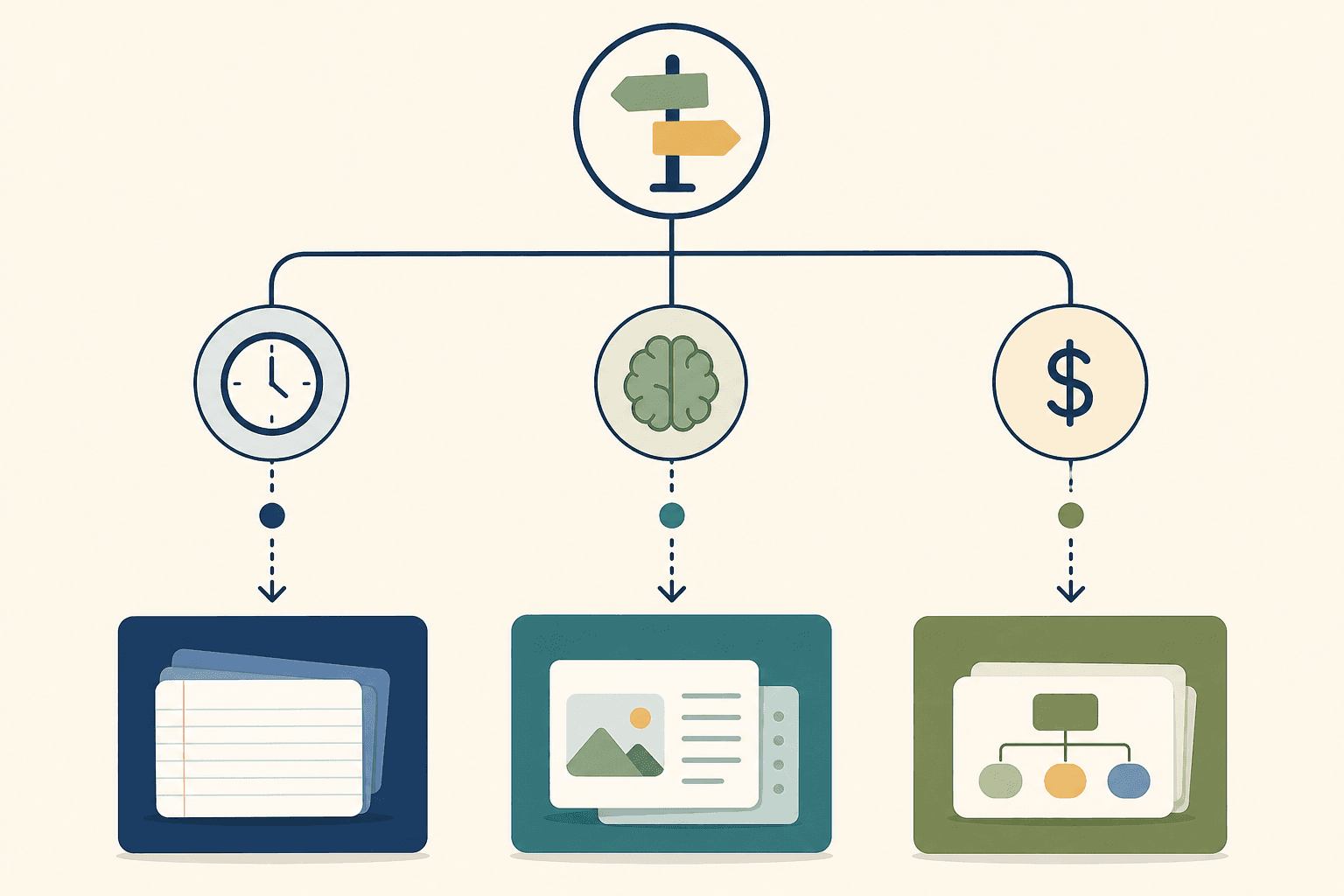
Two variables should drive your decision: how much time you have before your exam, and how you actually absorb vocabulary. Neither factor alone is sufficient.
By Timeline
- 3+ months out: Any of the primary options work. Use this runway to set up Anki properly if you're willing to invest in the learning curve, or start Brainscape's free tier and decide within two weeks whether the paid tier is worth it for you.
- 1–2 months out: Prioritize a deck with real SRS scheduling. Magoosh, Anki, or Brainscape all qualify. Skip paper lists and unstructured Quizlet sets — interval-based review is significantly more efficient when time is compressed.
- Under 4 weeks: Focus exclusively on high-frequency words from a single well-curated source. Don't start a new platform from scratch — use Magoosh's common and basic tiers, or the Kaplan/Manhattan Prep high-frequency lists if you already have them. Prioritize synonym clusters for SE preparation over isolated definitions.
By Learning Style
- Structured learner who wants a guided system: Brainscape. The adaptive algorithm handles scheduling and the dual-direction testing (word → definition, definition → word) matches SE question format without any manual configuration.
- Power user comfortable with setup: Anki with the GregMat+Magoosh+Manhattan community deck. Maximum control over intervals, maximum free word coverage, maximum long-term retention — if you're willing to spend time on configuration.
- Quick-start learner who wants zero friction: Magoosh. Open a browser, start a card. No account required for the web version. Actively maintained, clearly tiered, immediately usable.
Frequently Asked Questions
Is a bigger word list always better for GRE prep?
No. The GRE does not reward encyclopedic vocabulary — it rewards precise recall and synonym discrimination within a specific high-frequency band. A targeted list of 800–1,200 words drilled with spaced repetition and synonym context will outperform a 3,500-word list studied at surface level. Bigger lists create the illusion of preparation without building the deep word knowledge the exam actually tests.
Is Brainscape worth paying for?
It depends on how much the ETS endorsement and the built-in adaptive SRS matter to your study approach. The free tier gives you access to some content — enough to evaluate whether the platform fits your style. If you find the dual-direction testing and adaptive scheduling genuinely useful after a week, $8/month is a reasonable cost for a GRE study tool. If your exam is within 6 months and you prefer a single purchase, the ETS $50/6-month bundle achieves the same outcome.
Is Anki really free?
Anki desktop (Windows, macOS, Linux) and AnkiWeb are free. The Android app (AnkiDroid) is also free. The iOS app (AnkiMobile) is a paid one-time purchase from the App Store. The community GRE decks on AnkiWeb are free to download. The software itself costs nothing unless you're on iOS.
Does Quizlet work for GRE prep?
It can, but only if you're disciplined about deck selection. Quizlet's open authoring model means a search for "GRE vocabulary" returns decks ranging from 50 words with questionable definitions to well-constructed 1,000-word sets mapped to Magoosh or Manhattan Prep. If you use Quizlet, always check the deck description for its source list before studying a single card. And note that Quizlet's free tier lacks the structured SRS scheduling that makes spaced repetition effective for long-term retention — you're trading algorithm quality for platform familiarity.
Related Resources
- Spanish Flashcards for Beginners: What to Study, How to Make Cards, and Which App to Use →
A practical, science-backed guide for absolute beginners (A0–A1) on how to use Spanish flashcards effectively — covering which vocabulary to prioritize first, how to design cards that build real speaking ability, and how to choose between Anki, Quizlet, and Brainscape based on how much setup you're willing to do.
- AI-Generated vs. Handmade Flashcards: What the Research Says and How to Choose →
Research shows handmade flashcards have a measurable memory advantage when students actively process and phrase content themselves — but AI-generated cards cut creation time by 50–80% and integrate seamlessly with spaced repetition. This guide helps students decide which method fits their subject, timeline, and learning goals, with a hybrid workflow that captures the best of both.
- How to Make Effective Flashcards: Writing Rules, Review Systems, and Common Mistakes to Avoid →
Most students make flashcards but don't see results because they skip two essential steps: writing cards that force genuine retrieval and reviewing with a system built on active recall and spaced practice. This guide covers the science-backed rules for both — with annotated card examples, format comparisons, and review methods that actually build lasting memory.
Comments
Join the discussion with an anonymous comment.